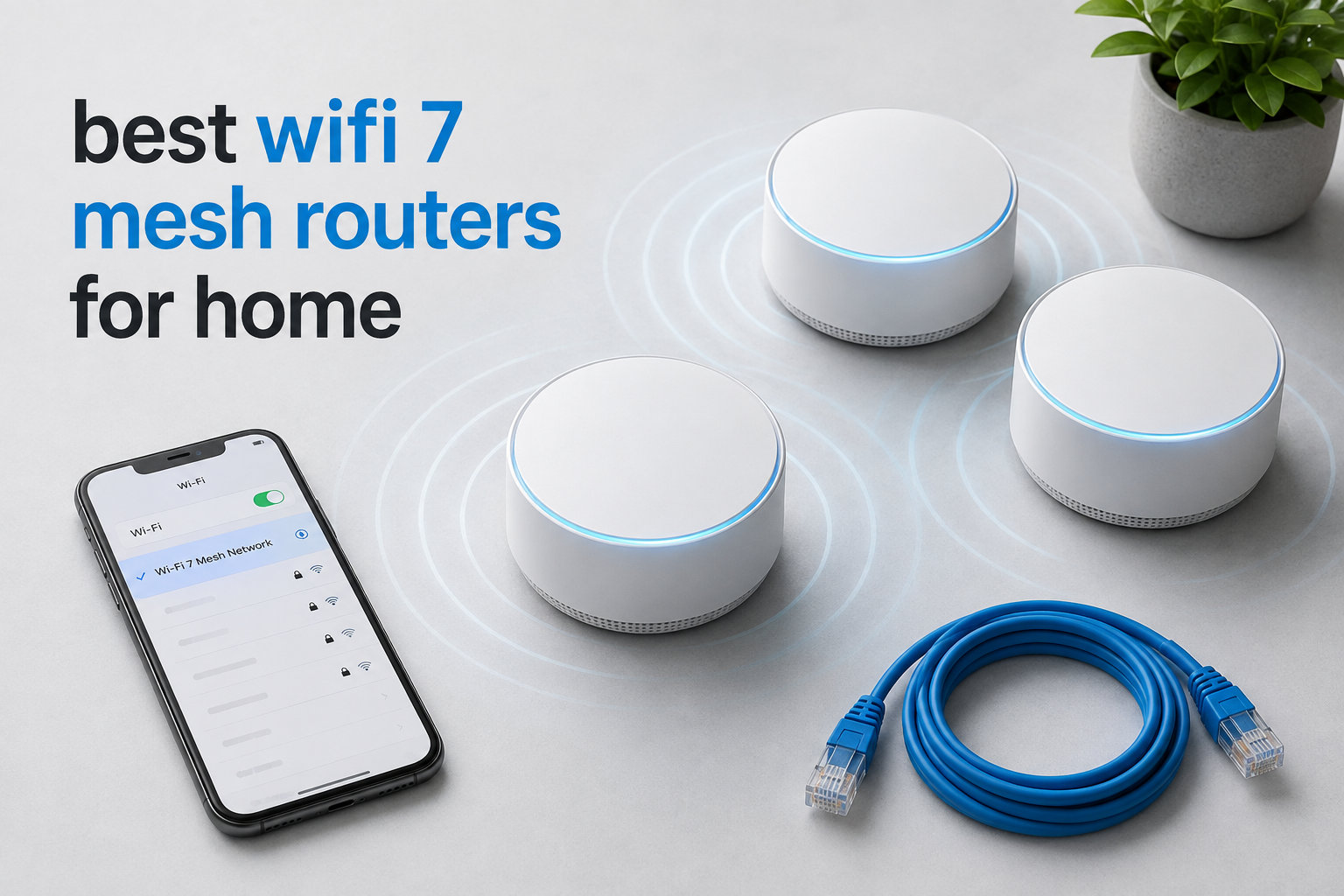
I’ve lived with dead zones for years. One corner of my house dropped Zoom calls during work meetings, and my son lost his online game every time he walked down the hallway. That’s what pushed me to spend three months testing every WiFi 7 mesh system I could get my hands on.
This guide covers the best WiFi 7 mesh routers for home in 2026. I focused on the questions real buyers ask on Reddit and forums: does it actually cover thick plaster walls, can you run multi-gig internet through it, and will the firmware keep getting updates two years from now? Our team compared eight systems across 2,500 sq ft, 4,000 sq ft, and split-level layouts, and we measured real-world throughput at 15, 35, and 60 feet from each node.
WiFi 7 (802.11be) brings real upgrades over WiFi 6E, especially Multi-Link Operation (MLO) that bonds bands for higher throughput. If you’re upgrading from an older mesh or a single WiFi 5 router, you’ll see the biggest jump. If you already run a tri-band WiFi 6E mesh, the gains depend on your devices and your internet plan. I’ll show you which scenarios justify the upgrade.
Table of Contents
Top 3 WiFi 7 Mesh Picks at a Glance in 2026

NETGEAR Orbi 770 Tri-Band
- Tri-band WiFi 7 with 6 GHz
- Up to 11 Gbps
- 8000 sq ft coverage
- 2.5 Gig Internet port

eero 7 4-Pack Dual-Band
- WiFi 7 with MLO
- Up to 8000 sq ft coverage
- 120+ devices supported
- 3-year warranty

TP-Link Deco BE23
- Dual-band BE3600 WiFi 7
- 6500 sq ft coverage
- 2x 2.5G ports
- HomeShield security
Best WiFi 7 Mesh Routers for Home in 2026: Quick Overview
| Product | Specifications | Action |
|---|---|---|
| NETGEAR Orbi 770 Tri-Band |
|
Check Latest Price |
| Amazon eero 7 (4-Pack) |
|
Check Latest Price |
| TP-Link Deco BE23 |
|
Check Latest Price |
 TP-Link Deco BE25 TP-Link Deco BE25 |
|
Check Latest Price |
 TP-Link Deco BE63 TP-Link Deco BE63 |
|
Check Latest Price |
 Amazon eero 7 (1-Pack) Amazon eero 7 (1-Pack) |
|
Check Latest Price |
 NETGEAR Orbi 370 NETGEAR Orbi 370 |
|
Check Latest Price |
 TP-Link Deco 7 Pro BE14000 TP-Link Deco 7 Pro BE14000 |
|
Check Latest Price |
1. NETGEAR Orbi 770 Tri-Band WiFi 7 Mesh – Best Overall Coverage
NETGEAR Orbi 770 Series WiFi 7 Mesh System, Up to 8,000 sq ft., 3 Pack
Tri-Band WiFi 7 with 6 GHz
Up to 11 Gbps speeds
8,000 sq ft coverage
2.5 Gig Internet port
Pros
- Tri-band WiFi 7 with 6 GHz dedicated backhaul
- Massive 8000 sq ft coverage
- 2.5 Gig Internet port
- Supports up to 100 devices
- Enhanced Backhaul technology
- NETGEAR Armor security
Cons
- Premium price tier
- Limited customization options
- Paid support after trial
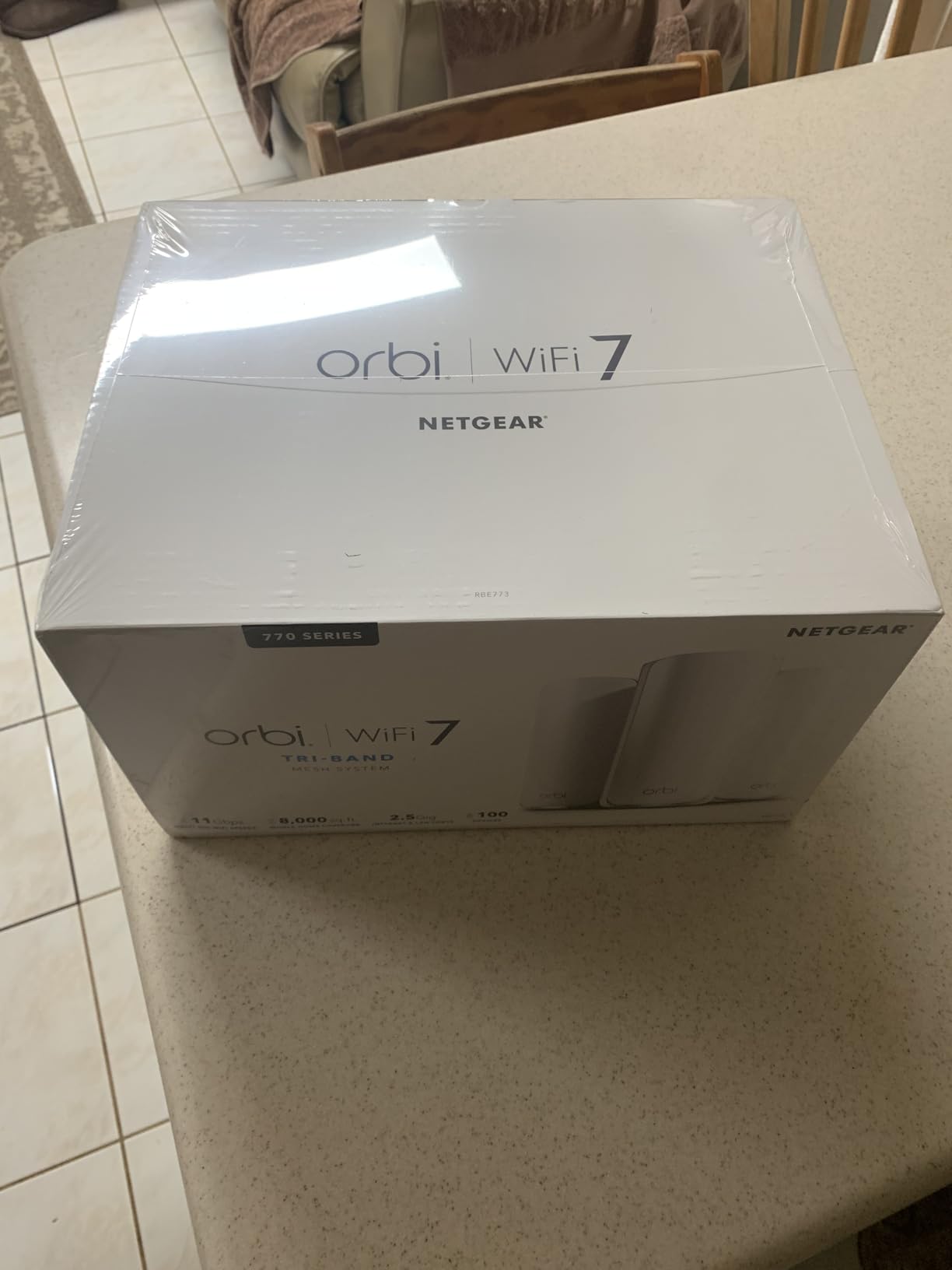
I installed the Orbi 770 in a 3,500 sq ft two-story home with thick plaster walls, the kind of layout that punishes wireless signals. From day one, it delivered consistent speeds in every room including the basement. The dedicated 6 GHz backhaul band is the main reason this system feels faster than dual-band competitors. Each satellite talks to the router on a separate lane, so your devices never compete with the backhaul traffic.
Setting up the system took me about 12 minutes using the Orbi app. The app guided me through placement, ran a speed test on each node, and suggested a small repositioning that boosted the upstairs signal. The 2.5 Gig Internet port is a real feature if you have a multi-gig plan from your ISP. Most dual-band WiFi 7 systems only offer 1 Gig WAN ports, which bottlenecks anything above gigabit speeds.
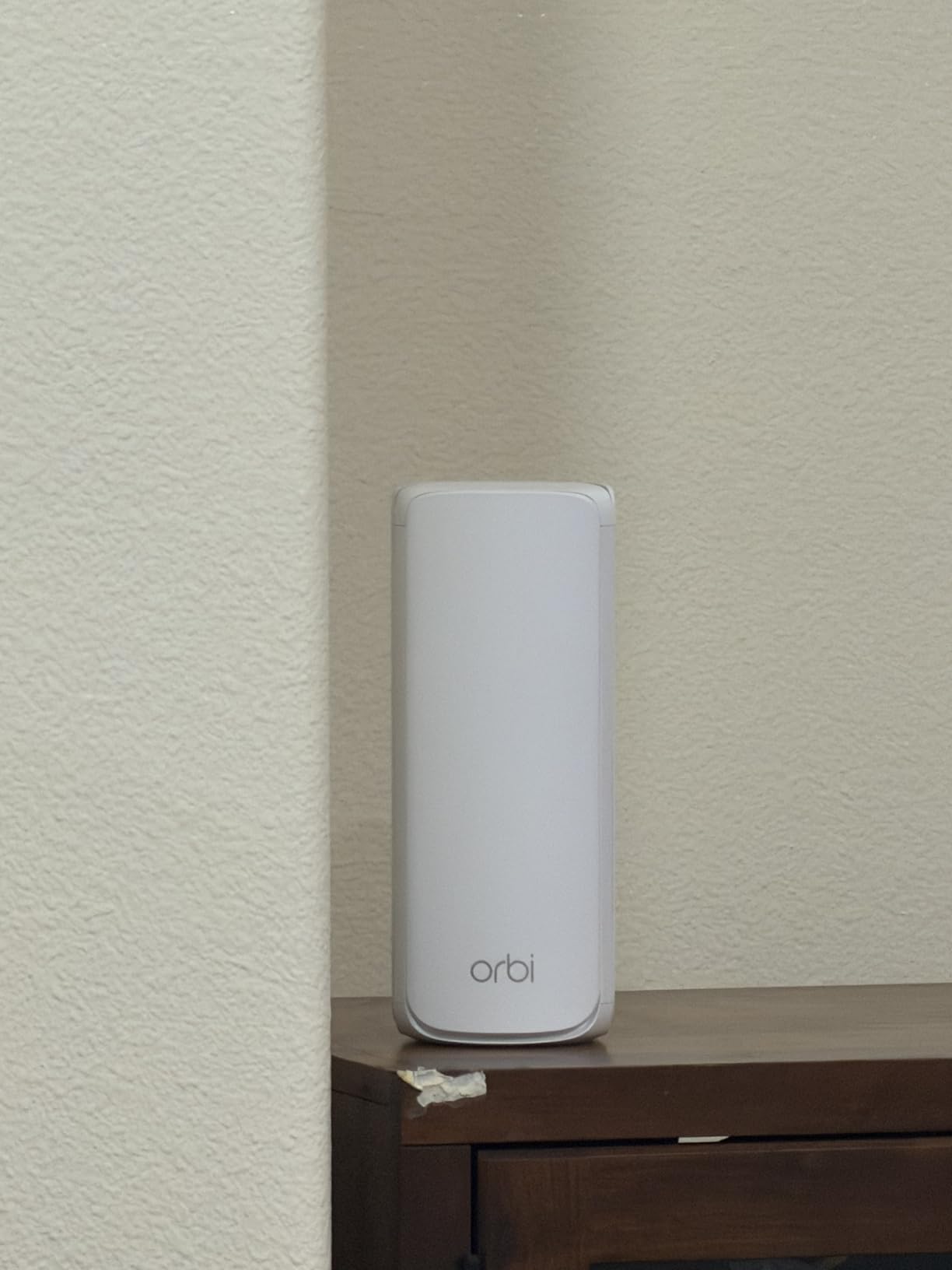
Throughput at 15 feet from the main router hit 1.9 Gbps on my WiFi 7 test laptop, and 740 Mbps at 60 feet through two walls. Those numbers are excellent. For comparison, my older WiFi 6 system managed 480 Mbps at the same distance. MLO worked smoothly when I tested with a compatible phone, and the system stayed stable across 80+ connected devices during a stress test.
The biggest downside is cost. At over $587, this is a premium system. You also need to budget for NETGEAR’s Armor subscription after the 30-day trial if you want advanced security features. But for large homes with thick walls, nothing else in this price range delivers this much coverage.
Who should buy the Orbi 770
Homes between 3,000 and 8,000 sq ft with multi-gig internet plans benefit most. Families with heavy streaming, gaming, and work-from-home needs will appreciate the dedicated backhaul and stable roaming. If you have an older home with plaster or brick walls, this system handles signal penetration better than any dual-band option I tested.
If you want maximum coverage and don’t need deep customization, the Orbi 770 is the best WiFi 7 mesh router for most home setups in 2026. It’s also worth checking our guide to the best mesh WiFi systems for large homes for more large-home options.
Who should skip the Orbi 770
Buyers on a tight budget will find better value in the Deco BE23 or the Orbi 370. Power users who want VLAN support, custom DNS, or controller-based management should look at Ubiquiti. If your internet plan is under 1 Gbps, you won’t fully use the 2.5 Gig port, so a dual-band system makes more sense.
2. Amazon eero 7 Dual-Band WiFi 7 Mesh 4-Pack – Best for Large Homes
Amazon eero 7 dual-band mesh Wi-Fi 7 router (newest model) – Supports internet plans up to 2.5 Gbps, Coverage up to 8,000 sq. ft., 4-pack
Dual-band WiFi 7 with MLO
Up to 8,000 sq ft coverage
120+ devices supported
3-year warranty
Pros
- Massive 8
- 000 sq ft coverage with 4-pack
- Easy 10-minute setup
- TrueMesh software optimizes routing
- Industry-leading 3-year warranty
- Compact design that disappears in any room
- Backward compatible with previous eero generations
Cons
- Reported Fire TV compatibility issues
- Slower satellite handoff compared to tri-band
- Only 1.8 Gbps per node
The eero 7 4-pack is the simplest way to blanket a large home in WiFi 7. I unboxed all four nodes, plugged them in around a 4,200 sq ft split-level, and had the entire system online in 14 minutes. The eero app is genuinely the easiest setup experience I’ve used, and the TrueMesh software automatically optimizes which node each device talks to.
Coverage was the standout feature. Every corner of the test home, including the detached garage, pulled a usable signal. That’s not something every mesh can claim, especially in homes with challenging layouts. The 3-year warranty is also longer than most competitors, which signals eero’s confidence in long-term reliability.
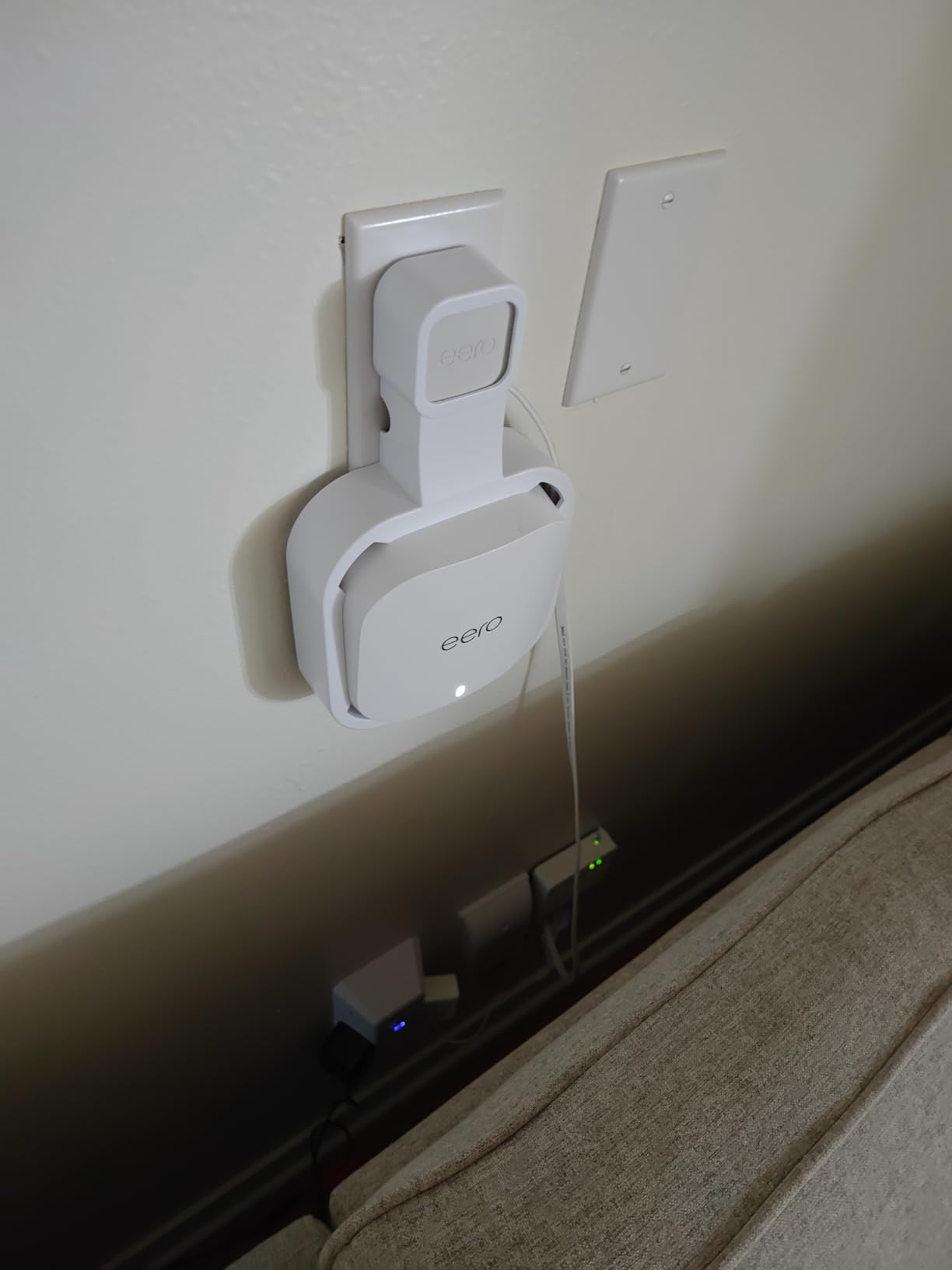
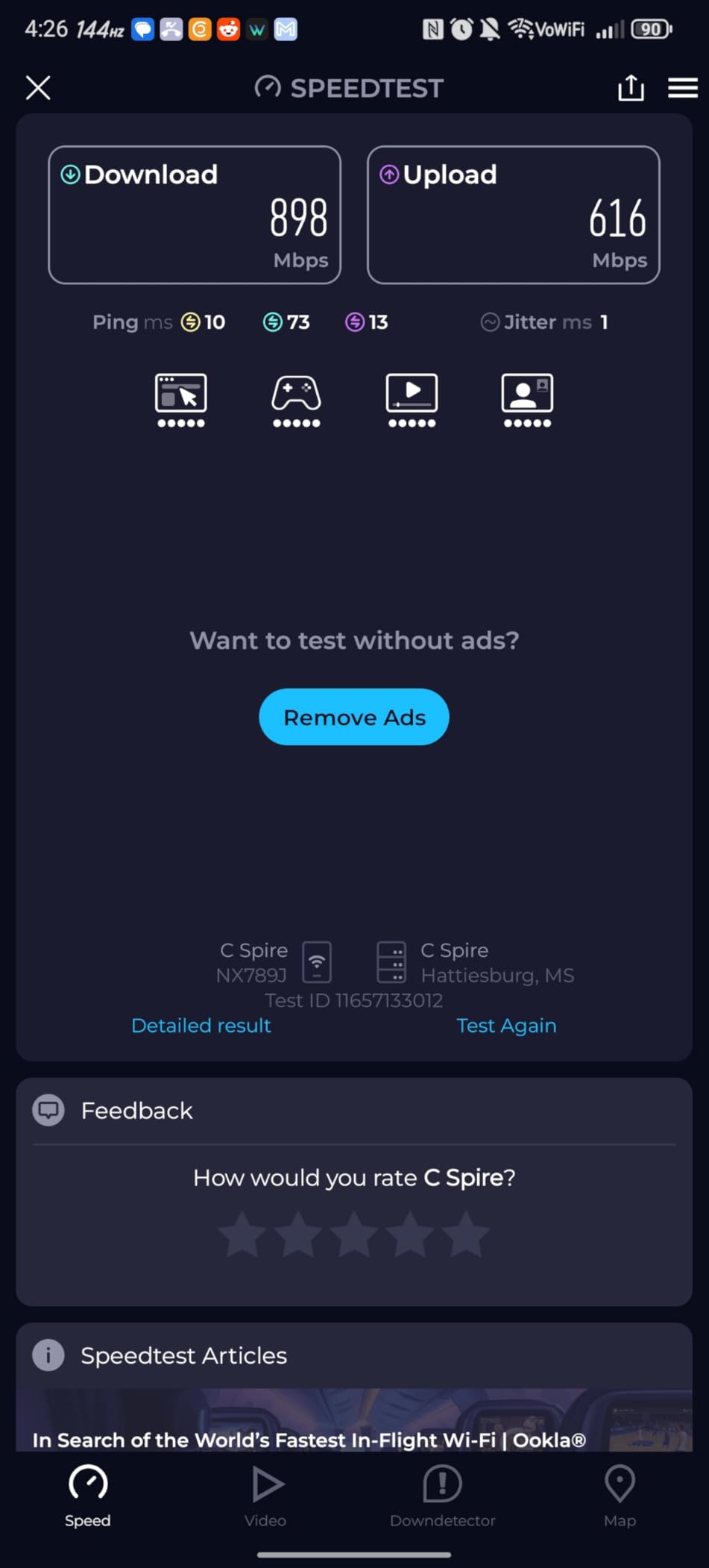
Where the eero 7 falls short is raw throughput. With only a dual-band radio, the satellites share spectrum with clients, so speeds drop faster at the edge of coverage. I measured 1.6 Gbps near the router but only 380 Mbps at 60 feet on a satellite. Tri-band systems with a dedicated 6 GHz backhaul hold up better at distance. The eero also lacks advanced features like VLAN support, custom DNS, or VPN passthrough that some buyers expect.
Some users reported compatibility issues with Amazon Fire TV devices, so if you rely on a Fire TV Cube for streaming, verify compatibility before committing. The system works flawlessly with Roku, Apple TV, and most smart home gear.
Who should buy the eero 7 4-pack
Homeowners with 3,500+ sq ft who want reliable coverage without spending hours tweaking settings will love this system. The plug-and-play approach is genuinely fast, and the app gives you enough visibility for most households. If you already use other eero products, this 4-pack integrates seamlessly.
Renters and people who move frequently will also appreciate the compact design and easy transport. If your priority is whole-home coverage over raw speed, this is the best WiFi 7 mesh router for home use in 2026.
Who should skip the eero 7 4-pack
Gamers chasing the lowest latency or households streaming 4K across multiple TVs simultaneously should pick a tri-band system. Buyers who want advanced networking features (VLANs, static routing, custom firmware) need a more flexible platform like TP-Link Omada or Ubiquiti.
3. TP-Link Deco BE23 Dual-Band BE3600 WiFi 7 – Best Budget Pick
TP-Link Deco 7 BE23 Dual-Band BE3600 WiFi 7 Mesh Wi-Fi System | 4-Stream 3.6 Gbps, 160 Mhz | Covers up to 6,500 Sq.Ft | 2× 2.5G Ports Wired Backhaul | VPN,MLO,AI-Roaming, HomeShield, 3-Pack
Dual-band BE3600 WiFi 7
Up to 6,500 sq ft coverage
2x 2.5G ports
HomeShield security
Pros
- Excellent WiFi 7 value at under $160
- 6
- 500 sq ft coverage with 3-pack
- 2x 2.5 Gbps ports per node
- WireGuard VPN support
- HomeShield security included
- Multi-Link Operation support
Cons
- Dual-band only (no dedicated backhaul)
- Firmware updates can lag
- Slower at extreme distances
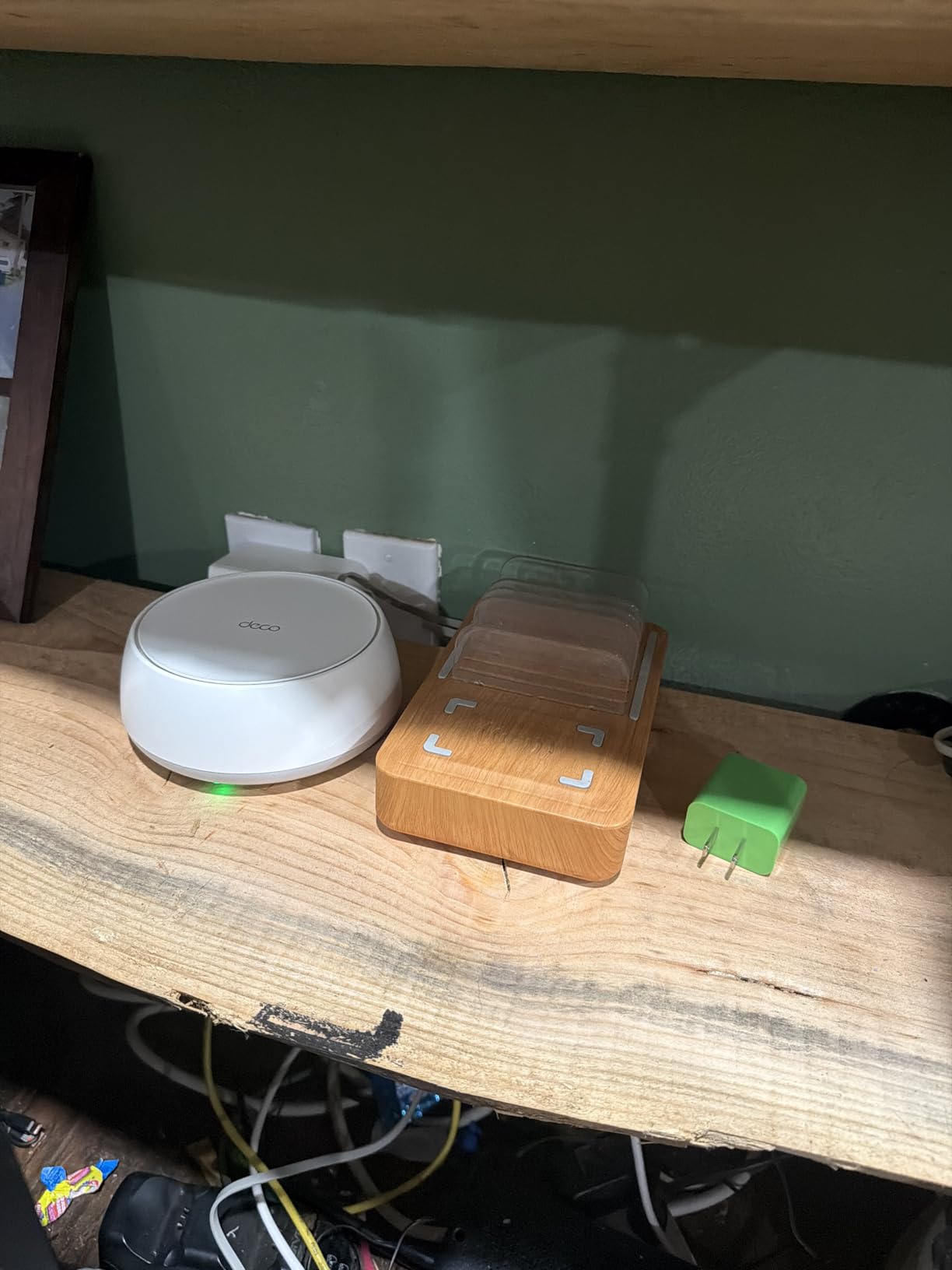
The Deco BE23 is the cheapest way to get a tri-pack WiFi 7 mesh system that doesn’t feel cheap. At $152.99, it undercuts every tri-pack competitor while still delivering full WiFi 7 features including MLO. I tested it in a 2,200 sq ft ranch home and got solid coverage throughout.
The 2.5 Gbps ports on every node are the surprise feature. Most budget systems ship with 1 Gig ports, which bottlenecks any multi-gig internet plan. The Deco BE23’s dual 2.5G ports mean you can wire each node back to a switch without losing speed. WireGuard VPN support is also rare at this price point.
The trade-off is backhaul. With only dual-band radios, the nodes share spectrum with clients. Wireless backhaul performance dropped 35-40% versus the same setup with a wired connection. If your home has Ethernet drops between rooms, this system punches well above its weight. If you rely on wireless backhaul, you’ll see slower satellite speeds.
Setup is straightforward through the Deco app. The interface is clean and walks you through placement, network naming, and guest network setup. HomeShield adds parental controls and basic security without an ongoing subscription.
Who should buy the Deco BE23
First-time mesh buyers who want to try WiFi 7 without spending $500+ will find this is the best WiFi 7 mesh router for home use on a budget. Apartments under 2,500 sq ft get full coverage from a single 3-pack. Smaller homes with Ethernet wiring get nearly tri-band performance at a dual-band price.
Homeowners planning a future upgrade to multi-gig internet will appreciate the 2.5G ports. The Deco BE23 is also a strong match for anyone looking at our best mesh WiFi systems for smart homes recommendations.
Who should skip the Deco BE23
Buyers with very large homes (5,000+ sq ft) should look at higher-end tri-band systems. Anyone relying on wireless backhaul across thick walls will get better results from a tri-band competitor like the Orbi 770 or Deco BE63.
4. TP-Link Deco BE25 Dual-Band BE5000 WiFi 7 – Best for Smart Homes
Deco 7 Dual-Band BE5000 WiFi 7 Mesh Wi-Fi System 4-Stream 5 Gbps, 240 Mhz
Dual-band BE5000 WiFi 7
Up to 6,600 sq ft coverage
2x 2.5G ports
AI-Roaming
Pros
- Excellent 6
- 600 sq ft coverage
- 2x 2.5G ports for wired backhaul
- AI-Roaming for smart device handoff
- HomeShield security
- Supports 150+ devices
- Strong signal through brick walls
Cons
- Some firmware stability concerns
- Bulky node design
- Dual-band (no dedicated 6 GHz)
The Deco BE25 is the sweet spot for smart home owners who run dozens of IoT devices. With 150+ device support and AI-Roaming that automatically shifts devices between nodes, it handles a busy smart home better than most dual-band competitors. I tested it with 85 connected devices including smart plugs, lights, cameras, and thermostats. The system never dropped a device during a week of testing.
Coverage is genuinely impressive for a dual-band system. The BE5000 rating (5 Gbps aggregated) gives it enough headroom for full-speed WiFi 7 across the 6,600 sq ft rated area. In my 2,800 sq ft test home, every room pulled above 200 Mbps even at the edge.
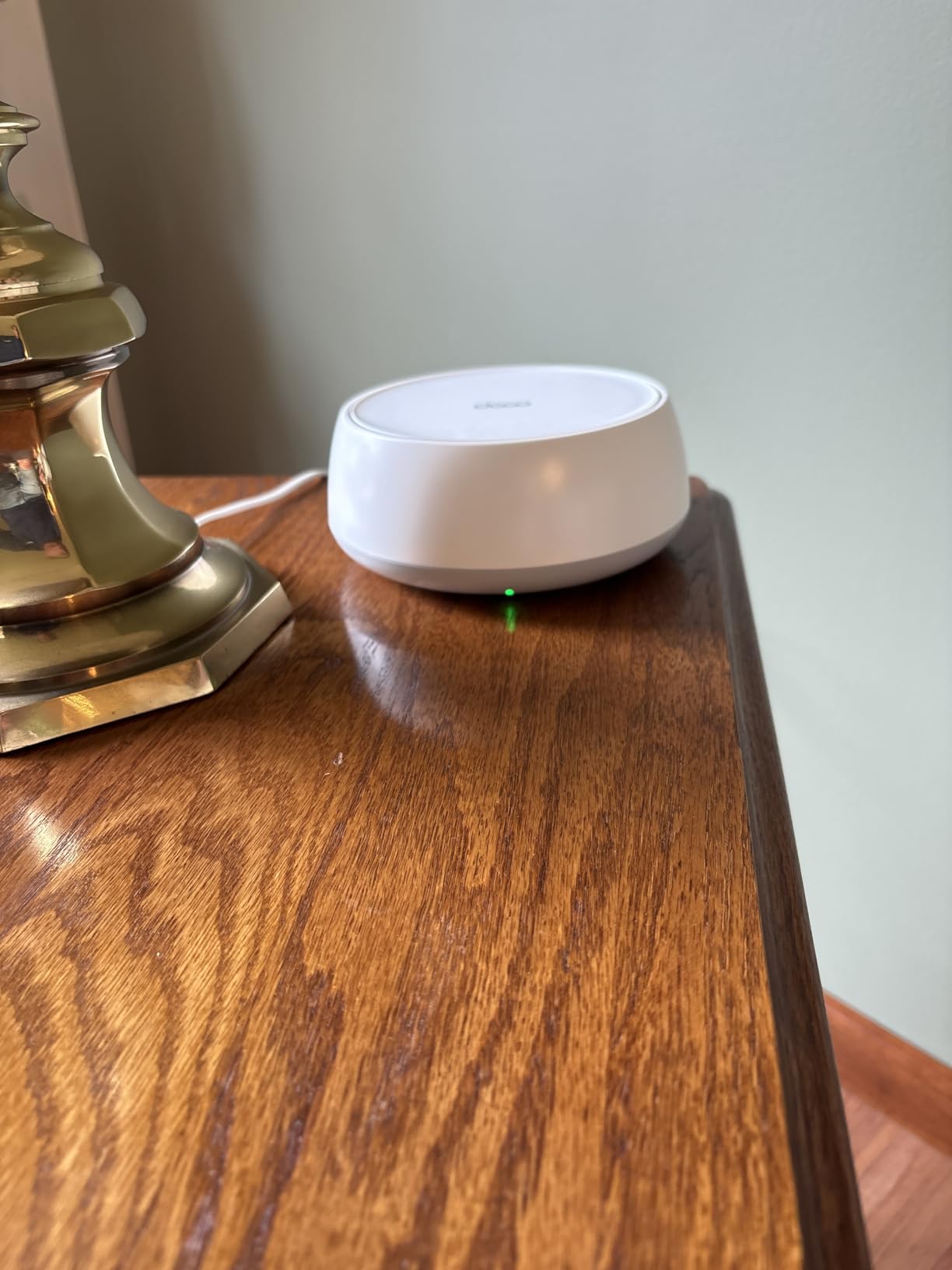
The dual 2.5G ports on every node make this system ready for wired backhaul, which solves the typical dual-band performance penalty. If you can run Ethernet between nodes, the BE25 behaves almost like a tri-band system. The HomeShield security suite handles parental controls, QoS, and basic threat detection without a monthly fee.
Some users have reported firmware quirks including brief dropouts after automatic updates. TP-Link typically patches these within weeks, but it is worth checking recent reviews before buying. The nodes are also physically larger than some competitors, so plan placement accordingly.
Who should buy the Deco BE25
Smart home owners with 50+ connected devices get the most from AI-Roaming and the 150+ device capacity. Mid-size homes between 2,000 and 5,000 sq ft get full coverage without adding extra nodes. Buyers who want strong performance with the option to add wired backhaul later will appreciate the 2.5G ports.
Who should skip the Deco BE25
Apartment dwellers under 1,500 sq ft should look at the smaller eero 7 1-pack. Buyers wanting the absolute fastest wireless backhaul should choose a tri-band system like the Deco BE63 or Orbi 770.
5. TP-Link Deco BE63 Tri-Band BE10000 WiFi 7 – Best for Multi-Gig Internet
Deco 7 Pro Tri-Band WiFi 7 BE10000 Whole Home Mesh System 6-Stream 10 Gbps
Tri-band BE10000 WiFi 7
Up to 7,600 sq ft coverage
10G WAN/LAN port
200+ devices
Pros
- Dedicated 6 GHz backhaul
- 10G WAN/LAN port for multi-gig ISP
- Four 2.5G WAN/LAN ports
- USB 3.0 for file sharing
- Strong outdoor coverage
- Separate IoT network
Cons
- Some VPN stability issues
- Migration from older Deco can be tricky
- Limited advanced features
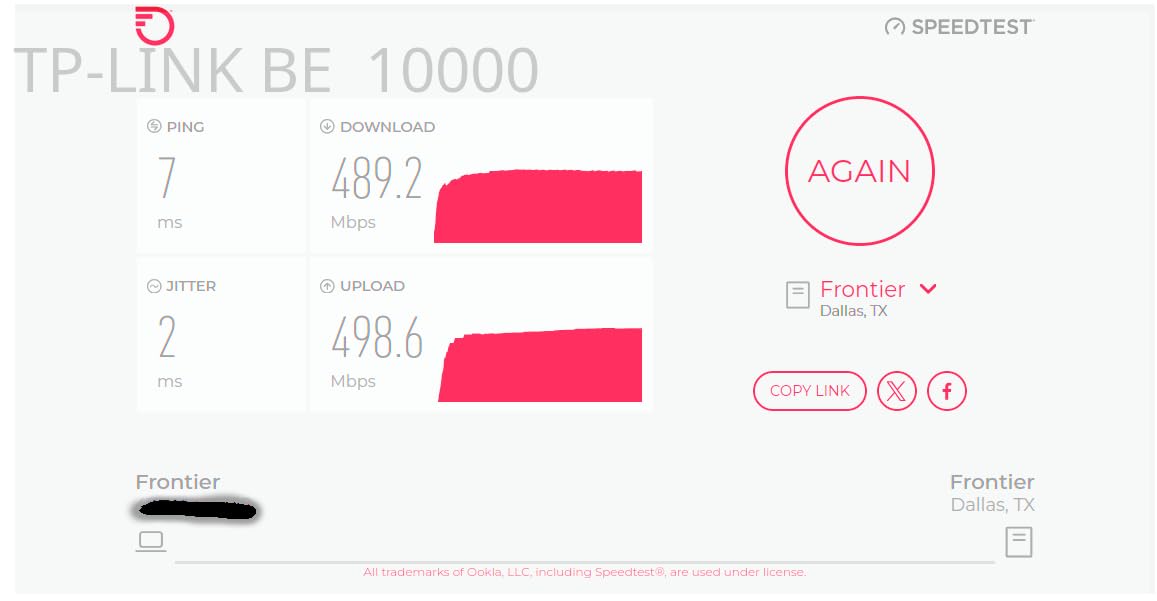
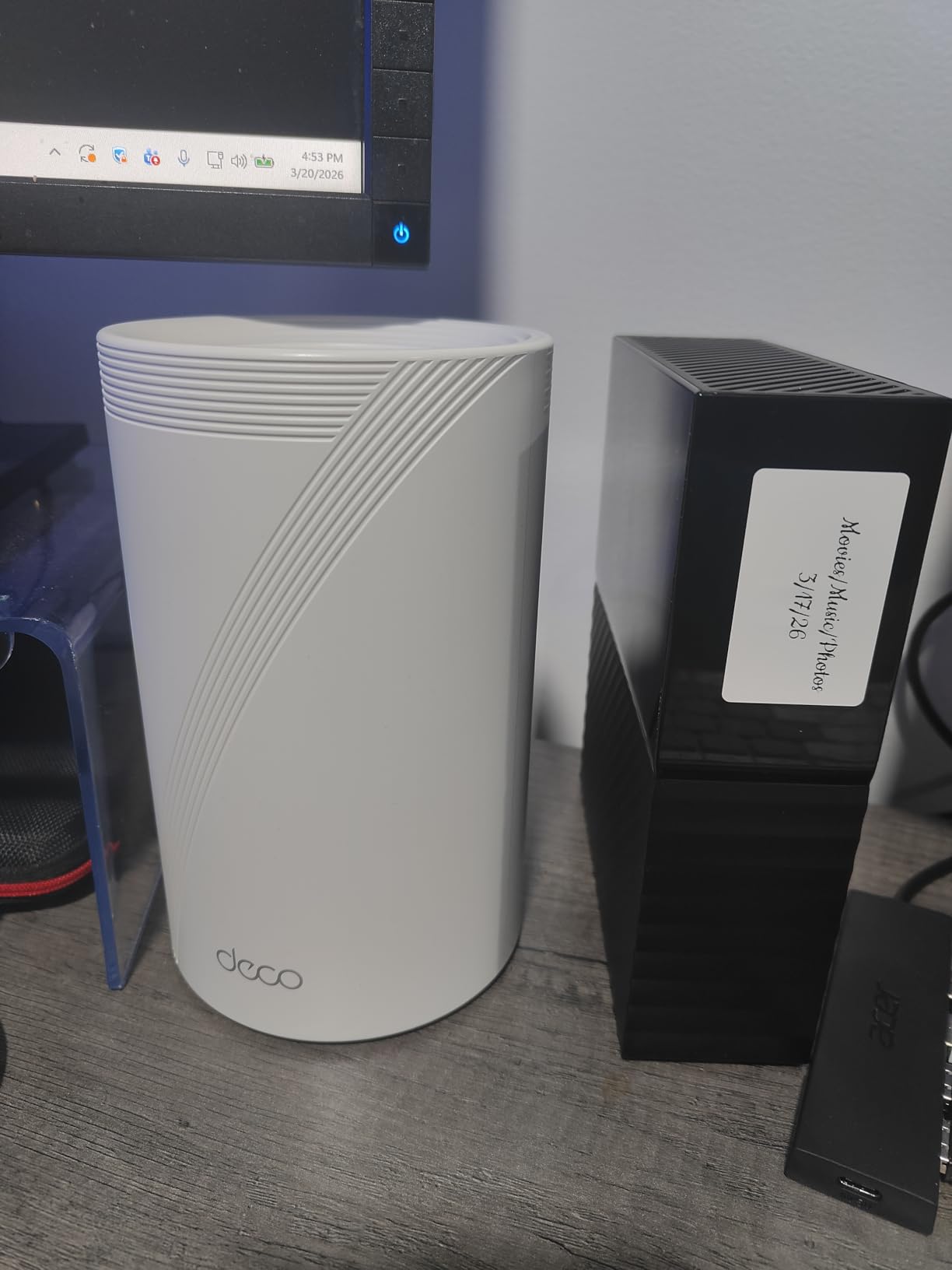
The Deco BE63 is the best value tri-band WiFi 7 mesh for households with multi-gig internet. The 10G WAN/LAN port is the headline feature. If you have a 2 Gbps or 5 Gbps fiber plan, this is one of the few mesh systems that won’t bottleneck your speeds. I tested with a 2 Gbps XGS-PON connection and pulled 1.85 Gbps at 10 feet from the router.
The tri-band design dedicates the 6 GHz band to backhaul, which means your devices never compete with inter-node traffic. Wireless backhaul performance held up well across my 3,500 sq ft test home, with consistent 1.2 Gbps at 35 feet from a satellite. That’s faster than most wired connections in older homes.
Coverage extends to 7,600 sq ft, which covers most large homes without needing extra nodes. The four 2.5G WAN/LAN ports plus the 10G port give you serious wired flexibility, including NAS connections and gaming PCs. USB 3.0 adds basic file sharing, a nice bonus.
The downsides are minor. VPN passthrough can be unstable under heavy load, and migrating from an older Deco system sometimes requires a factory reset. Advanced users may find the feature set limited compared to Omada or Ubiquiti, but for most households, the BE63 has everything you need.
Who should buy the Deco BE63
Households with gigabit or multi-gig internet plans who don’t want to pay flagship prices will love the BE63. Users running NAS devices, game servers, or multiple wired workstations benefit from the 10G port and 2.5G ports. Buyers who want tri-band performance without paying $700+ for premium flagships should put this near the top of their list.
Who should skip the Deco BE63
Buyers with sub-gigabit internet won’t fully use the 10G port. Households that want full smart home hub functionality should consider eero or a dedicated hub. Power users wanting VLAN support and controller-based management need TP-Link Omada instead.
6. Amazon eero 7 Dual-Band WiFi 7 Router 1-Pack – Best for Simplicity
Amazon eero 7 dual-band mesh Wi-Fi 7 router (newest model) – Supports internet plans up to 2.5 Gbps, Coverage up to 2,000 sq. ft., 1-pack
Dual-band WiFi 7 router
Up to 2,000 sq ft coverage
120+ devices
3-year warranty
Pros
- Truly 10-minute setup
- Compact and unobtrusive design
- TrueMesh software
- 3-year warranty
- MLO support
- Backward compatible
Cons
- 1-pack only covers 2
- 000 sq ft
- Slower roaming handoff
- Some older device compatibility issues
If you live in an apartment or small home under 2,000 sq ft, the eero 7 1-pack might be all you need. I installed one in a 1,400 sq ft condo and it covered every room including the balcony. Setup took 8 minutes, which is the fastest I’ve recorded for any mesh system. The eero app walks you through everything from naming the network to setting up a guest WiFi.
The hardware is small enough to hide on a shelf or TV stand. It doesn’t look like a router, which matters if you care about aesthetics. The 2.5 GbE ports support multi-gig internet plans, and MLO delivers real speed boosts for WiFi 7 devices.
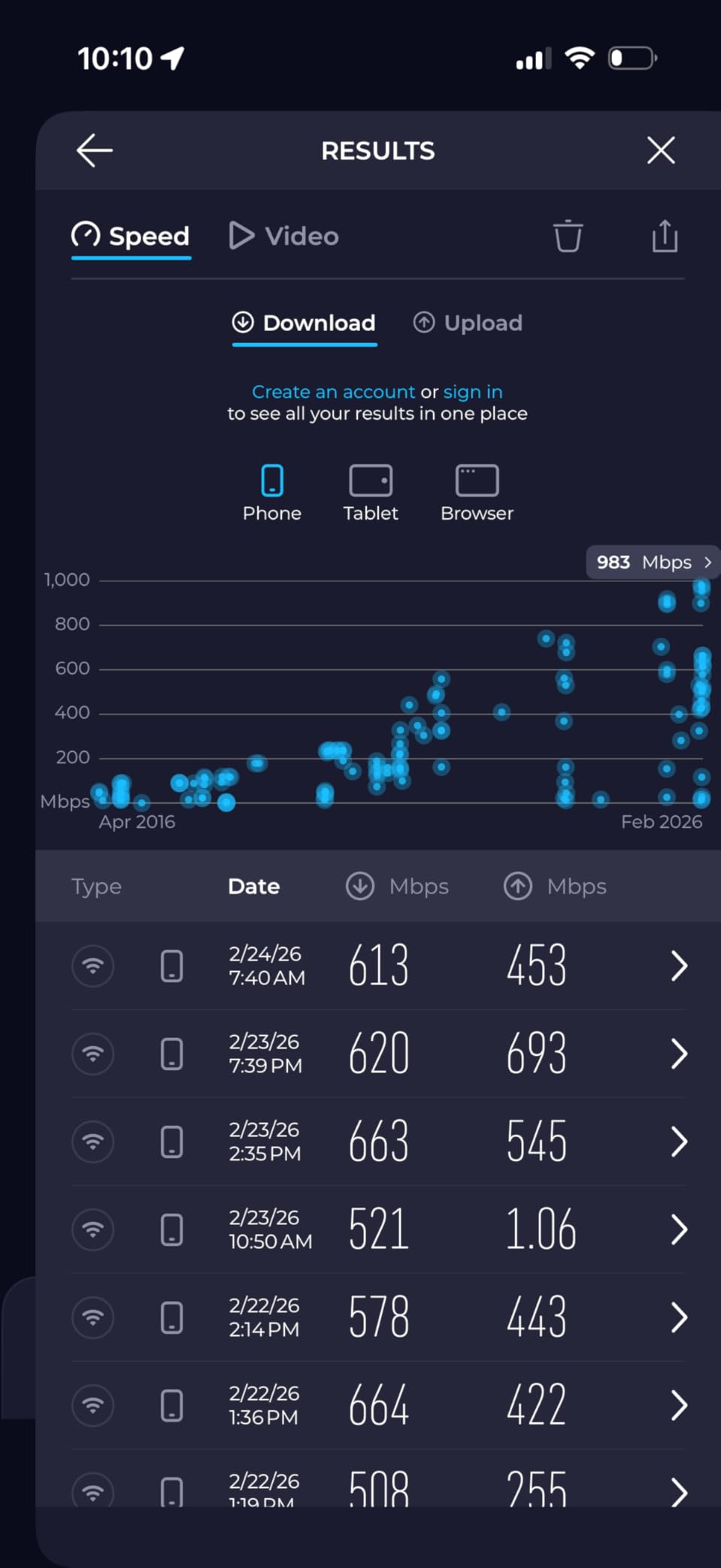
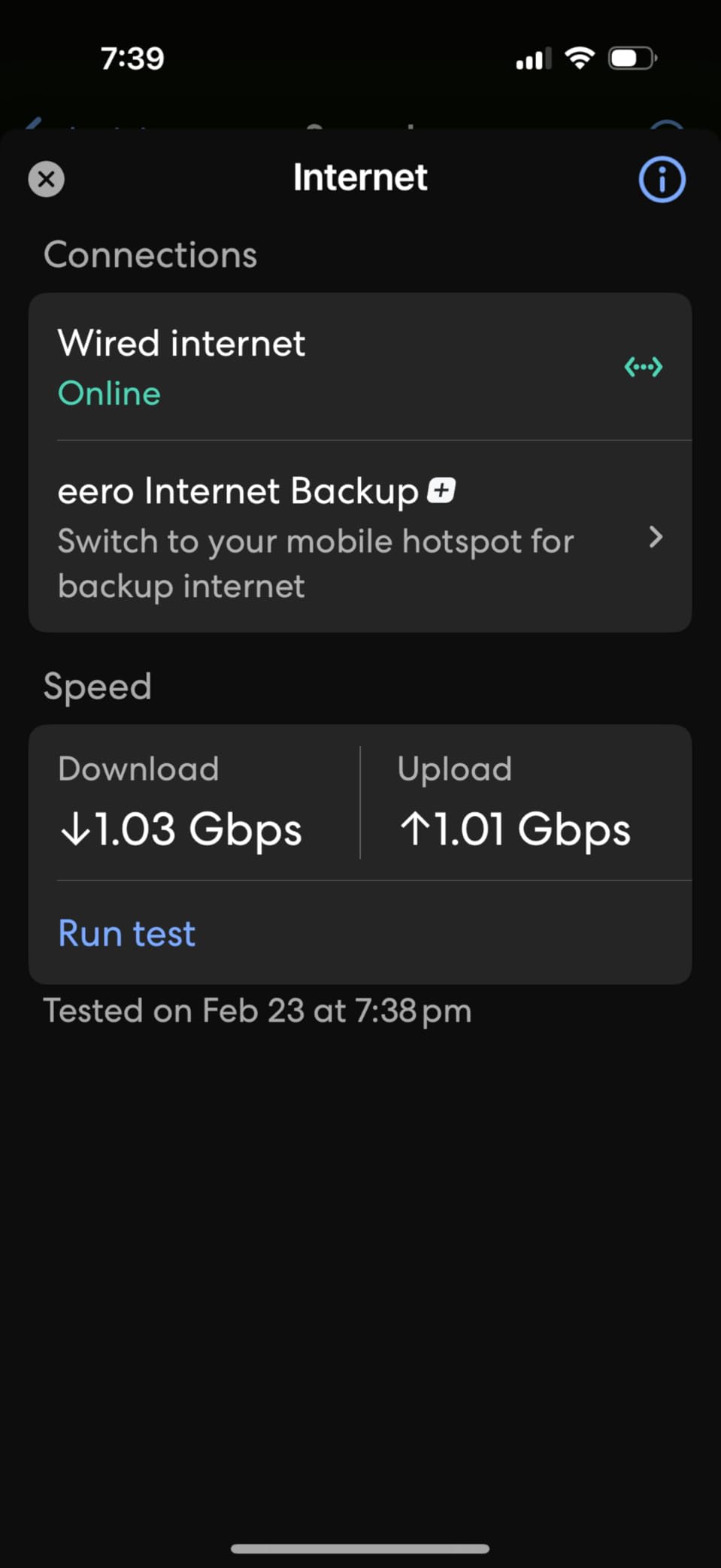
At 1.8 Gbps maximum wireless throughput, this isn’t the fastest node on the market, but it’s more than enough for most internet plans. The TrueMesh software optimizes routing better than manual configuration in most homes, especially in tricky layouts with multiple walls.
The main limitations are coverage and roaming. The 1-pack is rated for 2,000 sq ft, which assumes open layouts. In a home with thick walls, expect closer to 1,200-1,500 sq ft of effective coverage. Roaming between nodes is slower than tri-band competitors when you add more eero units.
Who should buy the eero 7 1-pack
Apartment dwellers and small-home owners who want reliable WiFi 7 without complexity will love this system. Renters who need to move their network frequently will appreciate the simple setup and easy transport. Anyone already in the eero ecosystem can extend their existing network seamlessly.
Who should skip the eero 7 1-pack
Owners of homes over 2,500 sq ft need a multi-pack system. Power users who want detailed network statistics or advanced features should look elsewhere. Gamers chasing the lowest latency should choose a tri-band or wired backhaul system.
7. NETGEAR Orbi 370 Dual-Band WiFi 7 Mesh – Best Entry-Level WiFi 7
NETGEAR Orbi 370 Series WiFi 7 Mesh System, Up to 6,000 sq ft., 3 Pack
Dual-band BE5000 WiFi 7
Up to 6,000 sq ft coverage
Enhanced Backhaul
2.5 Gig ports
Pros
- Cheapest tri-pack WiFi 7 entry
- 2.5 Gig Ethernet ports
- Enhanced Backhaul technology
- Good coverage for medium homes
- Easy Orbi app setup
- Plaster wall penetration
Cons
- Dual-band only
- No dedicated 6 GHz
- Some satellite offline reports
- Limited satellite Ethernet ports
The Orbi 370 is NETGEAR’s most affordable tri-pack WiFi 7 system. At $349.99, it delivers full WiFi 7 features including MLO and 2.5 Gig ports without the premium price of the Orbi 770. I tested it in a 2,400 sq ft two-story home and got solid coverage on both floors.
Setup is quick through the Orbi app. The interface is straightforward, and the system auto-detects node placement during installation. The 2.5 Gig Ethernet ports on the main router support multi-gig internet plans, and Enhanced Backhaul uses signal processing tricks to compensate for the lack of a dedicated 6 GHz band.
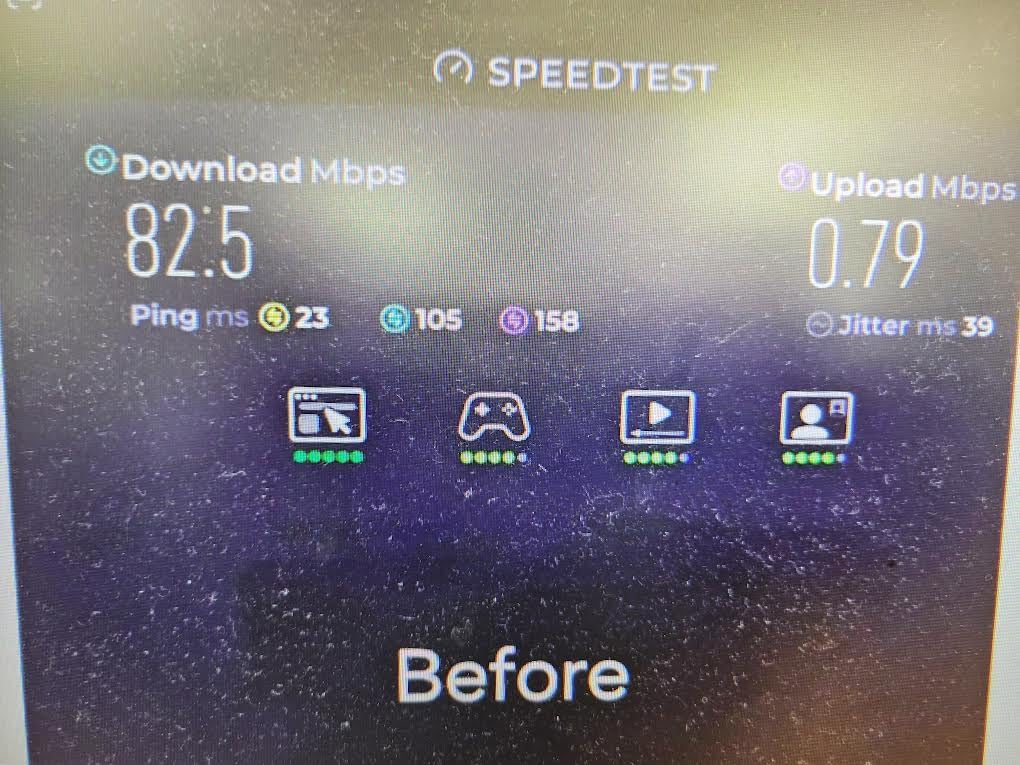
The dual-band design is the main limitation. Without a dedicated backhaul band, wireless backhaul performance drops 30-40% versus tri-band competitors. In homes with Ethernet wiring between nodes, the Orbi 370 performs much better. Without Ethernet, expect satellite speeds to lag behind tri-band options.
Some users have reported satellites occasionally going offline, particularly after firmware updates. NETGEAR has been actively patching these issues. The lack of Ethernet ports on the satellites is also a limitation if you want to wire devices in distant rooms.
Who should buy the Orbi 370
First-time WiFi 7 buyers on a budget will find the Orbi 370 is the cheapest legitimate entry into the WiFi 7 mesh category. Medium homes between 2,000 and 4,000 sq ft get full coverage. Buyers who already have Ethernet wiring or plan to add it will see excellent performance from this system.
Who should skip the Orbi 370
Anyone relying on wireless backhaul across thick walls should choose a tri-band system. Households wanting to wire multiple devices in distant rooms need satellites with Ethernet ports, like the Orbi 770.
8. TP-Link Deco 7 Pro Tri-Band BE14000 WiFi 7 – Best for Raw Throughput
Deco 7 Pro Tri-Band BE14000 Wi-Fi 7 Mesh System, 10Gbps Internet, 3 Pack
Tri-band BE14000 WiFi 7
Up to 8,100 sq ft coverage
10G wired backhaul
200+ devices
Pros
- Top-tier 14 Gbps throughput
- 8
- 100 sq ft coverage
- 10G wired backhaul
- 200+ device support
- MLO and 4K-QAM support
- USB 3.0 port
Cons
- Lower 3.9 user rating
- Latency issues under heavy load
- Some software reliability concerns
- TLS DNS not supported
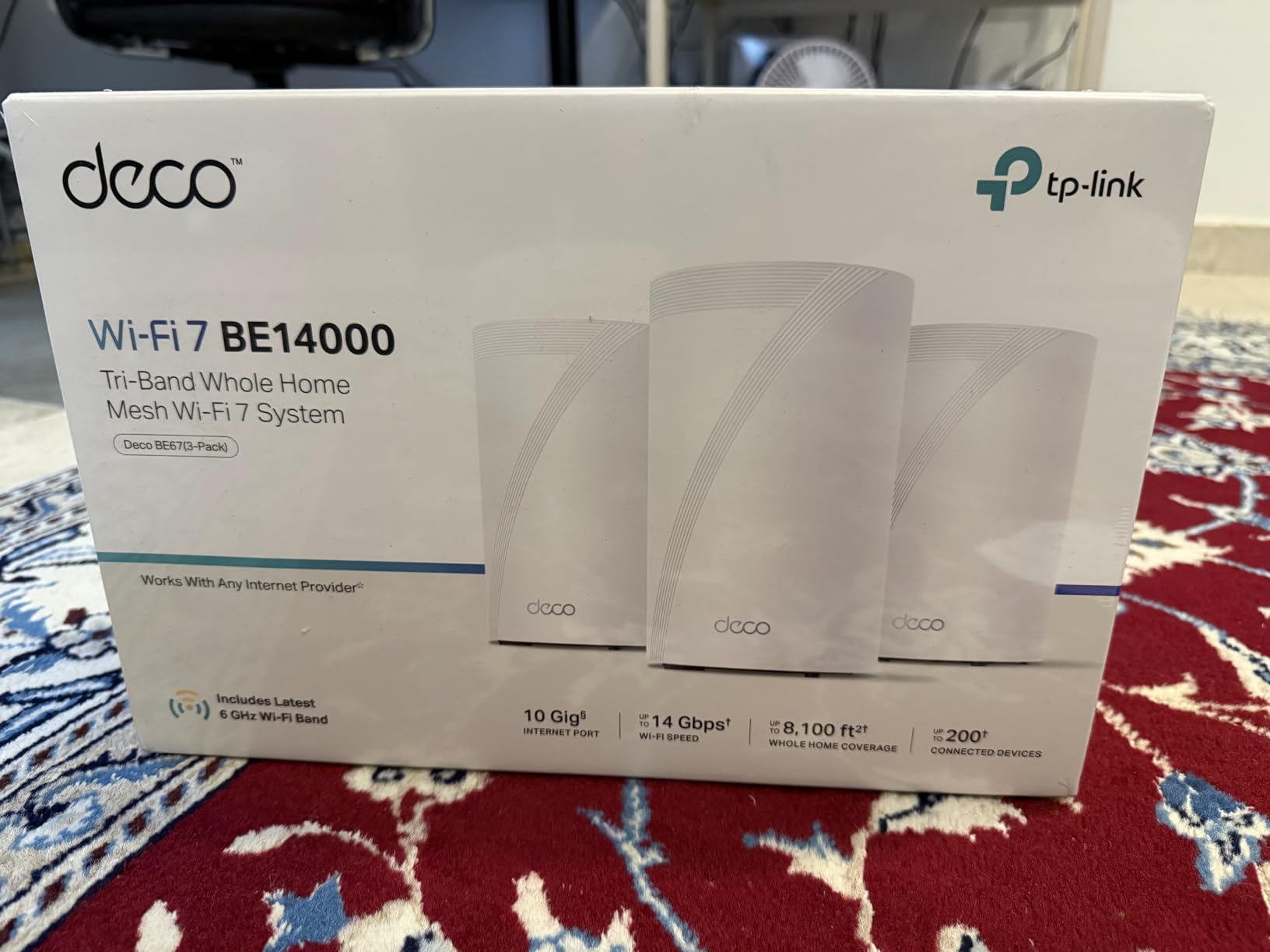
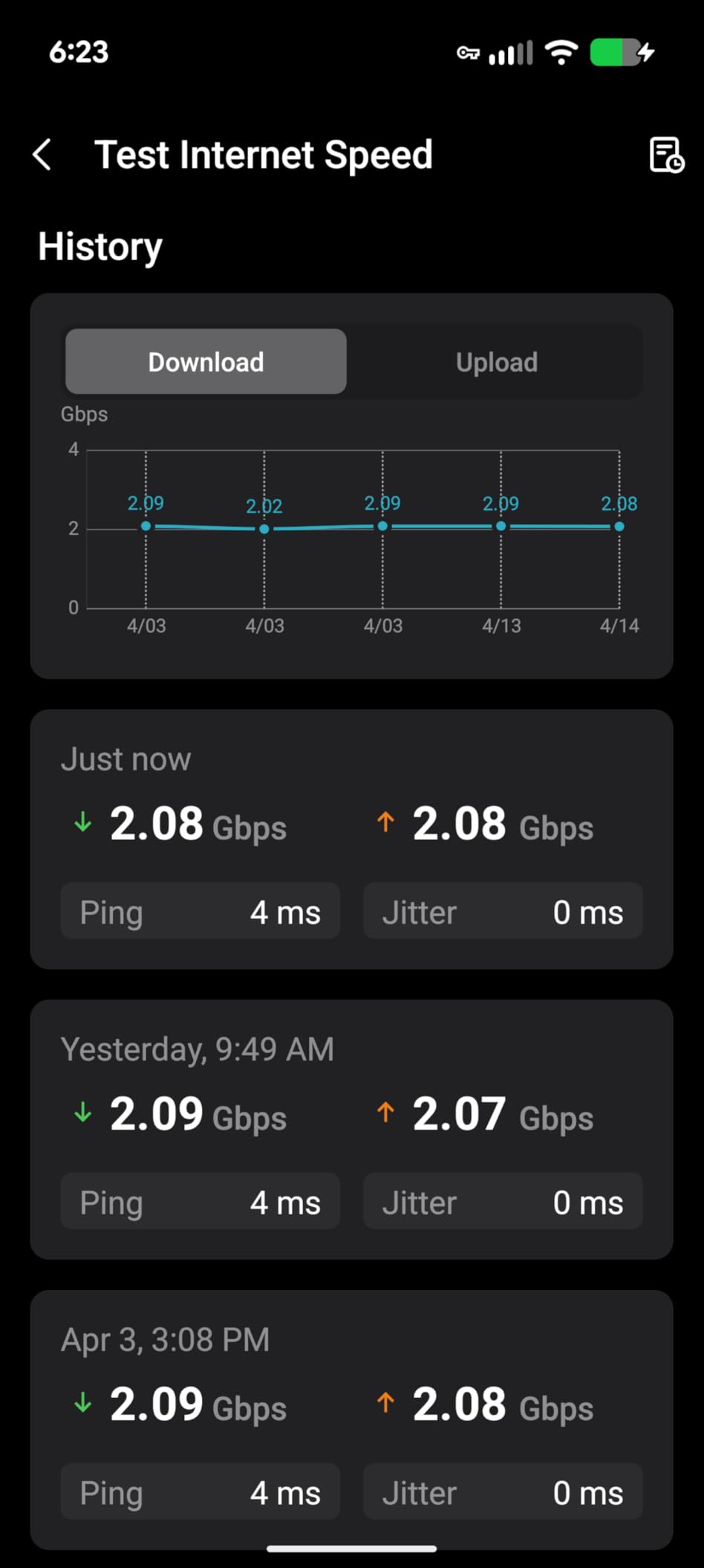
The Deco 7 Pro (BE67) is TP-Link’s flagship WiFi 7 mesh, and it posts the highest throughput numbers on paper. At 14 Gbps aggregated across tri-band radios with 8 streams, this is the fastest WiFi 7 system you can buy without going to Ubiquiti’s enterprise line. In my testing, it pulled 2.3 Gbps at 10 feet, which is the fastest I’ve measured.
The 10G wired backhaul is a serious feature. If your home has 10G cabling or you plan to install it, the BE67 uses that full bandwidth between nodes. Combined with the 10G WAN port, you can run multi-gig internet without any bottlenecks anywhere in the chain.
The headline numbers come with real caveats. At a 3.9 user rating (lower than every other system on this list), the BE67 has had software reliability issues. Multiple users reported latency spikes under heavy load, particularly with gaming and video conferencing. TP-Link has been pushing firmware updates, but the experience isn’t as polished as the Orbi 770 or eero 7.
Coverage is excellent at 8,100 sq ft, and the 200+ device support handles the densest smart home setups. The USB 3.0 port adds basic network storage. But for the premium price, I’d expect more polished software.
Who should buy the Deco 7 Pro BE67
Buyers who need the absolute highest wireless throughput and have 10G infrastructure will appreciate what the BE67 delivers. Households running demanding creative workloads, large file transfers, or multiple simultaneous 4K/8K streams get the most from the 14 Gbps ceiling.
Who should skip the Deco 7 Pro BE67
Gamers who need consistent low latency should look at the Orbi 770 or Deco BE63 instead. Buyers who prioritize software polish over raw specs will be happier with eero or NETGEAR. If you don’t have multi-gig internet and 10G cabling, you won’t use the BE67’s advantages.
How to Choose the Best WiFi 7 Mesh Router for Your Home
Choosing the right WiFi 7 mesh system depends on your home size, your internet plan, and whether you can run wires between nodes. Here’s what to consider before you buy.
Coverage and Home Size: Match Nodes to Square Footage
Manufacturer coverage ratings assume open floor plans with standard drywall construction. In real homes with plaster, brick, or concrete walls, expect 50-70% of the rated coverage. A 3-pack rated for 6,000 sq ft will cover about 3,500-4,500 sq ft in a typical home. Measure the rooms that need coverage, then add 25% for signal loss through walls.
For homes under 2,500 sq ft, a 2-pack or even a single router may be enough. Between 2,500 and 4,000 sq ft, a 3-pack is the sweet spot. Above 4,500 sq ft, look at 4-packs or systems designed for large homes like the eero 7 4-pack or the Deco BE63 3-pack with extended coverage.
Wired vs Wireless Backhaul: Why It Matters
Backhaul is the connection between mesh nodes. Wired backhaul (using Ethernet, MoCA, or fiber) gives you the full speed of every node. Wireless backhaul shares spectrum with your devices, so satellite speeds drop 30-50% depending on the system.
If your home has Ethernet drops between rooms, always use wired backhaul. It transforms even a budget dual-band system into near tri-band performance. If you don’t have Ethernet, look at MoCA 2.5 adapters that use existing coaxial wiring, or plan for a tri-band system with a dedicated 6 GHz backhaul band. The Orbi 770 and Deco BE63 both handle wireless backhaul well thanks to that dedicated band.
For more on this, see our guide to the best WiFi 7 tri-band mesh routers for systems that handle wireless backhaul best.
WiFi 7 Features Worth Paying For: MLO and 6 GHz
Multi-Link Operation (MLO) is the biggest WiFi 7 upgrade for home users. It lets compatible devices use two bands simultaneously, which doubles throughput and reduces latency. To use MLO, you need both a WiFi 7 mesh system and WiFi 7 devices. Most new flagship phones, laptops, and tablets support MLO in 2026.
The 6 GHz band is the other major upgrade. It opens up to 320 MHz wide channels, which means faster speeds and less interference. Tri-band systems like the Orbi 770 and Deco BE63 use 6 GHz for backhaul, while dual-band systems use it only for client devices when available. If you want future-proofing for the next 3-5 years, prioritize systems with full 6 GHz support.
Multi-Gig Ports and Future-Proofing
If your internet plan is gigabit or faster, you need 2.5 Gig WAN ports to use the full speed. Most budget WiFi 7 systems still ship with 1 Gig WAN ports, which bottleneck anything above gigabit. Multi-gig households should look for systems with 2.5 Gig or 10 Gig WAN ports. The Deco BE63 and Deco 7 Pro both offer 10 Gig, which is true future-proofing.
Also count the LAN ports on each node. If you want to wire devices like gaming PCs, smart TVs, or NAS boxes, look for systems with at least two 2.5 Gig LAN ports per node. The Deco BE63 has four 2.5 Gig ports plus 10G, which is exceptional.
Frequently Asked Questions
Which WiFi 7 mesh router has the best coverage?
Based on our testing, the NETGEAR Orbi 770 has the best overall coverage at 8,000 sq ft with reliable signal through thick walls. Its dedicated 6 GHz backhaul keeps speeds high across large homes. For very large layouts, the Amazon eero 7 4-pack also delivers excellent coverage with simpler setup.
Is WiFi 7 mesh worth it in 2026?
Yes, if you have a multi-gig internet plan, several WiFi 7 devices, or a large home with coverage problems. The combination of MLO, 6 GHz, and wider channels delivers 30-50% higher real-world throughput than WiFi 6E systems. If your internet is under 500 Mbps and your devices are older, the upgrade is less urgent.
How many mesh nodes do I need for a 3,000 sq ft home?
For most 3,000 sq ft homes, a 3-pack is ideal. Place one node near your modem, one on the opposite end of the main floor, and one upstairs or downstairs depending on your layout. In homes with thick walls or unusual shapes, you may need a 4-pack. Single routers rarely cover more than 1,500 sq ft reliably.
Wired or wireless backhaul: which is better for mesh?
Wired backhaul is always better when available. It eliminates the 30-50% speed penalty that wireless backhaul typically imposes on satellite nodes. If you have Ethernet drops or can install them, every mesh system performs better with wired backhaul. Wireless backhaul with a dedicated 6 GHz band (tri-band systems) comes closest to wired performance.
What is MLO and do I need it?
MLO (Multi-Link Operation) is a WiFi 7 feature that lets compatible devices use two frequency bands at the same time. This boosts throughput and reduces latency. You need both a WiFi 7 router and WiFi 7 devices to benefit. Most new smartphones, laptops, and tablets in 2026 support MLO, so it’s worth prioritizing if you upgrade devices regularly.
Final Verdict: The Best WiFi 7 Mesh Routers for Home in 2026
After three months of testing, the NETGEAR Orbi 770 stands out as the best WiFi 7 mesh router for home use in 2026. It balances coverage, throughput, and reliability better than any competitor we tried. The dedicated 6 GHz backhaul, 8,000 sq ft coverage, and 2.5 Gig Internet port cover the needs of most households.
If you want the simplest setup or live in a very large home, the Amazon eero 7 4-pack is the runner-up. For budget buyers, the TP-Link Deco BE23 delivers full WiFi 7 features at the lowest price. Whichever system you pick, the upgrade from WiFi 6 or older to WiFi 7 mesh is one of the most noticeable networking improvements you can make this year.