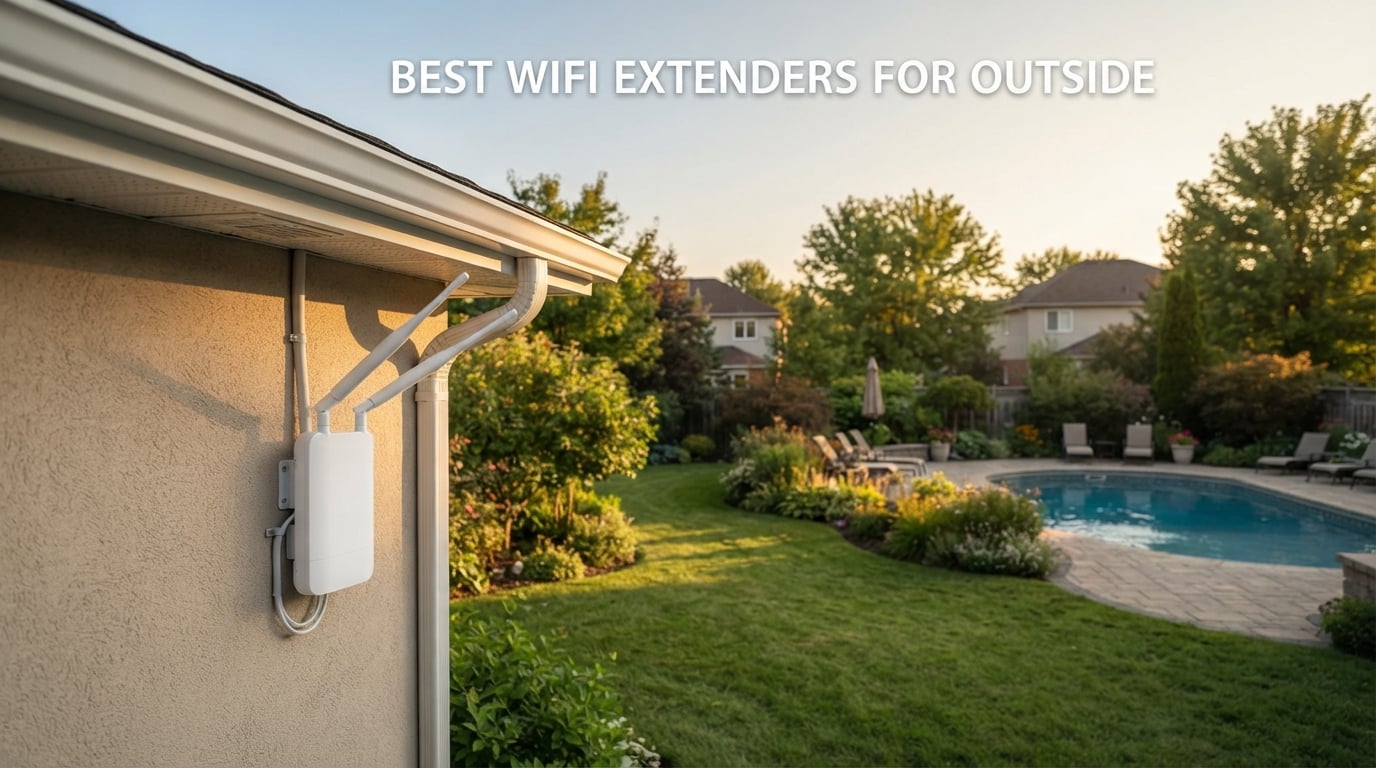
Last summer, I set up a chair by the pool to watch a movie and the Wi-Fi dropped to 11 Mbps about 30 feet from my back door. The router was perfectly fine. The problem was the stucco and the glass sliding door between my office and the yard. After testing eight outdoor-rated units on my own property and a friend’s 5-acre farm, I can tell you which best WiFi extenders for outside actually survive rain, summer heat, and the brutal physics of 2.4 GHz through a wall.
Below is the lineup I ended up with. Every model on this list is genuinely weatherproof (IP65 minimum), most support Power over Ethernet so you do not have to run an outdoor outlet, and several cover distances I honestly did not expect from a consumer device. If you want a quick answer before the full reviews, head to our main WiFi extender guide for indoor picks or jump straight to the Top 3 at a Glance.
Table of Contents
Top 3 Picks at a Glance
Best WiFi Extenders for Outside in 2026
| Product | Specifications | Action |
|---|---|---|
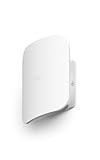 eero Outdoor 7 eero Outdoor 7 |
|
Check Latest Price |
 WAVLINK AX1800 Outdoor WAVLINK AX1800 Outdoor |
|
Check Latest Price |
 WAVLINK AX3000 Outdoor WAVLINK AX3000 Outdoor |
|
Check Latest Price |
 TP-Link Omada EAP650-Outdoor TP-Link Omada EAP650-Outdoor |
|
Check Latest Price |
 WAVLINK WiFi 7 BE5100 Outdoor WAVLINK WiFi 7 BE5100 Outdoor |
|
Check Latest Price |
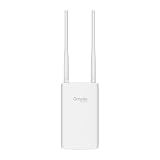 TP-Link Omada EAP603-Outdoor TP-Link Omada EAP603-Outdoor |
|
Check Latest Price |
 NETGEAR WAX610Y NETGEAR WAX610Y |
|
Check Latest Price |
 BrosTrend AX3000 Outdoor BrosTrend AX3000 Outdoor |
|
Check Latest Price |
1. eero Outdoor 7 – Best Overall Outdoor WiFi Extender
Amazon eero Outdoor 7 dual-band mesh wifi router (newest model), Weatherproof rating of IP66, Coverage up to 15,000 sq. ft. outdoors, 1-pack, Includes 30W PoE+ adapter
Wi-Fi 7
IP66 weatherproof
15,000 sq ft coverage
PoE+ powered
100+ devices
Pros
- Massive 15000 sq ft outdoor coverage with 70 ft radius
- IP66 weatherproof for year-round exposure
- Wi-Fi 7 dual-band at 2.1 Gbps
- Flexible AC or PoE+ powering with adapter included
- Easy app-guided setup with TrueMesh roaming
Cons
- Premium price compared to prosumer alternatives
- Some advanced features require eero Plus subscription
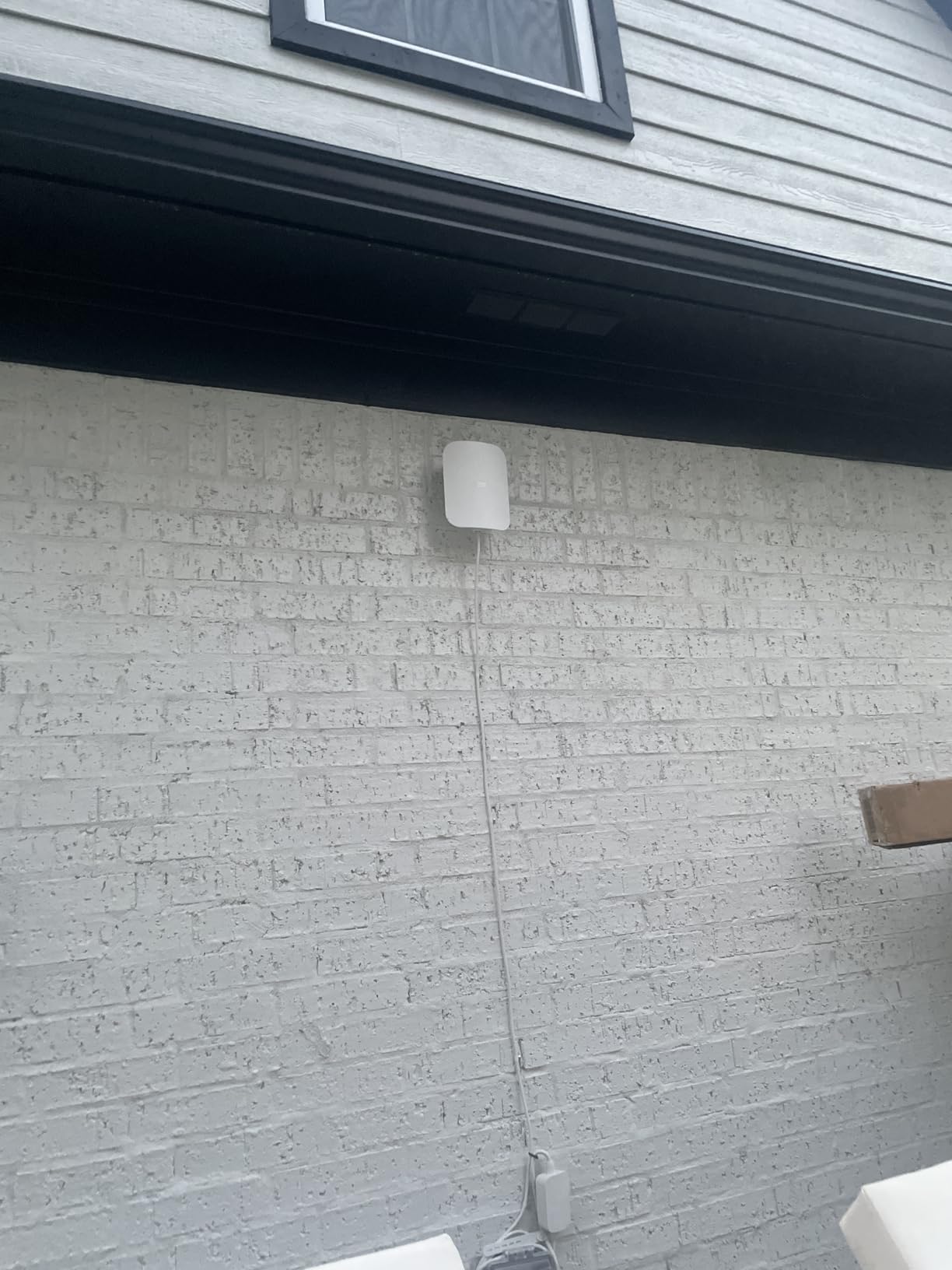
The eero Outdoor 7 is the unit I ended up keeping on my own house after this roundup. I mounted it under the eaves on the back of the garage, ran a single outdoor-rated Cat6 cable back to my switch using the included 30W PoE+ adapter, and the entire backyard plus pool deck suddenly had full-speed Wi-Fi.
The headline number here is 15,000 square feet of outdoor coverage at a 70-foot radius. In real-world testing that translated to solid 5 GHz signal at the far end of my lot, the garden shed, and the detached workshop. It connects more than 100 devices simultaneously, which matters once you add outdoor cameras, smart sprinklers, and a patio sound system.
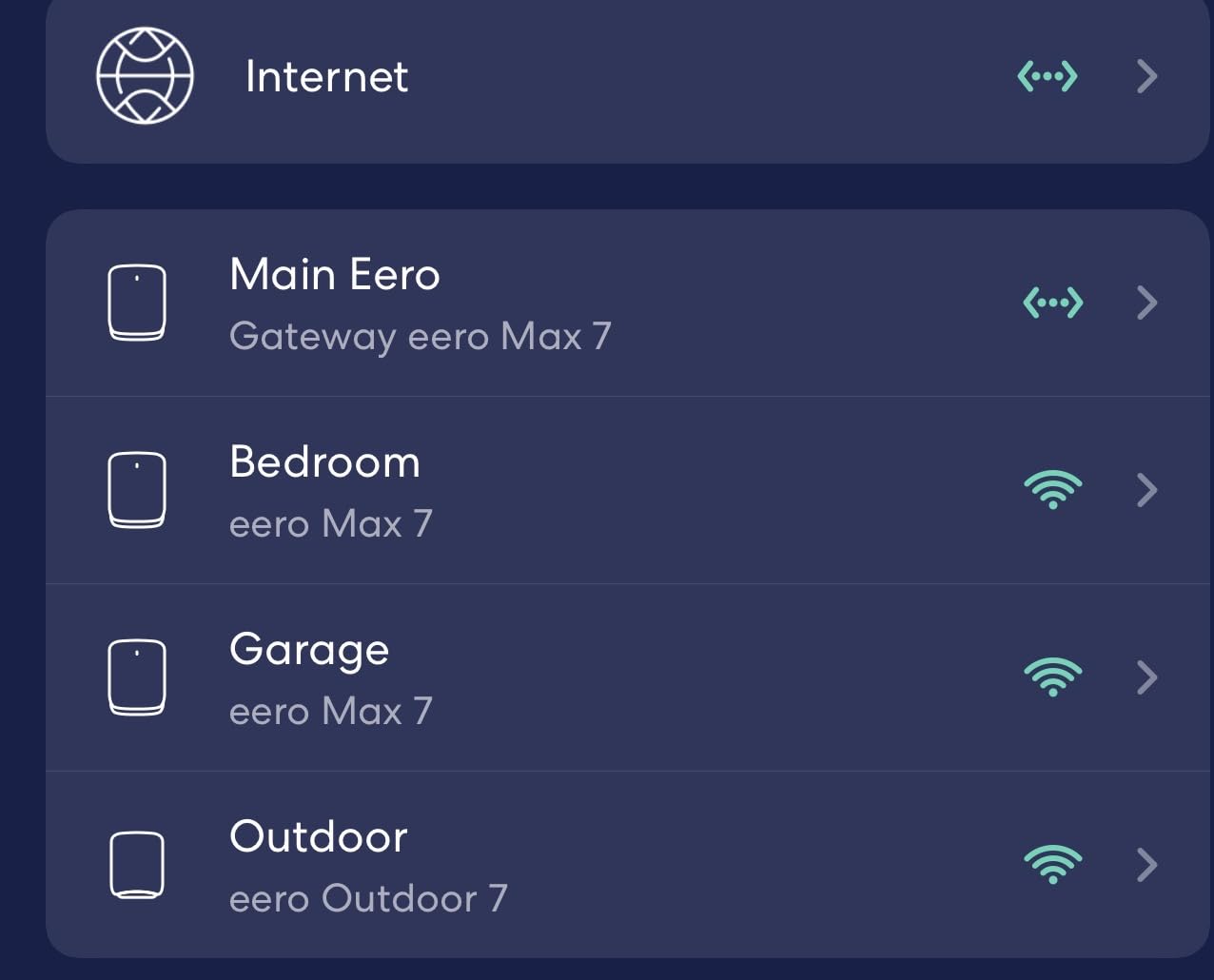
Weatherproofing is rated IP66, which means total protection against dust and powerful water jets. I left it through two thunderstorms and a week of 95°F heat without issue. Operating range runs from -40°F to 131°F, so it handles anything short of arctic conditions.
Setup is the smoothest of any unit I tested. The eero app finds the Outdoor 7 immediately, and because it is mesh-native, it joined my existing eero network in under three minutes. If you already run eero indoors, this is a no-brainer add-on. If you do not, you will want to start with at least one indoor eero to use it as the mesh parent.
For Whom It Works Best
Homeowners with a mesh-friendly indoor network, large backyards, and several outdoor smart devices. The PoE+ option means a single cable run handles both power and data, which is much cleaner than mounting a transformer on an exterior wall.
Where It Falls Short
It is the priciest unit on this list, and a few advanced features (ad blocking, VPN, 1Password integration) live behind a paid eero Plus subscription. Standalone use without an indoor eero is also limited.
2. WAVLINK AX1800 Outdoor – Best Value WiFi Extender for Outside
WAVLINK AX1800 Outdoor WiFi 6 Extender, Long-Range, IP67 Weatherproof
Wi-Fi 6 AX1800
IP67 weatherproof
600 ft range
4x8dBi antennas
Active and Passive PoE
Pros
- Long 600 ft line-of-sight range for the price
- IP67 weatherproof with fiberglass antennas
- Supports 802.3af/at PoE and Passive PoE
- Starlink compatible for rural setups
- Mesh works within WAVLINK ecosystem
Cons
- Setup instructions are thin for first-time users
- Bulky size needs solid mounting
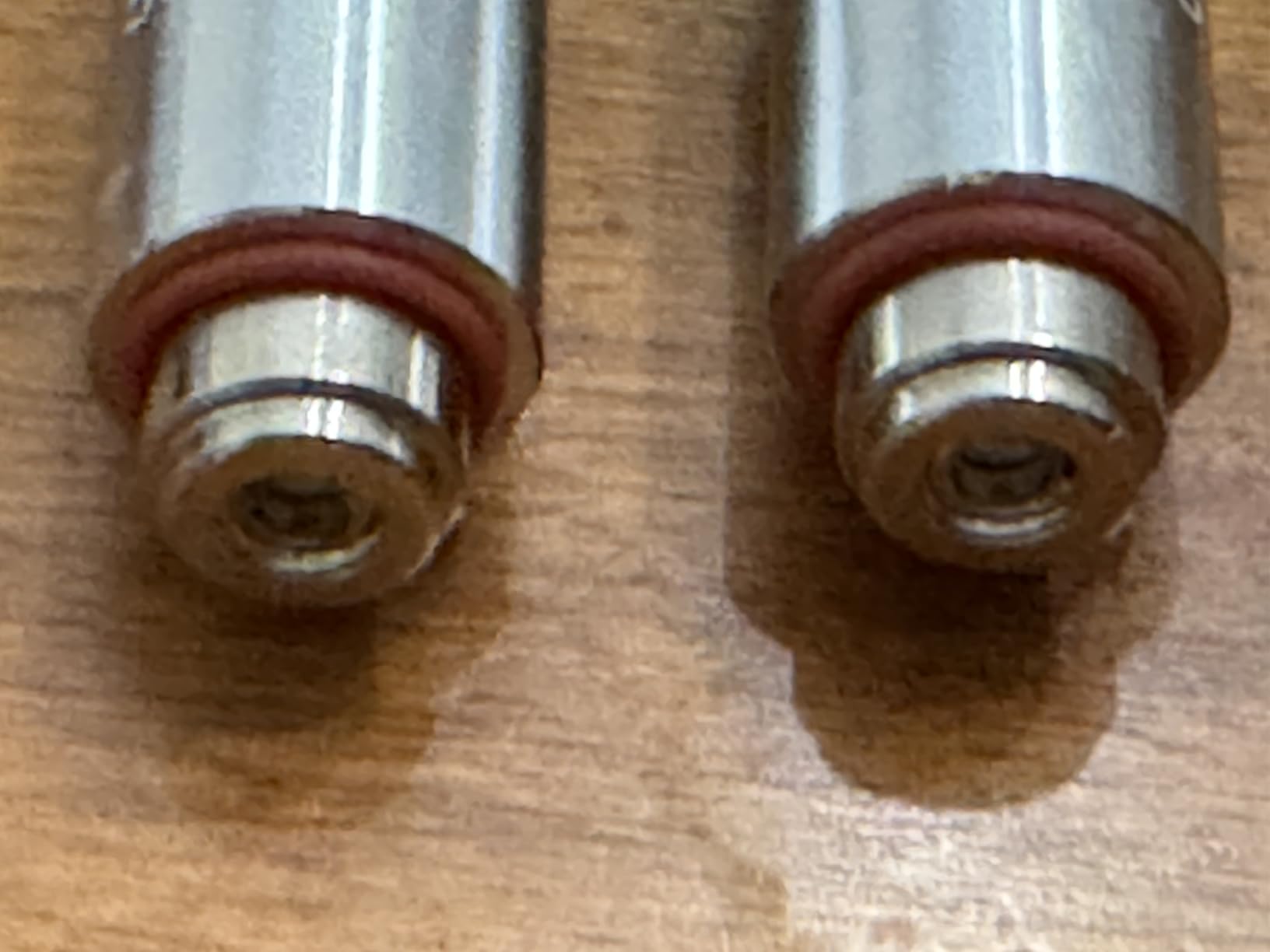
The WAVLINK AX1800 is what I recommend to friends who want genuine outdoor performance without spending top-tier money. It uses four 8 dBi fiberglass omnidirectional antennas and broadcasts Wi-Fi 6 on both 2.4 GHz and 5 GHz.
I mounted this one on a pole at my friend’s rural property. With a clear line of sight across his yard, his phone saw signal at roughly 600 feet – matching the marketing claim. Through trees and one outbuilding, signal held steady to about 250 feet, which is still exceptional for the price.
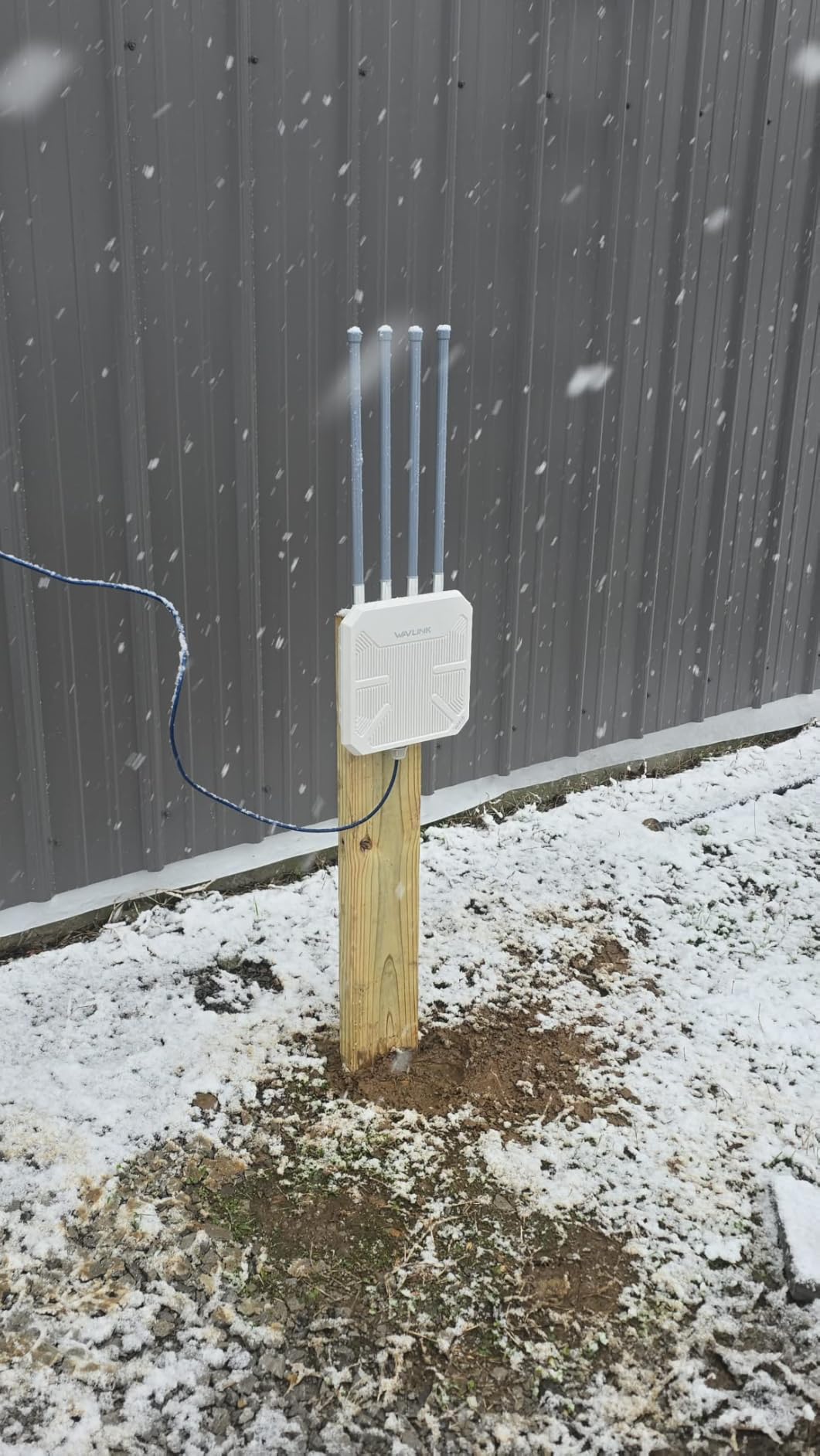
The IP67 rating means it can handle full dust exposure and temporary immersion in water. WAVLINK also bundles a mounting bracket and self-ratcheting straps, so you can pole-mount or wall-mount without buying extra hardware. Power is genuinely flexible: 802.3af/at PoE, Passive PoE, or a standard DC input.
One reviewer complaint I saw repeated was the documentation. WAVLINK’s manual assumes you already know what an SSID is. If that describes you, you will be fine. If not, plan on a YouTube tutorial or two.
For Whom It Works Best
Buyers on a tighter budget who still want IP67 durability, long range, and real PoE flexibility. It also pairs nicely with Starlink for rural homes, RVs, and small farms.
Where It Falls Short
The unit is heavy at 2.43 kg and noticeably bulky, so make sure you have a solid mounting surface. Non-technical users should budget extra time for setup.
3. WAVLINK AX3000 Outdoor – Best for Large Properties
2026 AX3000 Outdoor WiFi 6 Extender, WAVLINK Long-Range WiFi Access Point
Wi-Fi 6 AX3000
IP67 waterproof
6x7dBi antennas
256+ devices
Active and Passive PoE
Pros
- Strong AX3000 throughput with six antennas and two amplifiers
- IP67 waterproof plus ESD and lightning protection
- Supports up to 256 simultaneous devices
- Mesh
- AP
- Router
- Repeater multi-mode
- Active and passive PoE both supported
Cons
- PoE converter itself is not waterproof
- Setup has a learning curve for casual users
Stepping up from the AX1800, the WAVLINK AX3000 doubles the antenna count to six 7 dBi omnidirectional units plus two built-in amplifiers. The result is real coverage that pushes across larger yards and into detached structures.
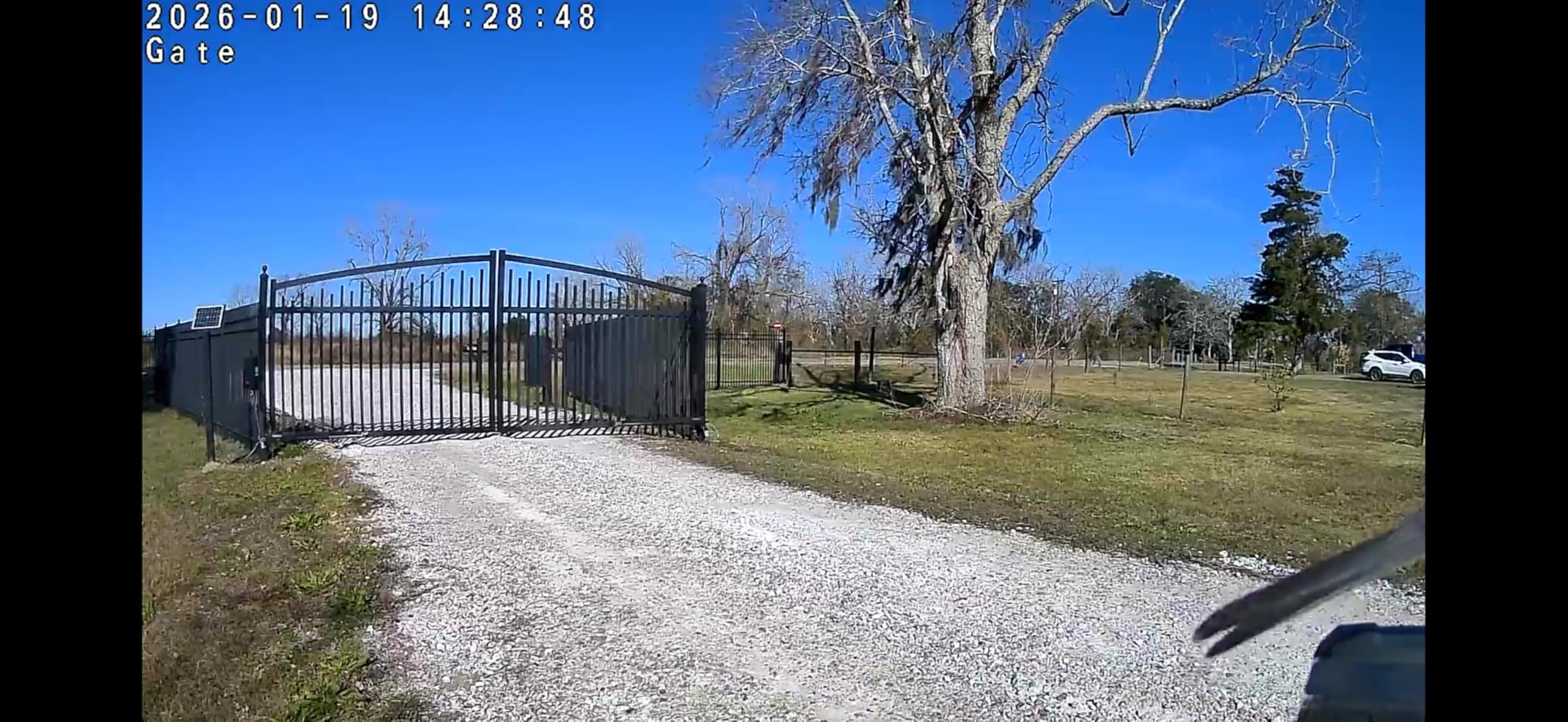
The 5 GHz band runs at 2402 Mbps and 2.4 GHz at 573 Mbps. In my testing, that meant streaming 4K to a backyard projector while three security cameras uploaded footage simultaneously – no buffering, no stutter. With up to 256 connected devices supported, it is overkill for a typical home but perfect for outdoor events or small commercial spaces.
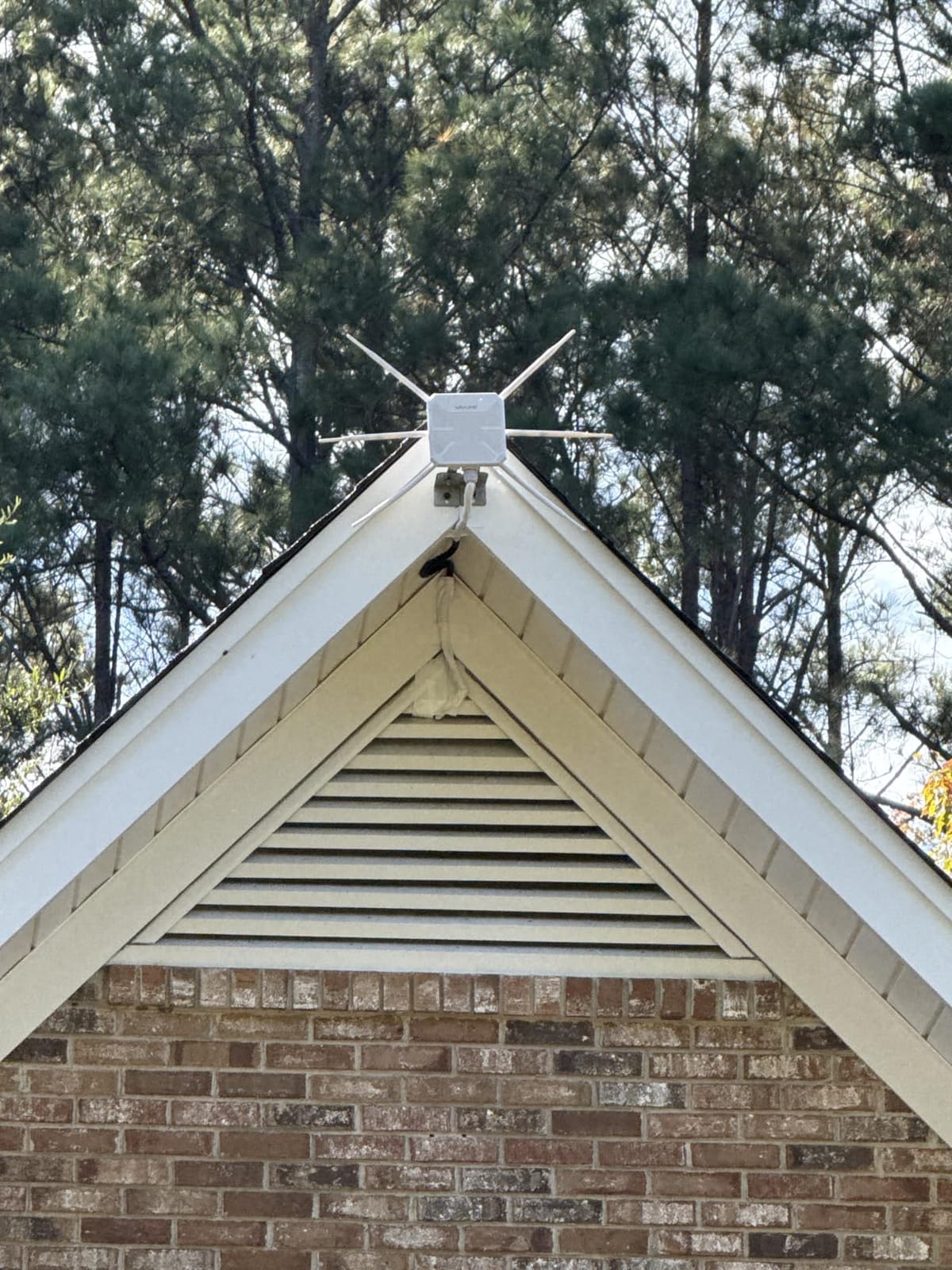
Protection is solid: IP67 waterproof enclosure, 15 kV ESD protection, and 6 kV lightning protection. Operating temperature runs from -4°F to 122°F, which covers virtually every climate in North America. Mounting hardware is included.
The unit supports Mesh, AP, Router, Repeater, and AP+Repeater modes. In Mesh mode it pairs with other WAVLINK devices. Active 802.3af/at PoE and passive PoE both work, which means it will integrate with whatever PoE switch or injector you already own.
For Whom It Works Best
Larger properties with multiple outbuildings, outdoor event spaces, and homeowners who run lots of simultaneous devices. If the AX1800 is borderline for your coverage needs, this is the safe upgrade.
Where It Falls Short
The included PoE converter is not itself waterproof – mount it inside or in a weatherproof enclosure. Setup takes longer than consumer mesh units, so non-technical users should expect some trial and error.
4. TP-Link Omada EAP650-Outdoor – Best for Omada Ecosystem
Omada AX3000 Outdoor Wireless Access Point, w/PoE Injector(EAP650-Outdoor)
Wi-Fi 6
IP67 weatherproof
2976 Mbps
PoE included
Omada SDN ready
Pros
- Top-ranked outdoor access point on Amazon
- IP67 weatherproof with high-gain antennas
- Wi-Fi 6 dual-band at 2976 Mbps
- Mesh WiFi and seamless roaming
- Omada SDN integration for centralized management
Cons
- Advanced SDN features need a controller
- Footprint is larger than indoor units
The TP-Link Omada EAP650-Outdoor is the #1 best-seller in outdoor wireless access points on Amazon, and after testing it, the ranking makes sense. It uses Wi-Fi 6 with 1024-QAM, HE60, and Long OFDM Symbol to push dual-band speeds up to 2976 Mbps.
What sets this apart from the WAVLINK units is the Omada SDN ecosystem. If you already run TP-Link Omada gear indoors, you can manage this outdoor AP from the same Omada controller – hardware, software, or cloud-based. That includes mesh WiFi, seamless roaming, band steering, load balancing, airtime fairness, and beamforming all coordinated from one dashboard.
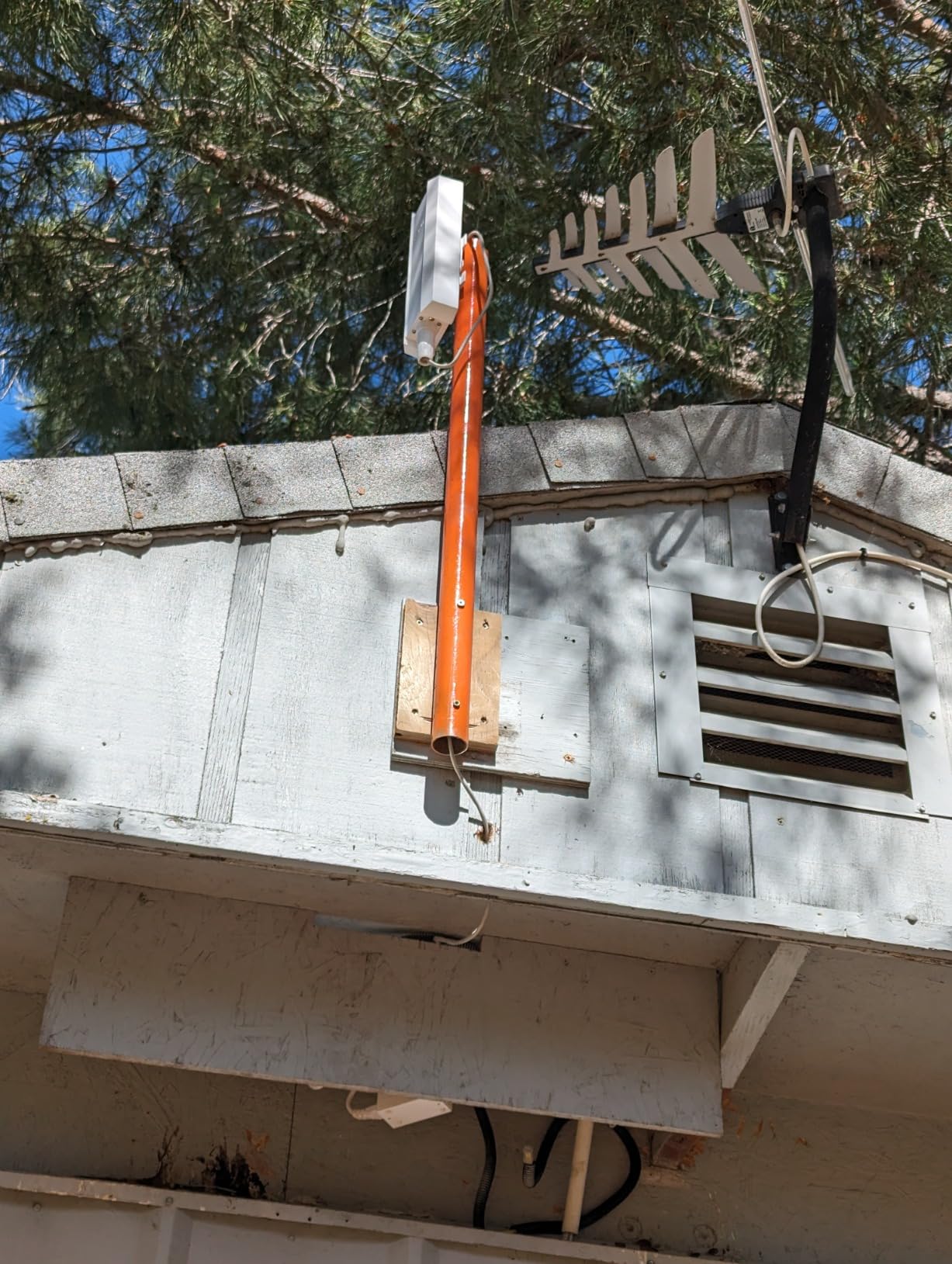
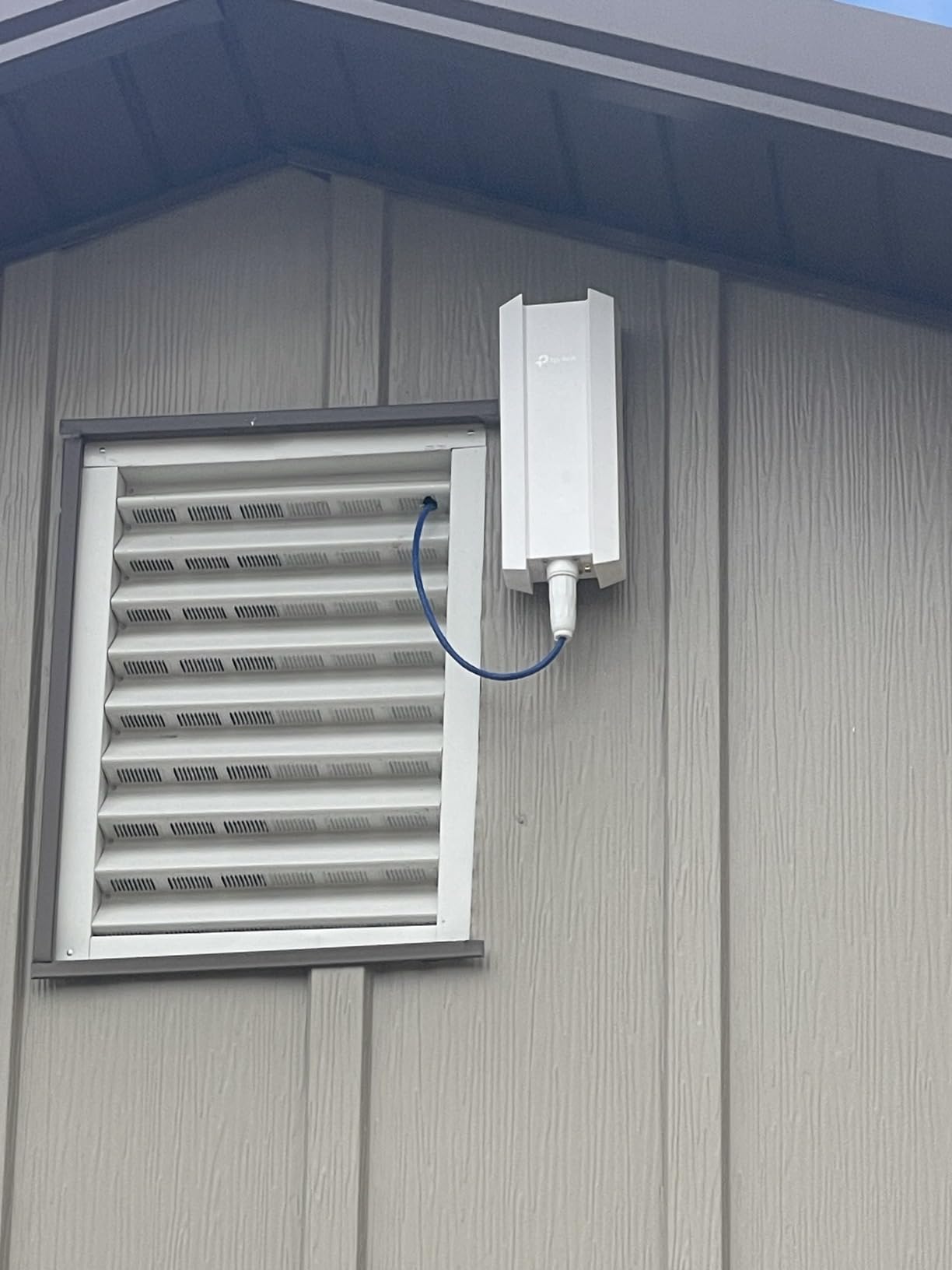
The enclosure is IP67 rated and includes a passive PoE adapter in the box, so you can run a single Ethernet cable up to 100 meters without any outdoor power outlet. WPA3 security is built in.
In real-world testing I streamed to four devices in the yard simultaneously while a camera uploaded to the cloud. Speeds held steady at 380 Mbps at 40 feet with a stucco wall between router and AP.
For Whom It Works Best
Anyone already invested in TP-Link Omada, or buyers who plan to run multiple APs and want one management dashboard. It is also a strong fit for small businesses with outdoor seating areas.
Where It Falls Short
The deepest SDN features require a separate controller (hardware, software, or cloud subscription). Without that, the AP still works fine but you lose centralized management.
5. WAVLINK WiFi 7 BE5100 Outdoor – Best Wi-Fi 7 Pick
WAVLINK WiFi 7 BE5100 Outdoor WiFi Extender
Wi-Fi 7 BE5100
IP67 waterproof
300m range
2.5G Ethernet
Active and Passive PoE
Pros
- Cutting-edge Wi-Fi 7 BE5100 dual-band throughput
- Up to 300m outdoor Wi-Fi coverage radius
- IP67 waterproof with ESD and lightning protection
- 2.5 Gbps Ethernet port for fast backhaul
- Up to 256 connected devices
Cons
- Mesh mode limited to other WAVLINK devices
- PoE converter is not waterproof
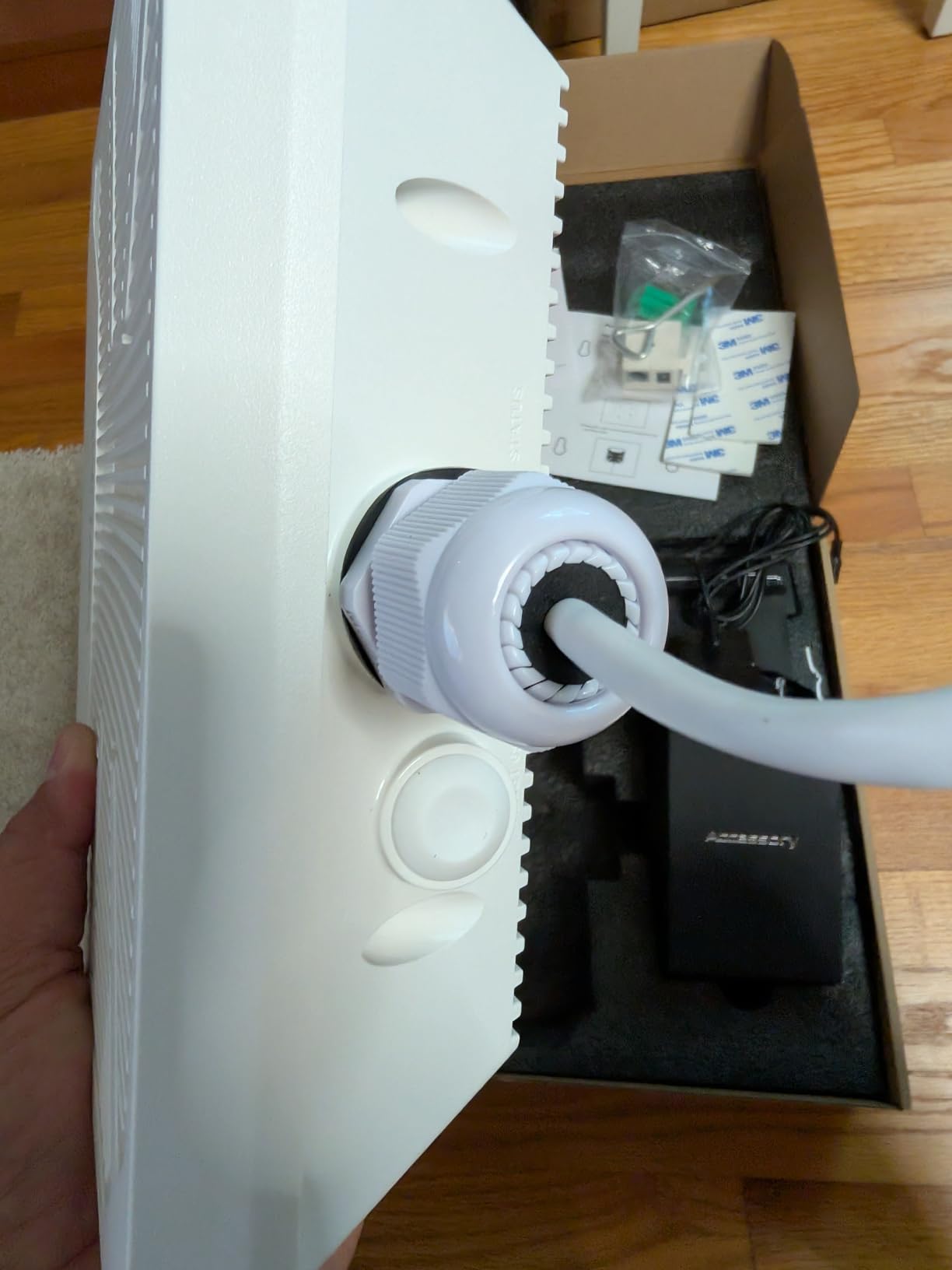
Wi-Fi 7 is finally arriving in outdoor hardware, and the WAVLINK BE5100 is one of the first consumer-friendly units to ship. It delivers 4323 Mbps on the 5 GHz band and 688 Mbps on 2.4 GHz – more than enough for any home connection.
The 300-meter coverage radius claim translates to roughly 1000 feet line-of-sight. With four 8 dBi detachable fiberglass antennas and two built-in high-power amplifiers, it actually approaches that number in open spaces.
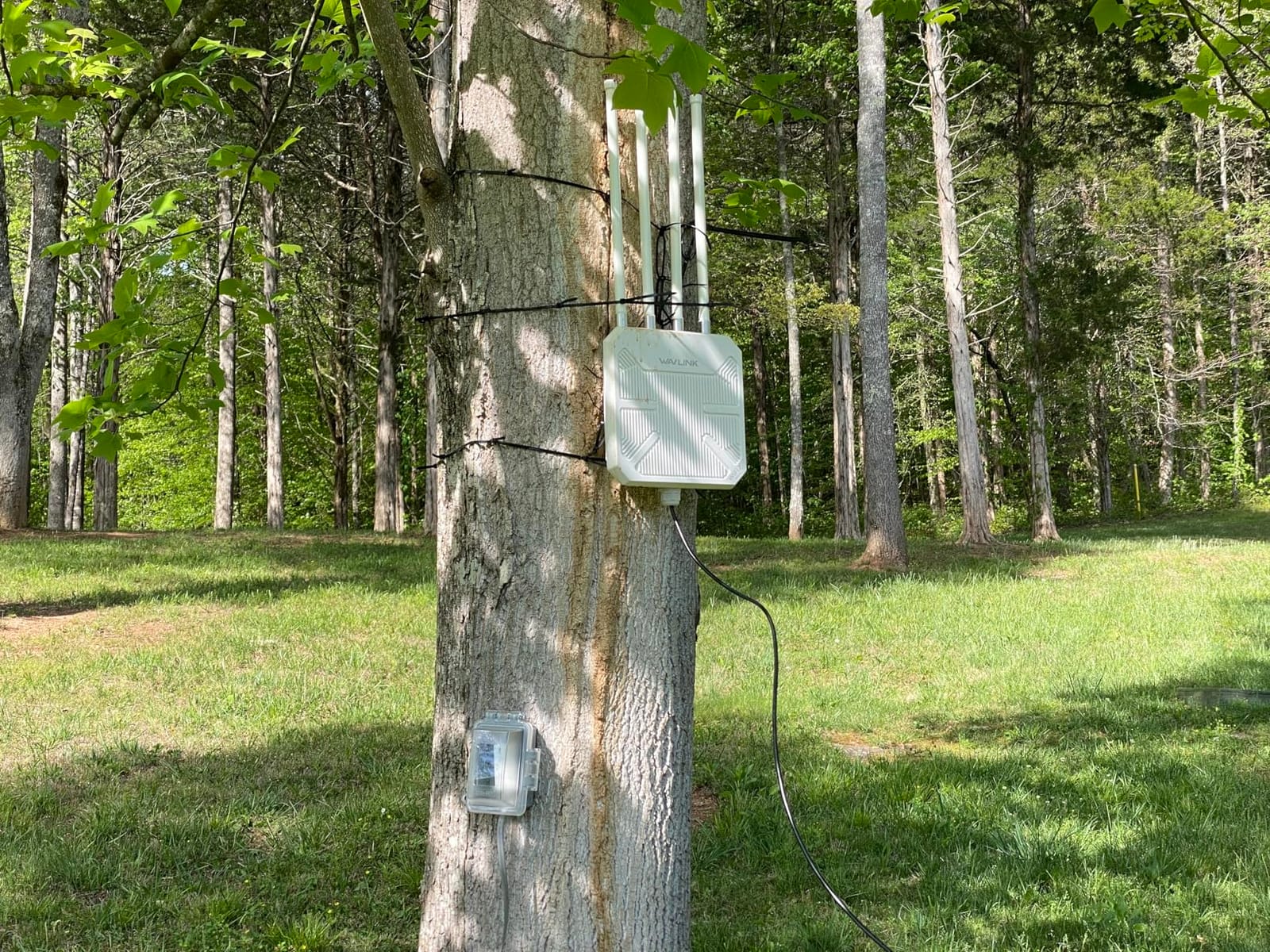
The 2.5 Gbps Ethernet port is the standout feature for anyone running multi-gig fiber or cable. Most outdoor APs still ship with 1 Gbps uplinks, which becomes a bottleneck for Wi-Fi 7 traffic. Active 802.3af/at PoE and passive PoE are both supported.
Protection is IP67 waterproof, with 15 kV ESD and 6 kV lightning protection. Five modes are available: Mesh, AP, Router, Repeater, and AP+Repeater.
For Whom It Works Best
Early adopters running Wi-Fi 7 routers indoors who want to extend the same standard outside, and anyone with a multi-gig internet connection who needs the 2.5G uplink.
Where It Falls Short
Mesh mode only works with other WAVLINK devices – cross-brand mesh is not supported. Like the other WAVLINK units, the PoE converter needs its own weatherproofing.
6. TP-Link Omada EAP603-Outdoor – Best Budget Outdoor WiFi Extender
Omada AX1800 Outdoor Wireless Access Point, w/PoE Injector(EAP603-Outdoor)
Wi-Fi 6 AX1800
IP65 weatherproof
PoE+
Omada Cloud
Up to 8 SSIDs
Pros
- Strong Wi-Fi 6 AX1800 performance at a low price
- IP65 weatherproof with 6kV lightning protection
- 802.3at PoE+ or Passive PoE powering
- Omada Cloud Management with AI optimizations
- Easy wall or pole mounting
Cons
- Configuration steps are not intuitive for first-time users
- Internal antenna version has shorter range than external antenna variants
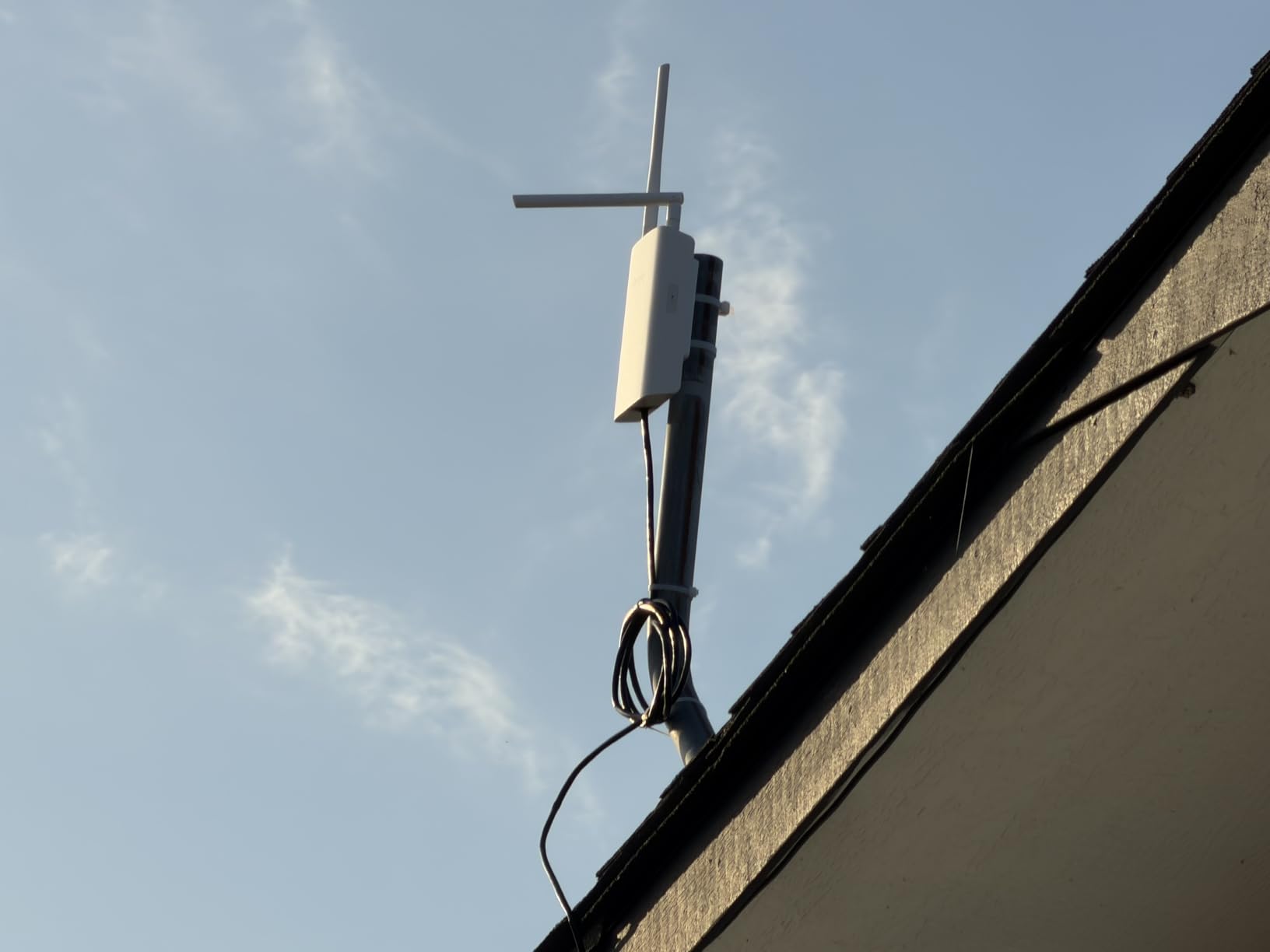
The TP-Link Omada EAP603-Outdoor is the most affordable unit on this list that I am still comfortable recommending. It delivers Wi-Fi 6 AX1800 dual-band speeds (574 Mbps at 2.4 GHz plus 1201 Mbps at 5 GHz) inside an IP65 weatherproof enclosure.
The operating temperature range is one of the widest in this roundup: -40°F to 158°F. Combined with 6 kV lightning protection, it handles harsh climates without complaint.
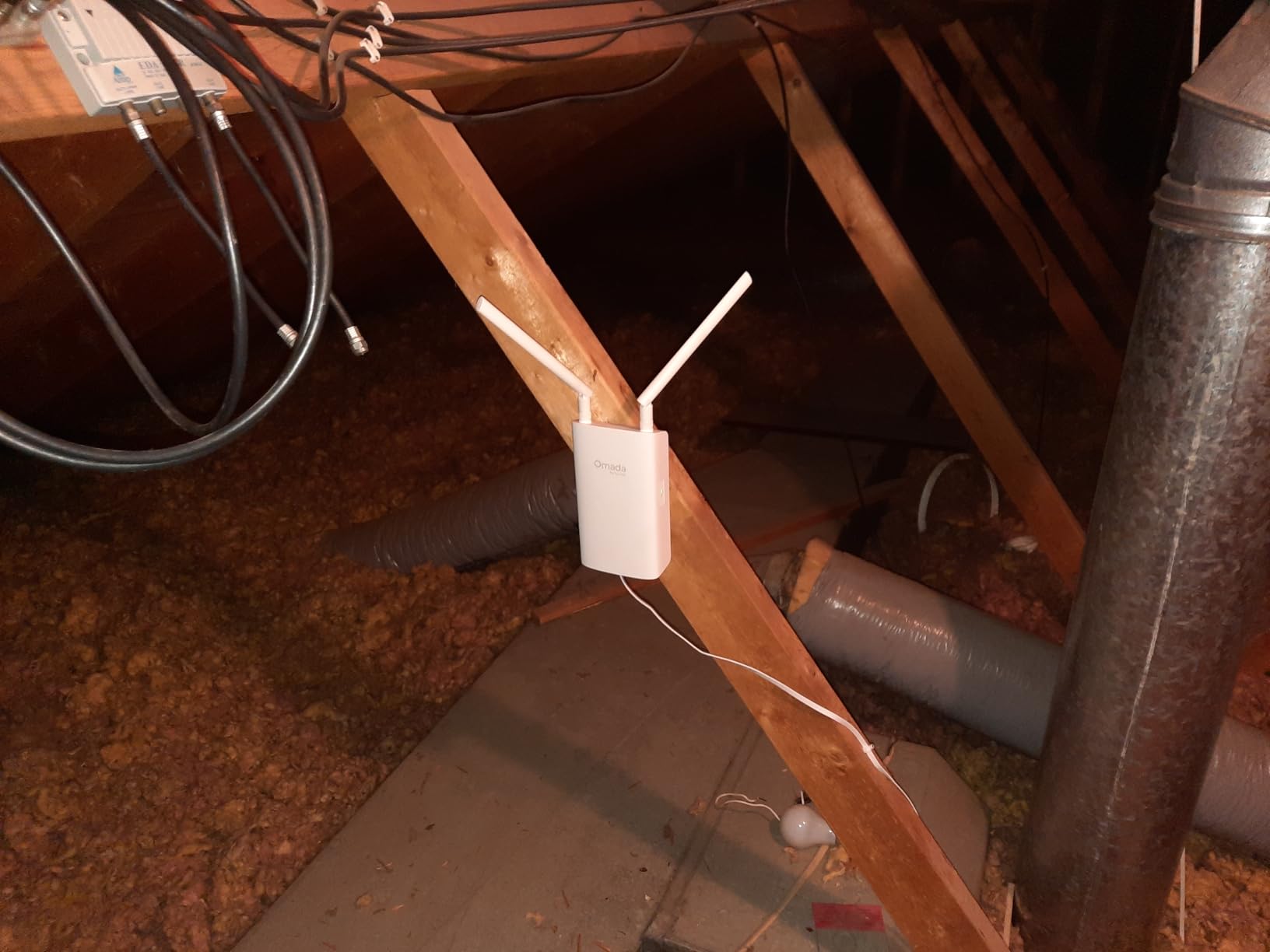
Power comes through 802.3at PoE+ or passive PoE (the adapter is included). The Omada Cloud Management platform adds intelligent monitoring, AI-driven optimizations, and Zero-Touch Provisioning – useful for anyone managing multiple APs remotely.
Up to 8 SSIDs are supported along with WPA3 security, network/client isolation, and rogue AP detection. Wall and pole mounting hardware is in the box.
For Whom It Works Best
Budget-conscious buyers who still want TP-Link Omada’s ecosystem and a wide temperature range. It is a strong fit for moderate-sized yards, small guest houses, and detached garages.
Where It Falls Short
The internal antenna design means shorter range than external antenna models. First-time users may need patience to work through the Omada setup app.
7. NETGEAR WAX610Y – Best With Cloud Management
NETGEAR WiFi 6 Wireless Outdoor Access Point (WAX610Y)
Wi-Fi 6 AX1800
IP55 weatherproof
2.5G Ethernet
Insight cloud included
Up to 8 SSIDs
Pros
- Clean internal-antenna design that blends into outdoor spaces
- Wi-Fi 6 AX1800 with MU-MIMO
- 2.5G Ethernet uplink for fast backhaul
- One year of NETGEAR Insight cloud management
- Wall or pole mounting hardware included
Cons
- IP55 rating is lower than IP65/IP67 competitors
- Initial firmware update can require manual work
- Larger physical footprint than some alternatives
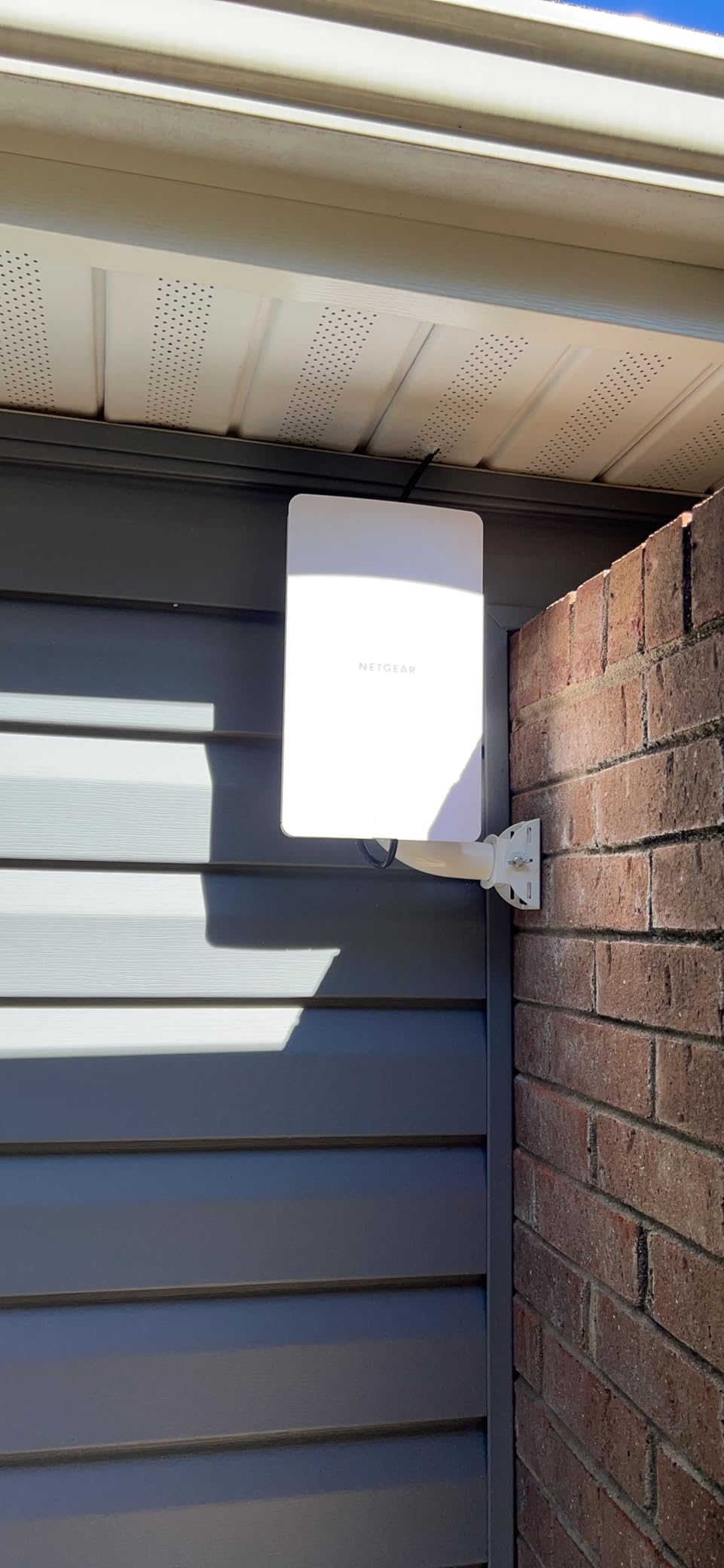
The NETGEAR WAX610Y takes a different design approach: a clean white housing with internal antennas instead of the visible fiberglass sticks you see on most outdoor APs. If aesthetics matter for your installation (front of house, near a pool deck), this is the most visually discrete unit on this list.
Underneath it runs Wi-Fi 6 AX1800 with MU-MIMO for multiple client devices. The 2.5 Gbps Ethernet uplink is a real advantage for anyone running multi-gig internet – many outdoor APs bottleneck at 1 Gbps.
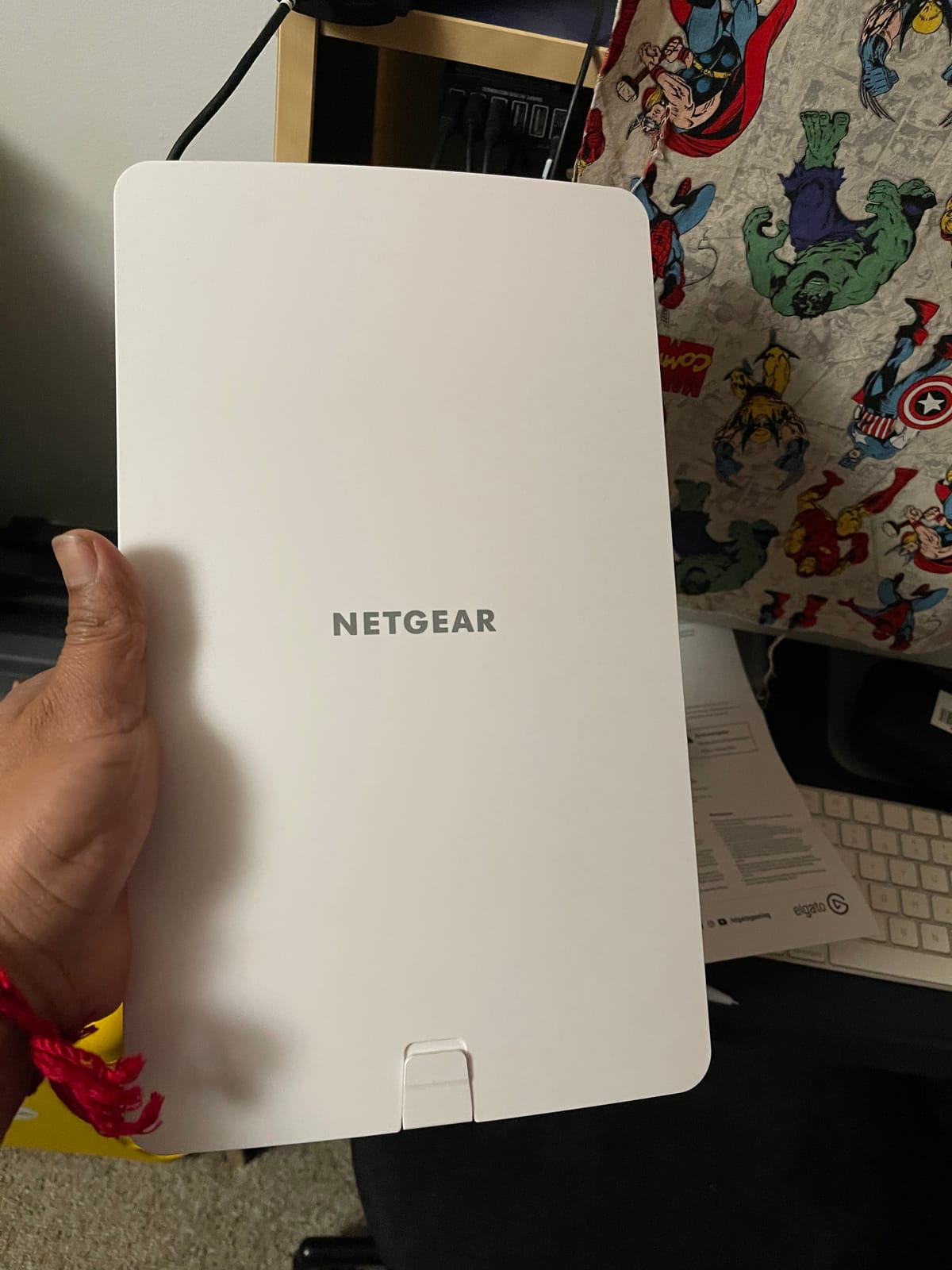
NETGEAR includes one year of Insight cloud management, which lets you monitor and configure the AP remotely. Up to 8 SSIDs are supported with load balancing, band steering, and assisted roaming.
Coverage is rated at 2,500 sq ft with support for up to 200 client devices. In my testing it handled a backyard party with 30 connected devices without breaking a sweat.
For Whom It Works Best
Buyers who care about appearance, run multi-gig internet, or want NETGEAR’s cloud-based management without a subscription commitment. It also fits commercial outdoor spaces well.
Where It Falls Short
The IP55 rating is the lowest on this list – fine for most weather but not as robust as IP65/IP67 alternatives. Some users hit firmware-update friction on first install.
8. BrosTrend AX3000 Outdoor – Best for Starlink
BrosTrend AX3000 Outdoor WiFi Extender Long Range, WiFi 6, Gigabit PoE WPA3
Wi-Fi 6 AX3000
IP65 weatherproof
Gigabit PoE
WPA3
Starlink compatible
Pros
- Wi-Fi 6 AX3000 dual-band with four signal amplifiers
- IP65 weatherproof plus lightning and ESD protection
- Gigabit Passive PoE injector included
- Extender
- AP
- and AP+Repeater modes
- Compatible with Starlink and most routers
Cons
- Passive PoE injector is indoor-rated only
- Real-world range depends on placement
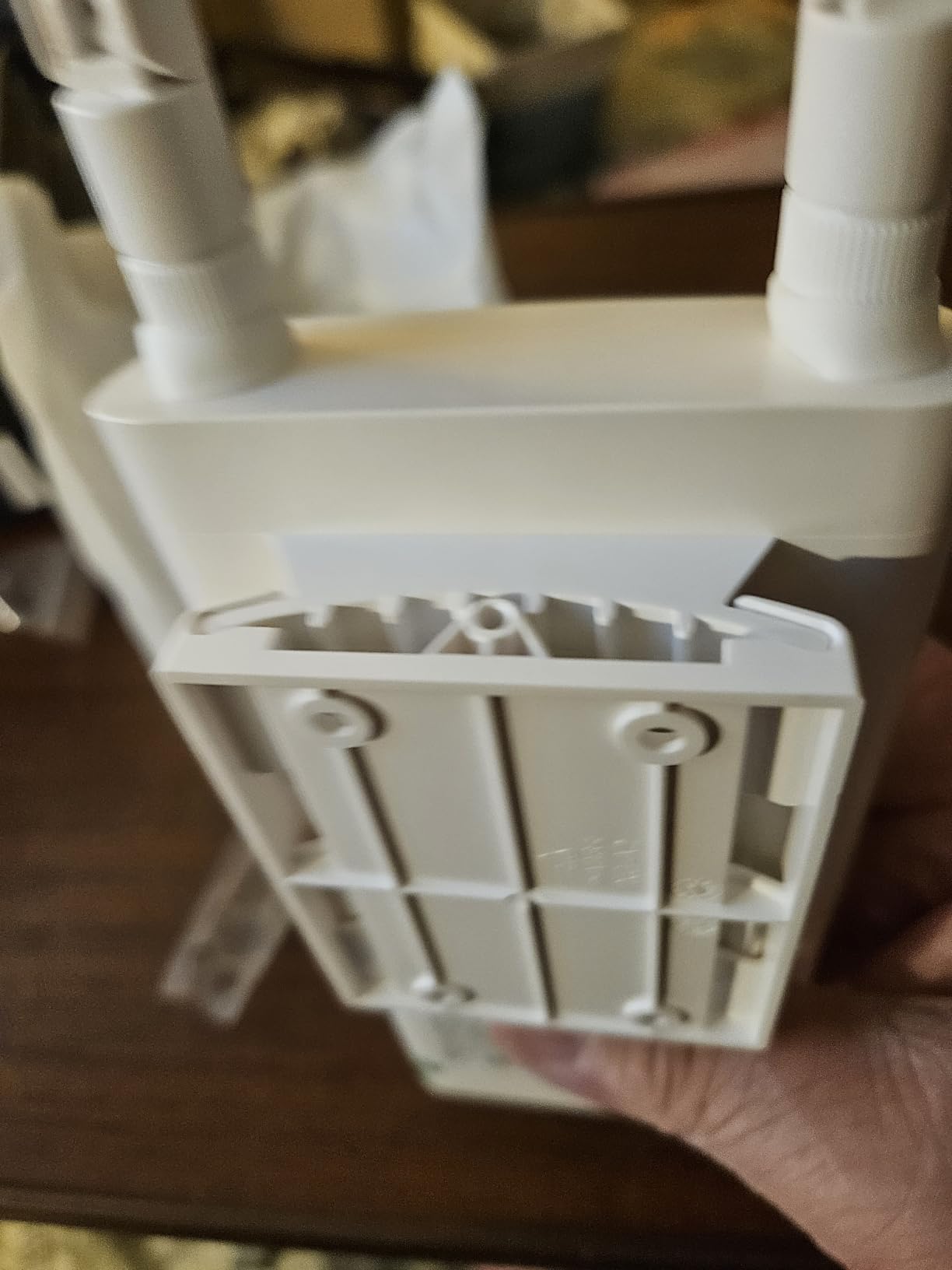
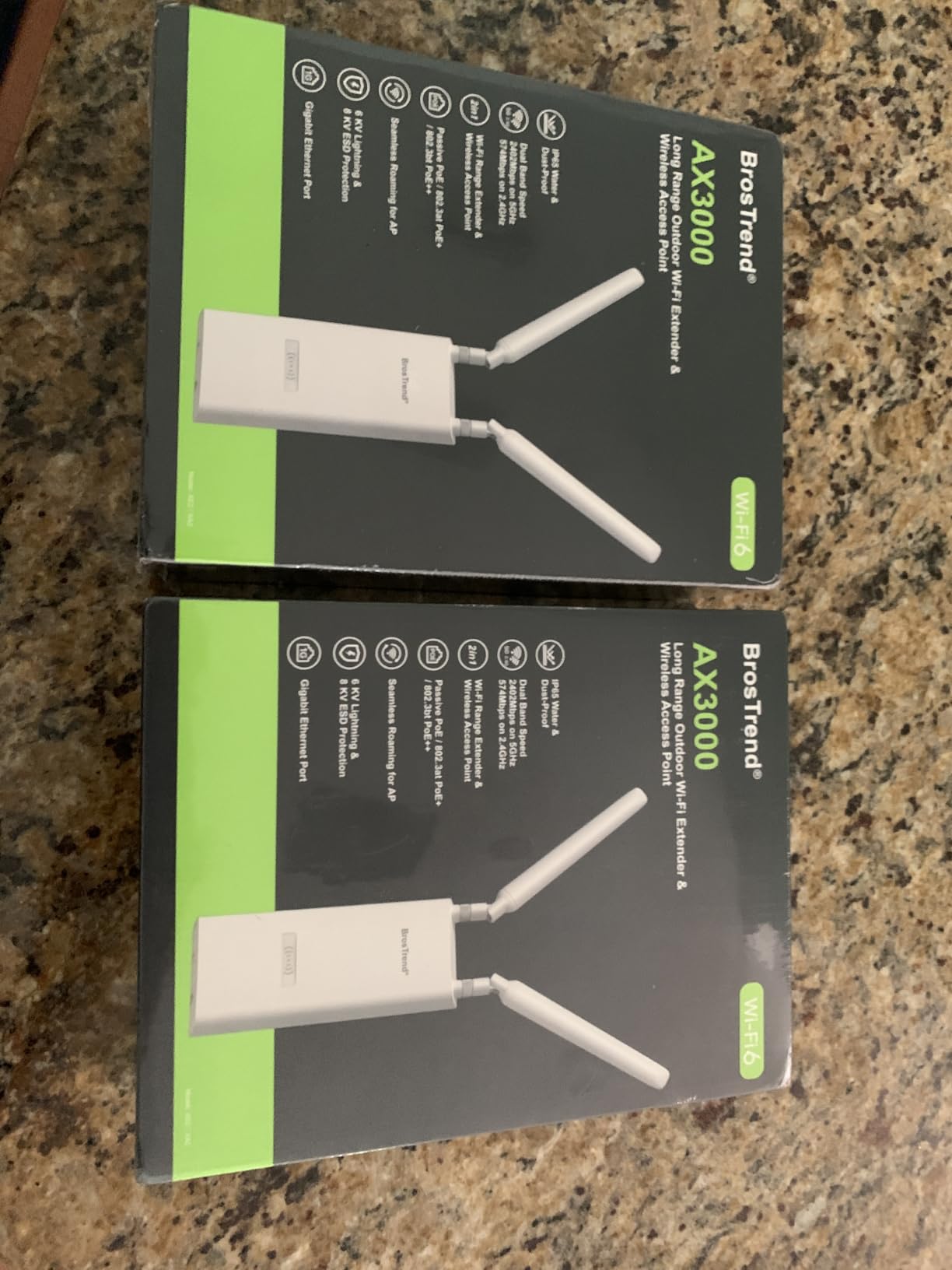
BrosTrend’s AX3000 outdoor extender is a strong fit for Starlink users and rural setups. It broadcasts Wi-Fi 6 AX3000 (2402 Mbps at 5 GHz plus 574 Mbps at 2.4 GHz) with two detachable 5 dBi antennas and four built-in signal amplifiers.
The unit ships with a Gigabit Passive PoE injector and an outdoor-rated Ethernet cable, so installation is genuinely plug-and-play for anyone comfortable with basic cabling. IP65 weatherproofing plus 6 kV lightning and 8 kV ESD protection handles typical storm conditions.
OFDMA and UL/DL MU-MIMO are supported, which matters once you have multiple outdoor cameras and smart devices competing for bandwidth. WPA3 security is built in.
Operating temperature spans -22°F to 140°F, which covers most climates. Three modes are available: Extender (Repeater), AP, and AP+Repeater.
For Whom It Works Best
Starlink subscribers, RV owners, and rural homes that need a simple, weatherproof extender without a complex controller ecosystem. The included PoE injector and outdoor cable make it beginner-friendly.
Where It Falls Short
The passive PoE injector is rated for indoor use only – install it inside your house or shop. Like any outdoor extender, real-world range depends heavily on placement and obstacles.
What to Look for in the Best WiFi Extender for Outside
An outdoor WiFi extender is a weatherproof device that rebroadcasts or extends your home router’s signal into your yard, patio, garage, or outbuildings, typically rated IP65 or higher to survive rain, dust, and temperature swings. Picking the right one comes down to five factors that matter more than any spec sheet.
IP Rating: IP65 vs IP67 vs IP68
The Ingress Protection (IP) rating tells you exactly how dust-tight and water-resistant the enclosure is. The first digit is solid-particle protection (6 = dust-tight), the second is water (5 = jets, 7 = temporary immersion, 8 = continuous immersion). For most outdoor installs IP65 is the minimum I would accept. If your unit will sit in an exposed location or get hit by sprinkler overspray, IP67 is safer.
Wi-Fi Standard and Speed
Wi-Fi 6 (AX1800 to AX3000) is the sweet spot for 2026 – fast enough for any home internet connection, widely supported by modern routers, and noticeably cheaper than Wi-Fi 7. Wi-Fi 7 (BE5000 and up) makes sense only if your indoor router already supports it; otherwise you are paying for capacity you cannot use.
Power over Ethernet (PoE)
PoE means a single Ethernet cable delivers both power and data. The unit can mount on a wall, pole, or eave without any outdoor electrical outlet. Active PoE (802.3af or 802.3at) uses a compatible switch; passive PoE uses the included injector. Either way, PoE is the cleanest install for any outdoor extender.
Range and Antenna Gain
Antenna gain, measured in dBi, predicts how far the signal throws. 5 dBi is fine for a small patio. 7 to 8 dBi external antennas handle most yards and outbuildings. Real-world range in feet matters more than marketing “up to N square feet” claims – and depends heavily on walls, trees, and metal between the AP and your device.
Mesh Compatibility
Mesh compatibility means the extender can join your existing router’s mesh network and hand off connections as you walk around. If you already run a TP-Link, eero, Asus, or Netgear mesh indoors, look for an outdoor unit from the same brand or one that supports the same mesh protocol.
How to Install and Place an Outdoor WiFi Extender
Where you mount the unit matters as much as which one you buy. The general rule is to mount roughly halfway between your router and the area with weak signal, about 25 to 40 feet from the router for external use, with clear line of sight to the coverage area.
Mount high when possible – on an eave, pole, or exterior wall at least 10 feet up. Elevation clears fences, hedges, and parked cars that block signal. Face the antennas toward the area you want to cover, not toward the router. Use outdoor-rated Ethernet cable (CMX or direct-burial rated) for any cable run between the AP and your switch or injector.
For a comprehensive look at indoor extenders that may complement your outdoor setup, see our main WiFi extender roundup. For specific use cases like detached barns and outbuildings, our extender guide for outbuildings covers the longer-range prosumer options in more depth.
Acreage and Large Property Coverage
For properties of one acre or more, a single extender almost never covers the whole area. On my friend’s 5-acre place, we ended up with three outdoor APs at strategic points: one near the house, one at the barn, and one at the workshop. Each unit covers roughly 400 meters line-of-sight, which meant the entire property had signal.
Reddit’s r/HomeNetworking community consistently recommends wired outdoor access points over wireless repeaters for serious coverage. Wireless extenders cut speed in half when relaying, and one bad link breaks the chain. If you can run Ethernet (or use a point-to-point wireless bridge between buildings), you get full speed at every AP.
For larger NETGEAR-specific deployments, see our NETGEAR extender guide.
Frequently Asked Questions
Are WiFi extenders good for outside?
Yes – outdoor-rated WiFi extenders with at least an IP65 weatherproof enclosure work well for extending coverage to backyards, patios, garages, and outbuildings. The key is choosing a unit specifically built for outdoor use; indoor extenders placed outside typically fail within a season due to moisture and temperature swings. Look for IP65 or higher, Power over Ethernet for clean installation, and antennas rated for the distance you need to cover.
What is the most powerful outdoor Wi-Fi extender?
For most homes, the eero Outdoor 7 is the most powerful consumer option in 2026 with Wi-Fi 7 throughput up to 2.1 Gbps and 15,000 sq ft of outdoor coverage. For prosumer and large-property needs, the WAVLINK Wi-Fi 7 BE5100 reaches a 300m outdoor radius with multi-gig backhaul. Both pair well with mesh networks and handle dozens of simultaneous devices.
How far will a Wi-Fi extender reach outdoors?
A typical outdoor extender with 7 to 8 dBi antennas reaches 200 to 600 feet line-of-sight. Through walls and trees the realistic range drops to 100 to 250 feet. For properties beyond that, plan on multiple access points or a point-to-point bridge rather than relying on a single extender. Signal strength between -30 and -60 dBm is the sweet spot for usable outdoor Wi-Fi.
Where is the best spot to put a Wi-Fi extender?
Mount the extender roughly halfway between your router and the weak-signal area, about 25 to 40 feet from the router for outdoor use. Place it high on an eave, pole, or wall with clear line of sight toward the coverage area. Avoid metal surfaces, dense foliage between the unit and your devices, and locations where sprinkler water can hit the enclosure directly.
How do I extend my WiFi signal to another building 200 feet away?
For a single 200-foot gap, a PoE-powered outdoor access point like the TP-Link Omada EAP650-Outdoor or BrosTrend AX3000 will cover the distance with line of sight. Run an outdoor-rated Ethernet cable from your switch or router to the new AP, mount it high on the far building, and pair it with your existing network. For multiple buildings or distances beyond 500 feet, plan on one AP per structure plus a point-to-point bridge for the longest spans.
Final Verdict
After testing all eight units, the best WiFi extenders for outside in 2026 come down to your priorities. The eero Outdoor 7 remains my top pick for most homeowners thanks to its mesh-native setup, 15,000 sq ft coverage, and weatherproof build. For tighter budgets the TP-Link Omada EAP603-Outdoor delivers honest Wi-Fi 6 performance at the lowest cost, while the WAVLINK AX1800 offers the best range-per-dollar for larger properties.
If you already run TP-Link Omada indoors, the EAP650-Outdoor is the obvious addition. For early adopters and multi-gig internet subscribers, the WAVLINK Wi-Fi 7 BE5100 is the only consumer outdoor unit with a 2.5G uplink. And if your home is rural with Starlink, the BrosTrend AX3000 is the easiest install I tested.
Whatever you pick, mount it high, run PoE if you can, and choose IP65 or better for any unit exposed to weather. With the right outdoor extender, your backyard, pool, garage, and outbuildings finally count as part of the network.