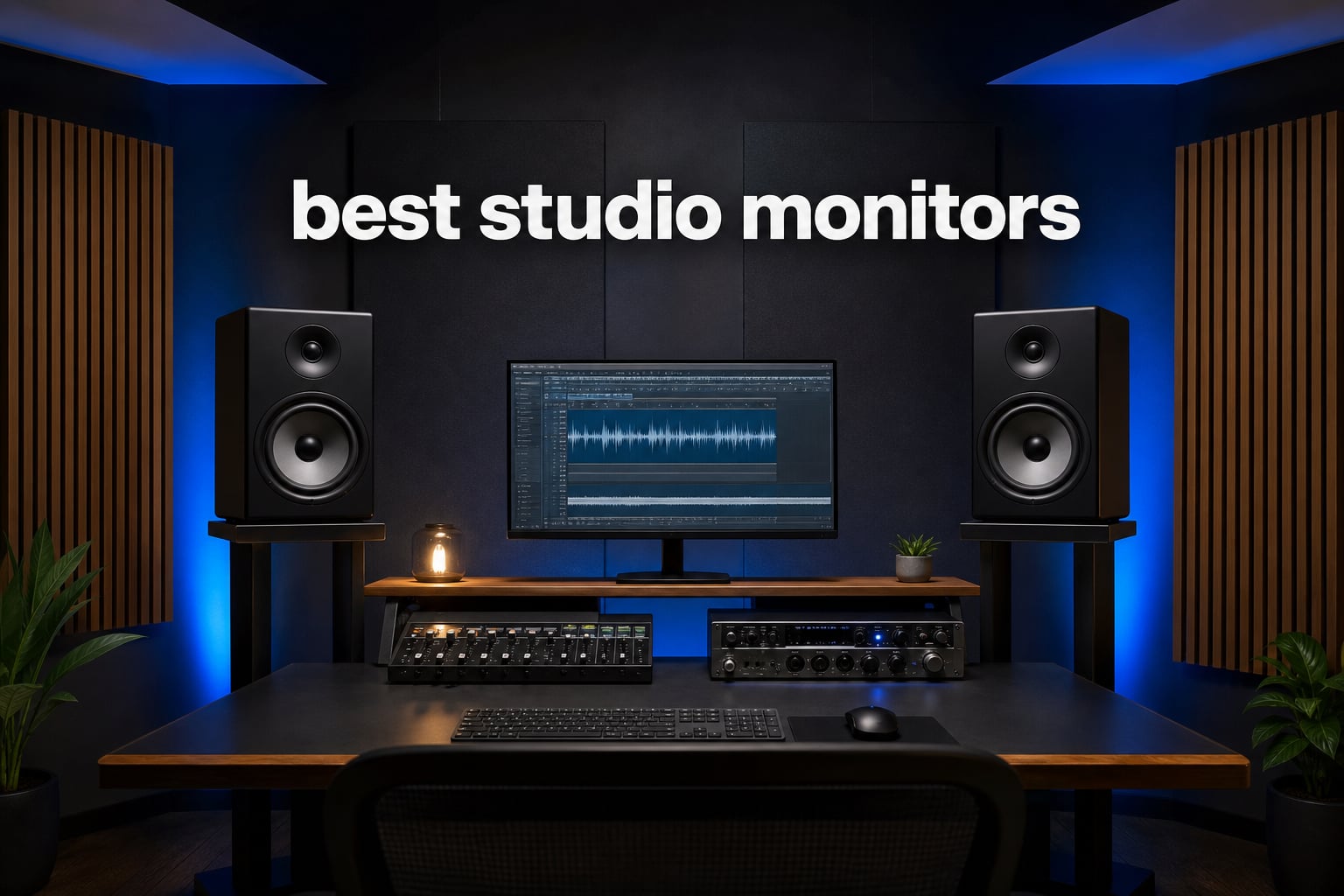
The best studio monitors make decisions in a mix easier because they are built to show what is in the recording, not flatter it. For this 2026 guide, we compared 12 powered studio monitors using their published driver layouts, connection options, room-adjustment controls, stated output, and buyer-feedback summaries.
A good pair is not automatically the largest pair. The right choice starts with the distance from your ears, the space behind the speakers, and whether you need balanced XLR or TRS connections from an audio interface. A small desk can work better with compact nearfield monitors and careful placement than with an oversized woofer fighting a small room.
Our short answer is simple: choose the Yamaha HS4 for a straightforward compact monitoring setup, the KRK ROKIT 5 Generation Five when DSP-driven room tuning and a five-inch format fit your setup, or the PreSonus Eris 3.5 for an accessible desktop system. The remaining picks cover USB-C workstations, larger rooms, portable reference work, and feature-rich active speakers.
We have not treated a specification as a promise about a room. Forum discussions repeatedly make the same point: basic room treatment and speaker placement can change mix decisions more than moving sideways between similar monitors. Read the monitor sections with that in mind, then use the setup guidance before judging bass, stereo imaging, or the sweet spot.
Table of Contents
Top 3 Picks for Best Studio Monitors (September 2026)
These three cover a compact neutral-style setup, a flexible five-inch nearfield option, and an entry desktop choice. They are different tools rather than interchangeable winners.


Best Studio Monitors In 2026
The overview below puts every reviewed model in one place. Check the driver size and input format first, then read the individual review for the setup context that specifications alone cannot provide.
1. The Yamaha HS4 is a practical compact monitor for balanced wired setups
Yamaha HS4 Powered Studio Monitor in Black, Pair (HS4 B)
4.5 inch woofer
60 Hz to 22 kHz
XLR TRS RCA inputs
Pros
- Room and high trim controls
- Three input types
- Pair includes useful cables
- 4.7 rating
Cons
- Bass extension is limited
- Compact driver size
The HS4 is the cleanest starting point here for someone who wants a purpose-built pair without turning a compact desk into a speaker stand. Its 4.5-inch cone woofer and one-inch dome tweeter are paired with room-control and high-trim adjustments, which gives you a way to respond to a bright desk or a nearby wall.
Connectivity is unusually friendly for a small monitor pair: a combo XLR/TRS input, RCA, and stereo mini input are all listed. That means an audio interface, a controller, or a simple computer source can fit without adapters becoming the main project.
The stated response is 60 Hz to 22 kHz at minus 10 dB, so I would not expect it to replace a larger monitor or subwoofer for judging the deepest electronic-music lows. It is more sensible for close listening where controlled mids, vocal placement, and level decisions matter most.
Its 4.7 rating across more than 2.3k reviews is strong supporting feedback, and the product data notes 84 percent five-star ratings. Those numbers do not tell us how it will behave in your room, but they support its place as a broadly trusted compact option.
The HS4 works best within a close nearfield triangle
Place each speaker and your head at the points of an equilateral triangle, then aim the tweeters toward your ears. The included anti-slip pads are useful on a desk, though stands or isolation pads can still help reduce desk vibration.
The HS4 connects easily to an interface or everyday source
Use the balanced combo input when your interface offers XLR or TRS outputs, and use RCA or stereo mini only when that is the source available. Set both speaker levels evenly before making small room-control adjustments.
2. The Edifier MR3 is a versatile desktop monitor with app and Bluetooth options

Edifier MR3 Powered Studio Monitor Speakers, Hi-Res Audio Certified Bluetooth V5.4 Active Bookshelf Loudspeakers, 2.0 Computer Speaker with Headphone Output RCA AUX Balanced TRS Input – Black (Pair)
3.5 inch drivers
52 Hz to 40 kHz
Balanced TRS and Bluetooth
Pros
- Hi-Res certification
- Balanced TRS input
- Headphone output
- App EQ control
Cons
- Small drivers limit scale
- Plastic enclosure
The Edifier MR3 brings several convenience features into a compact active-speaker format. It lists 3.5-inch mid-low drivers, one-inch tweeters, a 52 Hz to 40 kHz stated flat-response range, and a 92.5 dB peak SPL.
For a desk that serves both creative work and everyday listening, balanced TRS, RCA, AUX, a headphone output, and Bluetooth multipoint are a useful combination. The ConneX app adds EQ control, while the listed Music, Monitor, and Custom modes make the system more adaptable than a stripped-down reference monitor.
I would keep the wired balanced input as the default path for mix work. Bluetooth is convenient for reference tracks and general playback, but a stable wired connection is the simpler starting point when you are comparing subtle balance changes.
Buyer feedback is encouraging: the product holds a 4.7 rating from 660 reviews, with 81 percent five-star ratings reported. That is solid context for a feature-rich compact pair, although no small speaker can defeat the acoustics of a crowded desk.
The MR3 suits mixed computer and music workflows
It makes sense where one desktop must handle an interface, a computer, and casual wireless listening. The front headphone output also gives you a fast private-listening option without rearranging the signal path.
The MR3 needs space around it to keep the desk from coloring sound
Keep the cabinets clear of sidewalls where possible and raise them so the tweeters meet ear height. Use the app EQ as a correction tool after placement, not as a substitute for placement.
3. The KRK ROKIT 5 Generation Five is a flexible five-inch monitor with DSP tuning

KRK RP5G5 ROKIT 5 Generation Five 5″ Powered Studio Monitor Pair
5 inch monitor
DSP room tuning
Class D amplification
Pros
- DSP-driven tuning
- Low diffraction baffle
- Isolation pads included
- 4.7 rating
Cons
- Plastic enclosure
- Only XLR TRS combo input
The ROKIT 5 Generation Five is the choice here for producers who want a conventional five-inch nearfield monitor with more adjustment built in. KRK lists custom Class-D power amplifiers, a one-inch silk-dome tweeter, Kevlar drivers, and DSP-driven room tuning.
The low-diffraction baffle design is intended to support stereo imaging, while the included foam wedge isolation pads give the pair a useful starting point on a desk. Its listed XLR and quarter-inch TRS combo analog input suits the balanced outputs found on most audio interfaces.
DSP switches do not make a bad room neutral, but they can make a monitor less awkward to position when furniture forces a compromise. That directly addresses a common forum concern: mixes can become unreliable when a nearby boundary exaggerates bass.
The reported rating is 4.7 from 204 reviews, and the product data shows 89 percent five-star ratings. Treat the tuning options as a reason to learn your room rather than as permission to skip level matching and basic treatment.
The ROKIT 5 fits a producer who needs placement adjustment
The DSP room-tuning feature is its most meaningful differentiator for a home studio with imperfect speaker positions. Start with a neutral setting, listen to familiar tracks, and change one setting at a time.
The ROKIT 5 benefits from an audio interface with balanced outputs
A balanced XLR or TRS cable run keeps the connection straightforward and suits the monitor’s combo input. Put the supplied wedges under the speakers, then check whether the tweeters are aimed at your listening position.
4. The PreSonus Eris E5 is a front-ported nearfield monitor for close wall placement
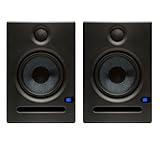
PreSonus Eris E5 Pair 2-Way 5.25” Near Field Studio Monitors
5.25 inch woofer
80 watt Class AB
Front-firing acoustic port
Pros
- Front port
- Acoustic tuning controls
- XLR TRS RCA inputs
- 102 dB maximum SPL
Cons
- Less efficient Class AB design
- 4.6 rating
The PreSonus Eris E5 pairs a 5.25-inch woven-composite woofer with a one-inch ultra-low-mass silk-dome tweeter. Its 80-watt Class AB bi-amplification and stated 102 dB maximum continuous SPL point to a monitor with more headroom than the tiny desktop options.
The front-firing acoustic port is the standout physical feature for a room where the rear of each cabinet must sit nearer a wall. That does not remove boundary effects, but it is a more practical cabinet layout for many desks and shelves.
Balanced XLR and quarter-inch inputs sit alongside unbalanced RCA, giving the E5 a broad compatibility range. The listed RF interference, output-current, thermal, transient, and subsonic protections are meaningful details for a pair that may stay powered through long sessions.
Its 4.6 rating comes from more than 1.3k reviews, with 80 percent reported as five-star. That feedback and the front-port design make it a sensible option for a home studio that needs more physical scale without abandoning close-field placement.
The Eris E5 works well when a rear port would face a wall
The front port makes installation less fussy in a constrained room, but start with some wall clearance anyway. Listen for low-mid buildup on familiar bass lines and use the acoustic controls sparingly.
The Eris E5 supports several source types without adapters
Choose XLR or quarter-inch balanced inputs from an interface, then reserve RCA for consumer gear. Keep source volume reasonably high and use the speaker gain controls for final calibration.
5. The ADAM Audio D3V is a USB-C desktop monitor with a ribbon tweeter
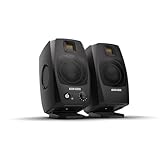
ADAM Audio D3V Active Desktop Monitoring System with USB-C Connection (Pair, Black)
USB-C audio
3.5 inch aluminum woofers
1.5 inch D-ART tweeter
Pros
- USB-C plug and play
- Ribbon-style D-ART tweeter
- Passive radiators
- Angled stands included
Cons
- Small woofer size
- Auto sleep may need adjustment
The D3V is designed around the modern desktop rather than a traditional large-monitor setup. ADAM specifies USB-C plug-and-play connectivity, balanced TRS and RCA inputs, 3.5-inch aluminum woofers, dual side passive radiators, and a 1.5-inch D-ART ribbon tweeter.
The detachable stands angle the speakers 15 degrees, and the cabinets also include a threaded mounting point. Those are useful placement details because desktop reflections are one of the fastest ways to make otherwise capable studio monitor speakers sound less clear.
The dual passive radiators are intended to extend bass from a small enclosure, while the listed DSP-powered room switches help adapt the pair. The stated 45 Hz lower response figure is promising on paper, but room position will still decide how believable low notes feel at the chair.
It has a 4.6 rating from 352 reviews, with 85 percent five-star ratings reported. The configurability of the 20-minute auto-sleep mode is also worth noticing for anyone who dislikes an automatic power function interrupting a session.
The D3V is strongest for a USB-C workstation with limited space
Direct USB-C audio makes the first connection simple when a computer is the main source. Balanced TRS remains available if you later add an interface and want a separate monitor path.
The D3V needs careful desk positioning for reliable imaging
Use the included angled stands or a secure alternative so the D-ART tweeters point to ear height. Leave room beside the passive radiators and avoid trapping the cabinets between a screen and sidewalls.
6. The Mackie CR3.5 is a simple creative-reference option with direct controls

Mackie CR3.5 3.5″ Creative Reference Powered Studio Monitors with Tone Knob and Location Switch — Active Speakers for Music Production, Desktop Computer, Gaming, HiFi Listening
3.5 inch woven woofer
Tone control
Desktop bookshelf switch
Pros
- Location switch
- Headphone output
- TRS RCA and 3.5 mm inputs
- Simple front controls
Cons
- Small bass capability
- May need a subwoofer
The Mackie CR3.5 is less of a conventional precision-monitor proposition and more of a flexible creative-reference pair. It combines a 3.5-inch woven woofer and silk-dome tweeter with a tone knob, a desktop/bookshelf location switch, and a built-in headphone output.
Its input list covers TRS, RCA, and 3.5 mm sources, which is helpful for creators moving between an interface, a computer, and a game console. The location switch explicitly acknowledges that close desktop listening and farther bookshelf listening need different presentation.
For music production, I would begin with the tone control set for the most transparent response and avoid using boosted bass or treble as a mixing reference. The control becomes more useful when checking how a mix reacts to a less-neutral presentation.
The monitor has a 4.6 rating from 300 reviews and is reported to have 81 percent five-star ratings. Its stated 50-watt maximum output is enough for personal listening, but the 3.5-inch woofer means it is not the pick for high-level low-end judgment.
The CR3.5 fits a compact desktop that serves several media jobs
The front headphone output and direct tone knob make it easy to change tasks without software menus. Use desktop mode when the speakers are close, then revisit the tone setting after every major position change.
The CR3.5 needs bass expectations that match its compact size
Use it to check arrangement, mids, vocals, and stereo balance at close range. If sub-bass is central to your work, cross-check on headphones or consider the compatible CR8SBT subwoofer listed by Mackie.
7. The Kali Audio LP-UNF is an ultra-nearfield system with boundary EQ

KALI AUDIO LP-UNF Ultra Nearfield Monitor System – Black
4.5 inch woofer
39 Hz response
Boundary EQ and Bluetooth
Pros
- Boundary EQ
- 3D Imaging Waveguide
- USB TRS RCA and Bluetooth
- 160 watt peak output
Cons
- Touch volume control may not suit everyone
- 4.6 rating
The Kali Audio LP-UNF is aimed squarely at ultra-nearfield listening, where the monitor sits close to the user on a desk. It lists 4.5-inch powered monitors with one-inch tweeters, a 39 Hz frequency response figure, Boundary EQ, and a 3D Imaging Waveguide.
That Boundary EQ is particularly relevant to the untreated-room question that comes up repeatedly in producer forums. It cannot cure reflections or nulls, but it gives you an explicit control for the placement compromises that desktops create.
USB, quarter-inch TRS, RCA, and Bluetooth cover both production and casual sources. A touch-sensitive volume slider may appeal to some users, although a physical knob is easier to locate by feel during a session.
The system is rated 4.6 from 136 reviews, and the product data highlights praise for its imaging and Boundary EQ. Its stated 160-watt peak output should not be read as a reason to monitor loudly; accurate decisions generally begin at consistent moderate levels.
The LP-UNF works best when the speakers sit unusually close
Ultra-nearfield use reduces how much room sound reaches your ears relative to direct sound. Keep the pair symmetrical around the display and aim them precisely, because close placement makes alignment obvious.
The LP-UNF gives practical adjustment for nearby surfaces
Start with Boundary EQ according to the manufacturer’s guidance for your placement. Then use familiar mixes to check whether kick drums and bass notes remain even rather than simply louder.
8. The Yamaha HS8 is a larger monitor for rooms that can support an eight-inch driver

Yamaha HS8 Studio Monitor Powered Studio Monitor Pair – Slate Grey
8 inch driver
120 watt output
Room control and high trim
Pros
- Large driver
- High-performance bi-amp
- Room and high trim controls
- XLR TRS inputs
Cons
- Heavy cabinets
- Needs more room than compact models
The Yamaha HS8 moves the list into large-driver territory with an eight-inch format, a high-performance bi-amp system, and a listed 120-watt maximum output. Its room-control and high-trim adjustments follow the same practical philosophy as the smaller HS4.
More woofer area can make low-frequency monitoring more substantial, but it also asks more of the room. In a tight bedroom, an eight-inch monitor may excite low-end problems that make kick and bass decisions less dependable rather than more professional.
The inputs are XLR and TRS, so this is clearly oriented toward an audio interface or another proper line-level source. It weighs 28.8 pounds according to the listing, which is another reason to plan solid stands and placement before it arrives.
It carries a 4.6 rating from 65 reviews, with 81 percent five-star ratings reported. Choose it when you have the listening distance and room volume to use it sensibly, not simply because its driver is the biggest in this comparison.
The HS8 fits a room with real distance behind the listening position
Give the cabinets breathing room and place them on sturdy stands rather than a shallow desk. A larger room and a longer nearfield triangle make it easier to hear the benefit of the bigger woofer.
The HS8 asks for basic acoustic control before loud playback
Use room-control adjustment if the speakers must sit near a wall, but also treat first-reflection points where possible. Low-frequency buildup should be addressed with position and room work before relying on trim controls.
9. The PreSonus Eris 3.5 is an entry desktop pair with useful front-panel access
PreSonus Eris 3.5 Studio Monitors, Pair — Powered, Active Monitor Speakers for Near Field Music Production, Desktop Computer, Hi-Fi Audio
3.5 inch woofer
50 watt amplification
TRS RCA aux and headphone
Pros
- Acoustic tuning controls
- Many inputs
- Front aux and headphone jack
- 4.5 rating
Cons
- 80 Hz low response
- Small drivers
The PreSonus Eris 3.5 puts a 3.5-inch woven-composite woofer, one-inch silk-dome tweeter, and 50 watts of built-in amplification into a very compact format. It is a reasonable first pair for learning what studio monitoring reveals compared with typical multimedia speakers.
Balanced TRS, RCA, front-panel auxiliary input, and a headphone jack make it genuinely adaptable at a desk. High- and low-frequency acoustic tuning controls add a useful degree of correction for the immediate environment.
The stated frequency response is 80 Hz to 20 kHz, so the lower octave of electronic-music sub-bass is outside its stated range. That is not a failure; it is a cue to cross-check low-end choices with headphones, a second system, or a spectrum analyzer rather than guessing.
This model has a 4.5 rating from more than 1.5k reviews and is identified in the data as a studio-monitor bestseller. The large review base makes it a widely used starting point, while the compact physical format makes expectations important.
The Eris 3.5 is good for learning close-field monitoring habits
Use the pair at ear level and work at a repeatable moderate volume. Learn how reliable commercial tracks sound through it before deciding that a frequency range is missing from your own mix.
The Eris 3.5 makes everyday desktop connections straightforward
Use TRS for a balanced interface connection and the front aux input for a quick portable source. The headphone jack is useful for late sessions, though it does not replace checking a mix on the speakers.
10. The Edifier MR5 offers a three-way active design and extensive connectivity
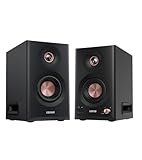
Edifier MR5 2.0 Studio Monitor Bookshelf Speakers, 110W(RMS), Hi-Res Audio, Bluetooth 6.0, 3-Way Active Design, Room Compensation, XLR/TRS/RCA Inputs, Compact Size for Home Studio & Music – Black
3-way active system
46 Hz to 40 kHz
XLR TRS RCA AUX
Pros
- Dedicated mid driver
- Room tuning controls
- 110 watt RMS output
- Hi-Res support
Cons
- Heavy pair
- 4.5 rating
The Edifier MR5 is the only listed three-way active design in this group, using a five-inch long-throw woofer, 3.75-inch mid driver, and one-inch silk-dome tweeter. A dedicated mid driver can be attractive when vocal and instrument detail is central to your work.
Its specifications list a 46 Hz to 40 kHz frequency response, 110 watts RMS, a 101 dB peak SPL, and a Class-D amplifier. XLR, TRS, RCA, AUX, Bluetooth 6.0, and a front headphone output make it one of the broadest connection packages here.
Physical rear room-acoustic tuning knobs and ConneX app support offer two ways to adjust the presentation. I would prefer the physical controls for repeatable monitoring settings and treat Bluetooth with LDAC as a convenience or reference-source feature.
The MR5 has a 4.5 rating from 302 reviews, with 76 percent five-star ratings noted. It is also a heavy system at 10.38 kilograms, so it belongs on a stable surface with room to work rather than precariously perched at a desk edge.
The MR5 suits users who want a dedicated midrange driver
The three-way layout gives this pair a clear structural difference from the two-way designs above. It is worth auditioning with vocal-heavy and dense arrangements, where midrange organization affects mixing choices.
The MR5 supports both production sources and flexible playback
For recording or mixing, connect an interface through XLR or TRS. Keep Bluetooth for noncritical reference listening, and adjust the room controls only after the speaker position is settled.
11. The Edifier QR65 is a desktop-focused active pair with included angled stands

Edifier QR65 Desktop Active Monitor with 2.75″ Long-Throw Aluminum Diaphragm mid-Low Drivers, Hi-Res Audio, Brilliant Light Effects, 70W Output Power Bluetooth Speakers with Stands – White
2.75 inch drivers
70 watt RMS
LDAC Bluetooth and angled stands
Pros
- Included 10 degree stands
- Hi-Res LDAC
- USB-C charging ports
- App control
Cons
- Small drivers for production
- Light effects distract from monitoring
The Edifier QR65 is expressly desktop oriented, using 2.75-inch long-throw aluminum mid-low drivers and 1.25-inch silk-dome tweeters. It includes aluminum stands with a 10-degree angle, an unusually practical inclusion for getting a small speaker pointed closer to ear level.
It also lists 70 watts RMS total output, Bluetooth 5.3 with LDAC support, and 65-watt TurboGaN charging through each USB-C port. Those features position it as a multifunction desktop system as much as a narrowly focused mixing monitor.
The app-controlled customizable light effects are a clear departure from an austere studio setup. Turn them off or ignore them during critical listening if they pull attention away from the task; visual effects do not make frequency response more accurate.
The QR65 is rated 4.4 from 274 reviews, with 75 percent five-star ratings reported. Its small driver size makes it a better candidate for arrangement, editing, and desktop reference listening than for judging deep bass at volume.
The QR65 fits a desktop where speaker angle is hard to achieve
The supplied ten-degree stands are its most studio-relevant feature. Check that the tweeters are directed at your ears rather than your chest, then make small stand-height changes if required.
The QR65 is best treated as a compact reference rather than a bass tool
Use it for close listening and compare low-end work elsewhere. Its USB-C charging and Bluetooth options are useful convenience features, but a wired source remains the better starting point for critical checks.
12. The IK Multimedia iLoud Micro Monitor Pro is a portable reference pair with ARC calibration

IK Multimedia Premium Version iLoud Micro Monitor Pro White (Pair) 50 Watt Portable & Powerful Reference Studio Monitor, Class D High-Efficiency Amplifier, Custom-Made Drivers for Music Mixing
ARC calibration mic
42 Hz extension
95 dB maximum SPL
Pros
- Built-in ARC calibration
- Compact portable format
- Integrated stand
- 42 Hz bass extension
Cons
- Wired only
- Small drivers
- 4.3 rating
The iLoud Micro Monitor Pro is the unusual portable-reference choice in this guide. IK Multimedia lists bass extension to 42 Hz, a 95 dB maximum SPL, a Class-D amplifier, an integrated stand, and built-in ARC calibration with an included microphone.
ARC calibration and ARC X software control are the key reasons to consider it for temporary rooms, travel, or a desktop that changes often. Calibration is not a substitute for a stable setup, but it is a real advantage over compact systems with no measurement-based adjustment.
Its custom-made drivers are described as delivering flat, detailed sound, and the product is designed to be lightweight and backpack friendly. This is a product category where portability and repeatability can matter more than cabinet size for a creator who works in more than one place.
The rating is 4.3 from 63 reviews, with 71 percent reported as five-star, so the buyer-feedback base is smaller than several selections above. It has XLR and RCA connectivity but no Bluetooth, which keeps the focus on wired playback paths.
The iLoud Micro Monitor Pro works for portable calibrated reference listening
Run the included calibration process after the speakers are placed in the working position. Repeat it when the desk, stands, or room changes, because the measurement only describes the setup used at that moment.
The iLoud Micro Monitor Pro still needs sensible low-end cross-checks
The stated 42 Hz extension is impressive for a compact portable pair, but loudness and room behavior still affect what you hear. Check bass choices on headphones and another playback system before committing a master.
How To Choose The Best Studio Monitors?
Start with the room, not a feature list. Three- to five-inch nearfield monitors are often easier to manage on a desk or in a small bedroom because you can listen close enough that direct sound has more influence than reflections.
Five-inch and larger monitors can provide more output and low-frequency reach, but they need more physical distance and a more cooperative room. An eight-inch model can be productive in a larger studio and frustrating in a tiny square room where bass gathers at boundaries.
Choose woofer size by listening distance instead of assumed status
A compact three- or four-inch system is appropriate for an ultra-nearfield desktop. A five-inch system is a common middle ground for a home studio, while larger drivers need room behind, beside, and in front of the speakers to behave predictably.
Do not confuse a lower stated frequency figure with better mix translation. Frequency response figures use different measurement conditions, and a small room can exaggerate or cancel a bass note more dramatically than the specification suggests.
Use balanced connections when your audio interface provides them
Balanced XLR and TRS inputs are the usual interface-to-monitor connection because they are designed for professional line-level signals and can reduce noise over a cable run. Match left and right channels, keep cables tidy, and avoid routing power cables tightly alongside audio cables where possible.
RCA, AUX, USB-C, and Bluetooth have real uses, especially on a desktop. For mixing and mastering, begin with the most direct wired path available, and keep your gain structure consistent so comparisons are about sound rather than volume.
Place monitors in an equilateral triangle and aim them at your ears
Put each monitor the same distance from your head and the same distance from each other, then toe them in so the tweeters point at the listening position. This creates the basic sweet spot and makes pan positions easier to judge.
The 38 percent rule is a starting placement idea: position the listening spot roughly 38 percent of the room length from the front wall, measured from that wall. It is not a rule that overrides furniture or room shape, but it can move you away from some strong lengthwise standing-wave problems.
Treat early reflections before chasing a monitor upgrade
Forum users frequently report that room treatment changes mixing confidence more than a modest monitor swap. Start with absorption at the first reflection points on the sidewalls, control the desk surface where practical, and use bass trapping if the room and budget allow.
An untreated room does not forbid using monitors. It does mean you should work at moderate levels, check your mixes on headphones and other systems, and avoid interpreting every bass bump as a speaker characteristic.
Add a subwoofer only when you can place and calibrate it
A subwoofer can extend a compact monitoring system, but it introduces another source of placement and crossover problems. Add one only when you can set its level, find a workable position, and verify that it is not creating a large hump at the listening position.
For many small rooms, learning a compact pair and cross-checking the lowest octave on headphones is the simpler path. If you do add a sub, measure or listen methodically with familiar reference tracks rather than turning it up until it feels exciting.
Choose active monitors when you want the amplifiers built in
Every product in this roundup is an active monitor system, meaning its amplification is built in. That removes the need to match a separate power amplifier and is especially convenient for desktop and home-studio use.
Passive monitors remain workable in larger or specialized systems, but they require an external amplifier and more attention to matching. For a first monitor setup, active speakers keep the connection path shorter: source, interface, cables, and monitors.
FAQs
What is the best brand for studio monitors?
There is no single best brand for every room. Yamaha is a strong choice for simple wired nearfield monitoring with room controls, KRK stands out here for DSP-driven tuning, and ADAM Audio offers a compact USB-C option with a D-ART tweeter. Choose by room size, listening distance, inputs, and adjustment features rather than brand alone.
What is the 38 rule for studio monitors?
The 38 percent rule suggests placing your listening position about 38 percent of the room length away from the front wall. It is a starting point intended to avoid some strong room-mode positions, not a fixed solution. Form an equilateral triangle with the monitors, then adjust position while listening or measuring.
What are the best desktop studio monitors?
For a compact wired desk, the Yamaha HS4 offers XLR, TRS, RCA, room control, and high trim. The ADAM Audio D3V is a strong desktop-specific choice when USB-C and an angled stand are useful. The Kali Audio LP-UNF is designed for ultra-nearfield use and adds Boundary EQ.
What is a good pair of studio monitors?
A good pair matches the room and lets you make repeatable decisions. Look for active nearfield monitors with a suitable woofer size, the inputs your interface uses, and basic room or EQ controls. Then place them symmetrically, aim tweeters at ear height, and learn their sound with familiar reference tracks.
The best studio monitors are the pair that fit your room and working distance
For a compact, wired monitoring setup, the Yamaha HS4 is our most broadly useful pick. Choose the KRK ROKIT 5 Generation Five when DSP room tuning and a five-inch format suit the room, the ADAM Audio D3V for a USB-C desktop, or the Yamaha HS8 only when your space can support a larger driver.
The best studio monitors in 2026 are not a shortcut around placement or room treatment. Set up the pair carefully, use balanced connections when possible, listen to familiar reference material, and cross-check low-end decisions before you trust any mix completely.