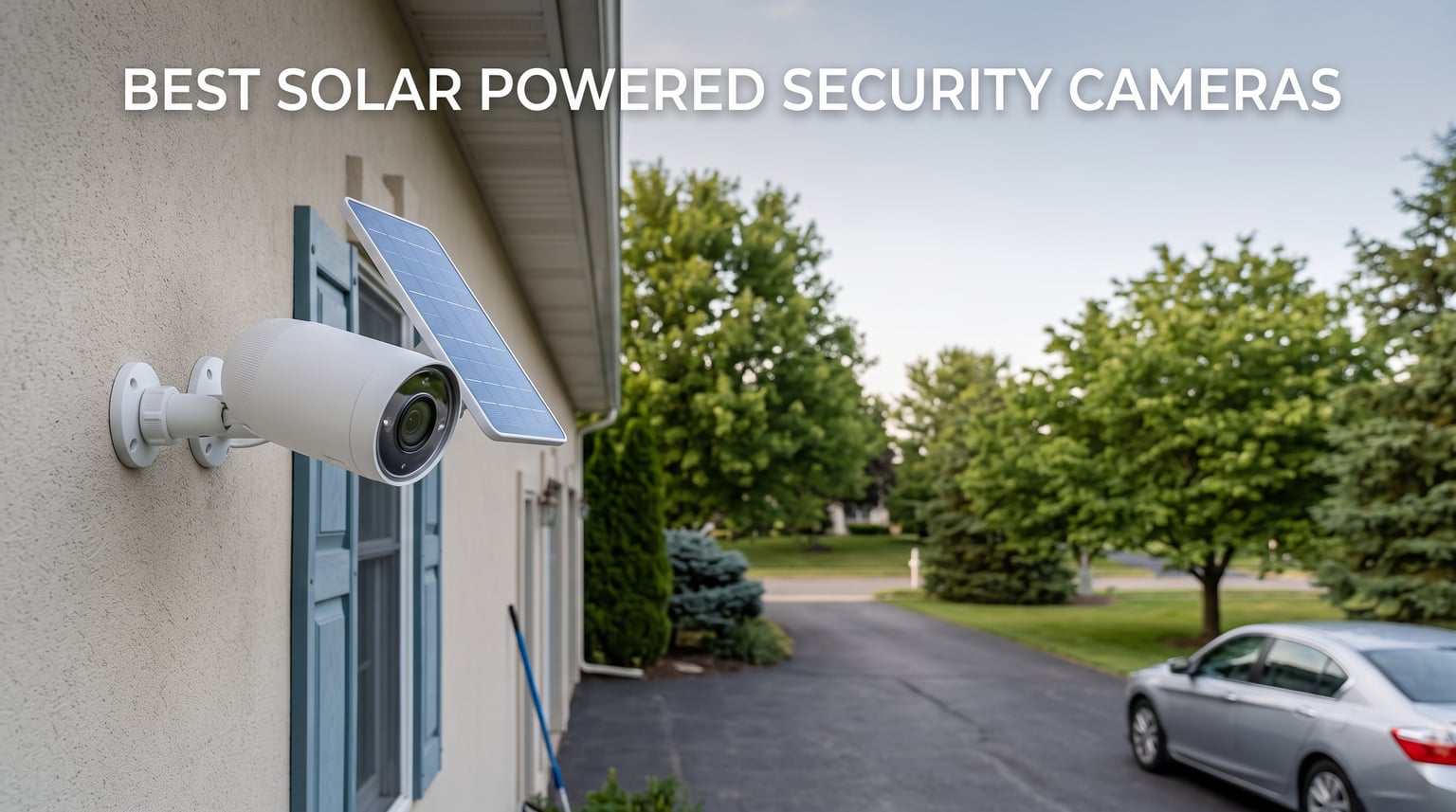
The best solar powered security cameras pair a rechargeable battery with a solar panel, so an outdoor camera can keep working without a power cable. That basic idea is especially useful at a driveway, shed, gate, garage, backyard, cabin, farm, or another spot where running wire is awkward.
Solar power is not magic power. A panel needs usable daylight, a battery has to carry the camera through the night and cloudy periods, and a wireless connection still has to reach the mounting spot. I approached this guide by comparing the confirmed specifications, feature lists, limitations, and review signals for eight current products rather than pretending that every location will get the same result.
A solar powered home security camera works by converting sunlight into electricity and trickle-charging its internal battery. Most solar cameras can operate around the clock with two to four hours of direct sun per day, but that general range is not a promise for every model or season; panel angle, shade, motion activity, live viewing, and local weather all matter.
My short answer is yes: solar cameras really work when their panel gets dependable sun and the camera is installed within dependable Wi-Fi range. They are a practical wire-free security camera choice, not a substitute for planning where the sun, router, and camera will be.
This ranking gives extra weight to useful distinctions that are easy to miss in a shopping card: resolution, pan-and-tilt coverage, Wi-Fi bands, weather rating, night vision, and whether local recording is clearly supported. It also calls out the concern that appears often in community discussions: lower winter light and cold conditions can make battery charging less forgiving.
For readers who want a solar security camera no subscription, look first for an explicit local-storage claim and then check what extra features need a service plan. Local recording can reduce recurring dependence, but a memory card or included base still has finite space, and advanced recognition may remain separate on some models.
Table of Contents
Top 3 Picks for Best Solar Powered Security Cameras (September 2026)
The REOLINK Argus PT Ultra leads this list for high-resolution detail and confirmed support for both 2.4 GHz and 5 GHz Wi-Fi 6. The eufy SoloCam S340 is the stronger choice when its dual-camera design, 8x hybrid zoom, built-in 8GB storage, and broad pan-and-tilt coverage fit the scene.
The Tapo SolarCam C402 KIT is the straightforward pick for a compact 1080p setup with person detection, Alexa and Google Assistant support, and confirmed microSD storage up to 512GB. Each is still Wi-Fi based, so none should be treated as a cellular solar powered security camera no WiFi solution.


Best Solar Powered Security Cameras In 2026
The quick overview below puts all eight products in one place. Use it to narrow the field, then read the individual notes because a headline resolution figure does not tell you whether a camera supports 5 GHz Wi-Fi, has pan coverage, or stores clips locally.
| Product | Specifications | Action |
|---|---|---|
| REOLINK Argus PT Ultra |
|
Check Latest Price |
 eufy SoloCam S340 eufy SoloCam S340 |
|
Check Latest Price |
| Tapo SolarCam C402 KIT |
|
Check Latest Price |
 eufy SoloCam E30 eufy SoloCam E30 |
|
Check Latest Price |
 aosu 4 Cam-Kit aosu 4 Cam-Kit |
|
Check Latest Price |
 SEHMUA 2 Pack SEHMUA 2 Pack |
|
Check Latest Price |
 LITYMOL 2K 360 View LITYMOL 2K 360 View |
|
Check Latest Price |
 AlkiVision 521 AlkiVision 521 |
|
Check Latest Price |
1. REOLINK Argus PT Ultra Is the Best Pick for 4K Detail and Flexible Wi-Fi
REOLINK First 4K Solar Security Cameras Wireless Outdoor, Argus PT Ultra+Solar Panel, 360° Pan Tilt Auto-Tracking, 8MP Color Night Vision, 2.4/5 GHz Wi-Fi 6, No Subscriptions, Home Hub Compatible
4K 8MP
355 degree pan and 140 degree tilt
2.4 and 5 GHz Wi-Fi 6
Pros
- 4K 8MP video
- 2.4 and 5 GHz Wi-Fi 6
- 355 degree pan and 140 degree tilt
- local storage up to 512GB
- no subscription claim
Cons
- 15 fps frame rate
- IP64 rating
I rank the REOLINK Argus PT Ultra first because its confirmed feature set solves two frequent outdoor-camera problems at once: capturing finer detail and connecting to a less crowded Wi-Fi option. It records at 4K/8MP, uses H.265 encoding, and supports both 2.4 GHz and 5 GHz Wi-Fi 6 rather than restricting an installation to the older band.
Its motorized coverage is also substantial. REOLINK lists 355 degrees of pan and 140 degrees of tilt, along with auto-tracking and person, vehicle, and pet detection; that combination makes more sense for a broad driveway or yard than a fixed camera pointed at one small doorway.
For night monitoring, the Argus PT Ultra has a built-in motion spotlight and color night vision listed to 33 feet. The camera’s 10x digital zoom can help inspect an area on screen, although digital zoom is not the same as adding new optical detail after capture.
The storage story is unusually clear for this group. It supports local microSD storage up to 512GB, works with the REOLINK Home Hub, and is marketed with no subscriptions required, which is why it is my leading solar panel security camera for buyers who prioritize local control.
Dual-Band Wi-Fi Is the Deciding Connection Advantage
The confirmed 2.4/5 GHz Wi-Fi 6 support gives this camera a useful installation advantage over the many 2.4 GHz-only models in this guide. A 5 GHz network can be convenient close to the router, while 2.4 GHz commonly reaches farther through obstacles; I would check signal strength at the intended mounting point before drilling either way.
This is still a Wi-Fi camera, not a cellular unit. A remote gate or off-grid building without a usable network needs a separate connectivity plan, because the solar panel solves charging but does not create an internet connection.
4K Is Most Helpful When Fine Identification Matters
The 8MP sensor is the reason to choose this model when you need more image detail from a wide outdoor view. It is a sensible match for reviewing activity across a larger approach, especially when the camera must pan between several points of interest.
There are two limits to keep in mind. The listed frame rate is 15 fps, and the weather rating is IP64, so compare those details against the rainfall, dust exposure, and motion you expect before treating high resolution as the only specification that matters.
2. eufy SoloCam S340 Is the Best Pick for Dual-Camera Coverage Without a Monthly Fee
eufy Security SoloCam S340, 3K Dual-Lens Solar Security Camera
3K dual camera
8x hybrid zoom
360 degree pan and tilt
Pros
- 3K dual-camera view
- 8x hybrid zoom
- 360 degree pan and tilt
- built-in 8GB storage
- no monthly fee
Cons
- 6 meter night vision range
- battery-dependent operation
The eufy SoloCam S340 stands out because it combines a 3K dual-camera layout with pan-and-tilt movement in one solar-powered outdoor unit. I would consider it for a front approach, side yard, or driveway where a normal wide shot is helpful but closer inspection can also matter.
The product data lists enhanced dual-camera clarity up to 40 feet or 12 meters and 8x hybrid zoom. That pairing gives the S340 a distinct role in this roundup: it is designed to retain a broad view while giving you another way to look closer at activity.
It has a 10,000mAh battery, solar charging, 360-degree pan and tilt, and built-in 8GB local storage. eufy states no monthly fee, so the included storage is a meaningful starting point for someone who does not want cloud recording to be the only route for saved clips.
Its user rating is 4.2 from 6k+ reviews in the supplied product data, which makes it one of the more established listings here. I would not stretch that signal into a promise about every installation, but the volume does give the review average more context than a small sample does.
Dual Cameras Are the Reason to Pick the S340
The dual-camera arrangement and 8x hybrid zoom are the decision-makers here, not simply the 3K label. A single view can make it hard to balance scene coverage and closer subject detail, so a product designed around both tasks may be easier to place at an active entry or a long approach.
Its 135-degree listed field of view works alongside the 360-degree pan-and-tilt function. As with any moving camera, choose a mounting height that gives the unit room to rotate without foliage, trim, or a roof edge interrupting the view.
Built-In Storage Is Useful but Has a Clear Capacity Limit
The camera includes 8GB of local storage and carries a no-monthly-fee claim. That can meet a simple recording need, but it is not unlimited retention, particularly in a busy location with repeated motion events.
The listed night-vision range is six meters, so place it according to that stated range rather than assuming it will light an entire long driveway. A closer mounting position, a clearer line of sight, and realistic alert zones will matter more than the camera’s ability to pan.
3. Tapo SolarCam C402 KIT Is the Best Straightforward Local-Storage Camera for a Smaller View
Tapo SolarCam 1080p Security Camera Wireless Outdoor- Battery Power with Solar, Person Detection, Subscription-Free Local Storage or Optional Cloud, Works with Alexa & Google Assistant, C402 KIT
1080p full color
Person detection
microSD up to 512GB
Pros
- person detection
- local microSD up to 512GB
- Alexa and Google Assistant
- 30 foot color night vision
- IP65 rating
Cons
- 1080p resolution
- cloud features may need a subscription
The Tapo SolarCam C402 KIT is the simpler recommendation for an outdoor area that does not need pan-and-tilt movement or 4K capture. Its confirmed basics are well matched: 1080p video, a 125-degree viewing angle, person and motion detection, color night vision to 30 feet, two-way audio, and an IP65 housing.
Where this Tapo solar camera gets more interesting is storage. The product details confirm microSD support up to 512GB for subscription-free local storage, while cloud storage remains optional; that makes the choice between local retention and cloud features more flexible than on cameras limited to a small built-in capacity.
It also works with Alexa and Google Assistant and offers two-factor authentication plus encrypted video as listed privacy features. For a camera near a garage door or a regular walking path, those are more relevant day-to-day qualities than a large pan range.
The listing reports a 4.2 rating from 4k+ reviews. The supplied information also says that some cloud features may require a subscription, so I would read the app’s feature descriptions carefully if a particular cloud alert or history function is essential.
Local microSD Recording Is the Main Reason to Choose Tapo
This is my strongest compact solar security camera no subscription option when a large local microSD capacity matters and 1080p is sufficient. The confirmed 512GB maximum is substantial for a product in this group, but you must supply a compatible card and plan retention around the activity level.
Local video is useful only if the camera is placed and maintained thoughtfully. A sheltered but sun-exposed location, a secure mounting point, and periodic checks that recording is active are sensible habits for any microSD-based setup.
A Fixed 125-Degree View Is Best for a Defined Zone
The C402 KIT has a fixed 125-degree field of view, so I would aim it at one well-defined zone rather than expect it to patrol a broad perimeter. A doorway, gate, patio, or parking space is a more natural assignment than a sprawling yard with activity in several directions.
The camera uses Wi-Fi and the provided data does not list 5 GHz support. Confirm that the 2.4 GHz signal is reliable at the installation site, then use person detection to focus alerts on the events most likely to matter.
4. eufy SoloCam E30 Is the Best 2K Pan Camera for Local microSD Recording
eufy Security SoloCam E30, 2K Solar Security Camera, 360° AI Tracking
2K with f/1.6 aperture
360 degree pan
microSD up to 128GB
Pros
- 2K clarity
- 360 degree pan
- AI tracking
- local microSD up to 128GB
- no monthly fee
Cons
- 2.4 GHz Wi-Fi only
- microSD card not included
- HomeBase needed for advanced functions
The eufy SoloCam E30 is a sensible middle ground for someone who wants 2K clarity, a moving 360-degree view, and a no-monthly-fee design without moving up to the dual-camera S340. Its f/1.6 aperture is a notable listed detail for day-and-night image quality, and the camera includes AI motion detection for people, vehicles, and events.
SolarPlus technology and a removable solar panel are part of the supplied feature set. The removable panel can make placement easier because the camera and panel do not have to share exactly the same angle, although both still need a route that keeps the panel in usable sun.
The E30 supports local microSD recording up to 128GB, and it can work with eufy’s HomeBase S380 or S280 for expanded storage. The data says a microSD card is not included, which is a practical detail to plan for before installation.
I also like its 4.3 rating from 1k+ reviews as a contextual signal. The reported concerns are worth retaining: buyers have raised questions around AI detection accuracy and solar-panel positioning, two things that can vary quite a bit with driveway traffic and the chosen wall.
Removable Solar Hardware Is the Practical Placement Benefit
A removable panel is helpful when the best camera angle faces a different direction from the best sun. This can make the E30 easier to fit beneath an eave or on a wall where the view needs to look sideways across a path rather than outward toward open sky.
Do not mistake flexibility for a guarantee. Before permanent mounting, I would temporarily check the live view, the Wi-Fi connection, and where the panel will be shaded at different times of day.
HomeBase Expands Storage but Is Not Required for Basic Local Recording
The E30 can record locally to a microSD card up to 128GB, so its core no-monthly-fee position does not depend on a HomeBase. The separate hub becomes relevant for advanced AI features and much larger storage, based on the available product information.
It supports 2.4 GHz Wi-Fi only. That band often helps with reach outdoors, but a location at the far edge of a property still deserves a signal test before you rely on alerts from any wireless solar security camera.
5. aosu 4 Cam-Kit Is the Best Complete Multi-Area Solar Security System
aosu D1 Classic 4-Cam Kit, Security Cameras Wireless Outdoor, Solar Powered
Four 2K cameras
32GB aosuBase
360 degree tracking
Pros
- four-camera kit
- 32GB local base
- 360 degree pan and tilt
- cross-camera tracking
- Alexa Google and SmartThings
Cons
- 32GB can fill with four cameras
- base required for full functionality
- app reliability concerns
The aosu 4 Cam-Kit is the right kind of product to consider when one camera cannot cover the job. Instead of asking a single pan camera to watch every side of a property, this kit provides four 2K cameras, a 32GB aosuBase, and simultaneous live viewing for four areas.
Each camera has 360-degree pan and tilt, auto motion tracking, color night vision with four LED lights, and a stated night-vision range of 33 feet. The system also offers cross-camera tracking, which is a meaningful differentiator for an entrance, yard, side passage, and rear area that all need their own view.
aosu says three hours of daily sunlight can keep the cameras operating and that the kit needs no subscription. The supplied specifications list IP65 weather resistance and compatibility with Alexa, Google Assistant, and SmartThings, giving the system several routes into an established smart-home setup.
The available rating is 4.3 from 3k+ reviews. Review signals praise the no-subscription arrangement, video quality, and app features, while some users report app reliability and customer-support concerns; I would weigh that feedback carefully if you want a system with several cameras managed from one app.
Four Separate Views Are Better Than One Moving View for a Perimeter
A four-camera kit is a direct answer for a property with multiple independent areas. A camera that turns to follow motion can be facing away from another event, while fixed coverage across four placements can retain context at each zone.
Plan the mounting positions before setup. The best result comes from assigning each camera a clear job, such as the front approach, drive, side gate, or rear door, instead of mounting several units toward the same open space.
The aosuBase Makes Local Recording Central to the System
The included aosuBase has 32GB storage and is claimed to offer up to four months of loop recording. Four cameras naturally create more footage than one, so retention will depend on motion volume, recording settings, and how often the system overwrites earlier clips.
The base is also part of the full system design, not an incidental accessory. Keep it within a stable network environment and confirm that every camera has both a sun path and a dependable wireless path back to the home network.
6. SEHMUA 2 Pack Is the Best Option for Two Pan-and-Tilt Views
SEHMUA 2K Solar Security Cameras Wireless Outdoor, 2 Pack 360° View Pan/Tilt WiFi Security Camera Outside with Color Night Vision,Easy to Install, PIR Alarm, 2-Way Audio
Two 2K cameras
355 degree view
98 foot night vision
Pros
- two-camera package
- 2K video
- 355 degree pan and tilt
- 98 foot listed night vision
- PIR sensor
Cons
- 2.4 GHz Wi-Fi only
- cloud storage after trial
- night vision concerns at long range
The SEHMUA 2 Pack offers a practical two-location setup with 2K video, a 355-degree viewing angle, pan-and-tilt controls, solar charging, and IP65 weather resistance. I would consider it for a home that needs a front and rear view but does not need the breadth of a four-camera system.
The supplied details list a 6,000mAh battery, a removable solar panel, a 98-foot color-night-vision range, 4x digital zoom, PIR sensing, and two-way audio. The stated five-minute setup refers to the easy-install approach, but the real time needed should include planning the panel’s sunlight and verifying app connectivity at both locations.
It supports microSD cards up to 128GB and optional cloud storage. The rating is 4.4 from 3k+ reviews, with comments that generally favor easy installation and reliable performance while noting that night vision at longer distances can disappoint some users.
That feedback is useful because a maximum quoted night-vision distance is not a guaranteed identification distance. A clean line of sight and nearby useful lighting can matter more than a large number on a listing.
Two Cameras Cover Opposite Sides of a Home More Reliably
The key reason to choose this package is the ability to cover two separate spots from the start. A front-door view and a back-garden view, or a driveway and a side gate, can each have their own camera instead of asking one unit to rotate between them.
Each camera can pan and tilt, but placement still sets the baseline. Put the mounting point high enough to resist casual tampering while keeping faces and approach paths within a useful angle rather than pointing straight down from a roofline.
PIR Sensitivity Needs Adjustment Around Active Areas
The PIR sensor is intended to reduce false alarms, and the supplied feature list calls out motion detection and two-way audio. In a busy area, the distinction between a useful event and repeated traffic matters just as much as the camera’s resolution.
SEHMUA supports 2.4 GHz Wi-Fi only, so do the connection check at both selected sites. Its cloud storage needs a subscription after a 30-day trial, making local microSD recording the clearer path for owners who prefer to avoid that ongoing option.
7. LITYMOL 2K 360 View Is the Best Pick for Adjustable PIR Controls
LITYMOL 2K 360° View Security Cameras Wireless Outdoor, Solar Cameras for Home Security, Color/IR Illumination Night Vision, AI Detection, 2-Way Audio, Siren Alarm, SD/Cloud Storage, 2.4g WiFi
2K video
355 degree pan and 120 degree tilt
10-level PIR
Pros
- 355 degree pan and 120 degree tilt
- 10-level PIR adjustment
- 256GB microSD support
- 3.2W solar panel
- IP65 rating
Cons
- 2.4 GHz Wi-Fi only
- AI identification needs a paid feature
- false alarms reported
The LITYMOL 2K 360 View is one of the more compelling options when alert tuning is the priority. Along with 2K video, 355 degrees of pan, 120 degrees of tilt, a 3.2W solar panel, and a 5,200mAh battery, it provides a 10-level adjustable PIR sensor.
That adjustment is important around a street-facing driveway, sidewalk, or backyard with regular non-security activity. A camera that sends too many irrelevant alerts often gets ignored, so the ability to tune sensitivity deserves more attention than a generic motion-detection label.
The camera lists color night vision to 33 feet with a spotlight, two-way audio, a siren, and microSD support up to 256GB. It is rated IP65 and has a stated operating range of minus 20 degrees Celsius to 50 degrees Celsius, but a temperature range should not be read as a promise that solar charging will be identical across winter conditions.
Its supplied rating is 4.6 from roughly 1.5k reviews. The review signal favors its motion detection, video clarity, and solar charging, yet it also mentions that false alarms can be higher than expected; the adjustable PIR setting is therefore a feature worth taking time to configure.
Ten PIR Levels Give This Camera a Useful Tuning Edge
Ten sensitivity levels give the LITYMOL a direct advantage when the scene changes throughout the day. Start conservatively in a busy location, watch the alerts for several days, then adjust one step at a time rather than making several changes that obscure what improved the result.
AI identification for people, vehicles, pets, and packages requires a paid feature according to the product data. The base PIR alert can still be useful, but buyers who need categorised notifications should confirm the app features that apply to their setup.
Its Cold-Weather Rating Does Not Remove Winter Planning
The minus 20 degrees Celsius to 50 degrees Celsius operating range is helpful context for an outdoor product. Still, cold-weather users in community discussions repeatedly report reduced charging performance, so give the solar panel a clear southern or otherwise high-sun exposure appropriate to your location and clear away seasonal shade where possible.
A battery can also lose usable performance in cold conditions, and short days leave less charging time. I would keep a charged backup plan for prolonged cloudy periods rather than assume a panel will recover from every stretch of winter weather.
8. AlkiVision 521 Is the Best Pick for IP67 Weather Protection and a Full 360-Degree View
AlkiVision Solar Security Cameras Wireless Outdoor – 2K Night Color Vision Cameras for Home Security, AI Motion Detection, 360° View, Spotlight, 2-Way Audio, Siren, IP67 Waterproof, SD/Cloud Storage
2K color night vision
360 degree view
IP67 waterproof
Pros
- 2K color night vision
- 360 degree view
- IP67 waterproof rating
- spotlight siren and two-way audio
- SD storage up to 128GB
Cons
- AI recognition needs a subscription
- 2.4 GHz Wi-Fi only
- low light may reduce solar charging
The AlkiVision 521 closes the list with a combination that will appeal to exposed outdoor locations: an IP67 waterproof rating, 2K or 1920p resolution, color night vision, a 360-degree panoramic view, and a 5,000mAh battery. It also lists a spotlight, siren, and two-way audio for a more active response when motion is detected.
AlkiVision says two hours of direct sunlight daily can support its solar setup and claims up to six months of use per charge from the 5,000mAh battery. Those figures describe listed conditions, so I would treat them as a starting point and not extrapolate them to a heavily triggered camera under trees or a low-sun winter location.
For recordings, it supports an SD card up to 128GB and includes 72 hours of free cycle cloud storage. Its supplied rating is 4.9 from 63 reviews, an excellent average with a smaller sample than the higher-volume listings above.
The feature list includes AI motion detection for people, vehicles, pets, and packages. AI recognition requires a subscription, so that part of the experience belongs in the decision before selecting this camera rather than being an unexpected app limitation afterward.
IP67 Is the Most Important Reason to Choose AlkiVision
The IP67 waterproof rating is the clearest differentiator here. If the camera will sit at a wall with direct rain and wind exposure, that rating gives it a stronger stated protection level than the IP65 and IP64 ratings listed for many other products in this guide.
Weather protection does not solve poor placement. Keep the camera’s view clear, avoid aiming it directly into a strong light source, and mount the panel where it gets direct light without turning the camera away from the area you want to watch.
The Smaller Review Sample Needs Context Alongside the High Rating
A 4.9 rating is impressive, but it comes from 63 supplied reviews rather than several thousand. I regard it as a promising signal, not enough on its own to outweigh a model whose confirmed storage, Wi-Fi, coverage, or local-service requirements better match the installation.
This camera uses 2.4 GHz Wi-Fi. Test that connection at the selected exterior wall and confirm that the 128GB SD-card limit and 72-hour free cloud cycle meet your intended retention needs.
How To Choose The Best Solar Powered Security Cameras?
The best buying decision starts with the location, not the camera. A solar powered outdoor camera needs a position that sees the intended approach, receives real daylight, and stays inside a stable wireless network; if one of those three conditions is missing, even a strong product specification will not make the setup dependable.
Direct Sunlight Is the First Requirement for Reliable Solar Charging
Solar panels trickle-charge a camera battery rather than producing an unlimited stream of power. The general guidance in the supplied research is two to four hours of direct sunlight daily, while specific listings range from two hours for AlkiVision to three hours for the aosu kit; use those as planning markers, then give your actual panel more exposure where you can.
Look at shade at midday as well as early morning. Trees leaf out, gutters create narrow shadows, and a panel mounted under a deep eave may receive much less light than the wall itself seems to get.
Angle matters because the panel, not merely the camera, needs the sun. A removable panel such as the one listed for the eufy E30 can help separate the best camera view from the best charging position, while integrated designs need a compromise that serves both.
Cold Weather Requires More Charging Margin Than Mild Weather
Cold-climate reports consistently flag two problems: shorter daylight and less forgiving battery charging. A camera can remain within an advertised operating range and still collect less energy when the days are short, the panel is snow-covered, or clouds persist.
Build margin into the choice. Reduce unnecessary motion events, keep the panel clear, check the battery level through the app, and install where direct winter sun is realistic rather than relying on a bright but indirect location.
More active use can also affect battery demand. Frequent live viewing, repeated alerts, spotlight activation, sirens, and high traffic all draw power, so a quiet shed and a busy front walk should not be expected to have the same recharge pattern.
Wi-Fi Reach Is the Second Requirement, Not an Afterthought
Every product in this list uses Wi-Fi. A solar camera is wire-free for power, but it is not automatically connection-free; a distant barn, gate, or rural boundary needs reliable Wi-Fi coverage, a network extension, or a different camera category that explicitly supports the connection type you need.
Most of these products list 2.4 GHz Wi-Fi only, including the LITYMOL, SEHMUA, eufy E30, AlkiVision, and the available Tapo data. REOLINK is the exception here with confirmed 2.4/5 GHz Wi-Fi 6 support, which is a real differentiator when your router and site support both bands.
Test with a phone at the camera height, not just beside the house. Masonry, metal siding, dense vegetation, and the ground itself can reduce a signal enough to turn a seemingly simple installation into delayed video or unreliable alerts.
Coverage Determines Whether Fixed, Pan, or Multi-Camera Hardware Fits
A fixed camera is usually best for a narrow and predictable approach, such as a door, gate, or small patio. The Tapo C402’s 125-degree view is a good example of a product that is easier to assign to one defined zone than an entire property.
Pan-and-tilt cameras are better for a wider area where activity can happen in more than one direction. REOLINK, eufy, LITYMOL, SEHMUA, and aosu all list broad motorized coverage, but a turning camera still cannot look in two directions at once.
For several critical directions, separate cameras are the clearer answer. The SEHMUA two-pack and aosu four-camera kit let you cover discrete zones at the same time, which can preserve context when multiple people or vehicles move through a property.
Resolution Helps, but It Does Not Replace Sensible Placement
Resolution ranges from 1080p on the Tapo C402 through 2K on several entries, 3K on the eufy S340, and 4K/8MP on the REOLINK. More pixels can help with detail, but it cannot correct a camera aimed too high, a subject too far away, or a view blocked by branches.
Place the camera to capture the route people actually use. The S340’s dual-camera design and hybrid zoom, or REOLINK’s 4K detail and digital zoom, are strongest when the initial view already contains a useful subject at an appropriate distance.
Night vision deserves a separate check. The confirmed range is 30 feet for Tapo, 33 feet for LITYMOL, aosu, and REOLINK, six meters for the S340, and up to 98 feet for SEHMUA; actual clarity will also reflect weather, lighting, angle, and scene contrast.
Local Storage Is the Best Starting Point for Subscription-Averse Buyers
Choose a solar security camera no subscription by checking the recording method first. The REOLINK has local microSD support up to 512GB and a no-subscription claim, Tapo supports local microSD up to 512GB, eufy E30 supports up to 128GB, eufy S340 has built-in 8GB, and aosu uses a 32GB base.
Storage size is not an abstract number. More motion events, longer clips, and more cameras can shorten retention, so choose a capacity that matches your traffic level and check periodically that the camera is actually saving the clips you expect.
Optional cloud storage can still be useful for off-device access, but features vary. The supplied data says AI recognition needs a subscription on AlkiVision and LITYMOL, SEHMUA cloud storage needs one after its trial, and certain Tapo cloud features may need one; review the feature boundary before depending on a particular alert type.
Solar Cameras Are Better for Flexible Placement, While Hardwired Cameras Are Better for Constant Power
Solar cameras are better when avoiding a power run is the deciding issue. They work well for a detached structure, a remote corner of a yard, a gate, or a renter-friendly outdoor placement where routing electrical wire is impractical.
Hardwired cameras are better when a power route already exists and continuous power matters more than flexible placement. They avoid the solar charging variable, which can be useful in a shaded area, a very busy recording location, or a region with long dark winters.
Neither choice automatically solves network planning or recording retention. The right answer is the system that gives the specific location adequate power, signal, view, storage, and weather protection without asking one feature to compensate for every other limitation.
FAQs
Do solar powered security cameras really work?
Yes. Solar-powered security cameras can work reliably when their panel receives regular direct sunlight, the battery has enough reserve for overnight and cloudy periods, and Wi-Fi reaches the camera. They trickle-charge an internal battery, so shade, winter daylight, frequent motion alerts, live viewing, and cold conditions can reduce the charging margin.
What is the number one outdoor security camera?
For this eight-product comparison, the REOLINK Argus PT Ultra is the top outdoor pick because it combines confirmed 4K/8MP video, 355-degree pan and 140-degree tilt, person/vehicle/pet detection, 2.4 and 5 GHz Wi-Fi 6, local microSD support up to 512GB, and a no-subscription claim. The best model for a specific property can differ if dual cameras, a multi-camera kit, or a fixed view is more important.
What is the best solar security system without subscription?
The aosu 4 Cam-Kit is the strongest system-style option here for buyers seeking no-subscription recording because it includes four solar cameras and a 32GB aosuBase. For a single camera, the REOLINK Argus PT Ultra, eufy SoloCam S340, eufy SoloCam E30, and Tapo SolarCam C402 offer confirmed local-storage paths; compare their capacities and any feature-specific service requirements before choosing.
Which is better solar or hardwired security cameras?
Solar cameras are better for locations where running power cable is difficult, such as gates, sheds, driveways, and remote corners of a property. Hardwired cameras are better where existing power is available and constant power is more important than flexible placement. Solar cameras still need direct sun and Wi-Fi, while hardwired models still need a useful network and recording plan.
The Best Final Choice Is the Camera That Fits Your Actual Mounting Spot
The best solar powered security cameras in 2026 are not interchangeable. I would choose the REOLINK Argus PT Ultra for 4K detail and dual-band Wi-Fi, the eufy SoloCam S340 for dual-camera coverage with built-in local storage, and Tapo C402 for a focused fixed view with person detection and large supported microSD capacity.
Choose aosu or SEHMUA when multiple areas need simultaneous coverage, LITYMOL when PIR adjustment is a central concern, AlkiVision when its IP67 rating fits an exposed site, and the eufy E30 when a removable panel and 2K pan coverage make placement simpler. Before selecting any wireless solar security camera, verify direct sun, Wi-Fi strength, local-storage needs, and the actual path you want the lens to watch.