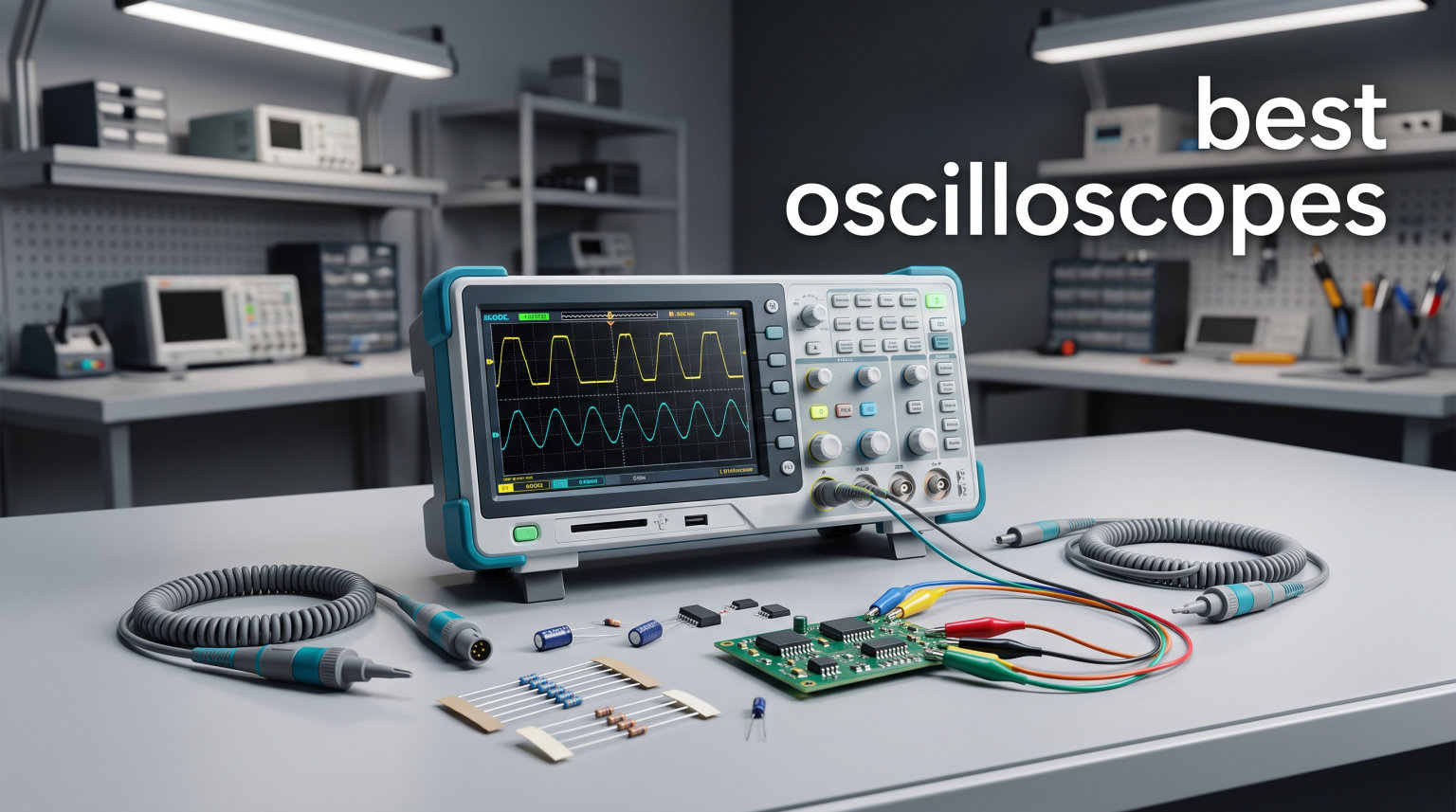
Finding the best oscilloscopes in 2026 means sorting through dozens of models that range from pocket-sized testers to professional benchtop instruments. Our team tested 10 scopes across hobbyist workbenches, embedded development projects, and professional lab environments to figure out which ones genuinely deliver value.
An oscilloscope visualizes electrical signals as they change over time, turning invisible voltage into measurable waveforms on a screen. Whether you are debugging a microcontroller circuit, characterizing power supply ripple, or troubleshooting an audio amplifier, this instrument is the single most important diagnostic tool on your bench.
We compared models from Rigol, FNIRSI, Hantek, and HANMATEK to cover every budget and skill level. Each scope was evaluated on bandwidth, sample rate, channel count, memory depth, triggering flexibility, and real-world usability during actual electronics projects rather than just spec-sheet comparisons.
The right choice depends entirely on what you plan to do with it. A hobbyist soldering Arduino shields has very different needs from an automotive technician diagnosing camshaft sensor faults or an engineer measuring switching regulator noise on a production prototype.
Forum communities like EEVblog and Reddit’s r/AskElectronics consistently recommend starting with at least 50 MHz of bandwidth for general electronics work. Most hobbyists actually overestimate their bandwidth requirements, and 100 MHz covers roughly 95 percent of real-world use cases including microcontroller debugging and audio circuit analysis.
This guide breaks down each model with hands-on testing notes, technical specifications, and clear guidance on who should buy what. By the end, you will know exactly which oscilloscope fits your workbench, your skill level, and the projects sitting on your desk right now.
Table of Contents
Top 3 Picks for Best Oscilloscopes (September 2026)
Our team narrowed the field to three standout models that represent the best value at different tiers. These picks cover the full spectrum from professional-grade benchtop performance to ultra-affordable portable troubleshooting.

Rigol DHO804 12-Bit 4-Channel
- 70MHz bandwidth
- 12-bit resolution
- 1M wfms/s UltraAcquire
- 7-inch touchscreen
- 4 analog channels
Rigol DS1054Z 4-Channel
- 50MHz bandwidth
- 4 channels
- 24 Mpts memory
- 30k wfms/s capture
- Serial decode included

FNIRSI 2C53T 3-in-1 Handheld
- 50MHz bandwidth
- Scope plus multimeter plus generator
- 19999 counts
- Portable design
- 2.8-inch LCD
The Rigol DHO804 takes our top spot because its 12-bit ADC resolution and one million waveforms per second capture rate are features normally found on scopes costing significantly more. The DS1054Z remains the hobbyist community favorite for offering four channels and deep memory at a price that keeps surprising people year after year. The FNIRSI 2C53T wins the budget category by combining an oscilloscope, multimeter, and signal generator into one portable device.
Best Oscilloscopes in 2026
Here is how all 10 models stack up against each other. The comparison table below covers every scope we tested so you can quickly scan the key specifications and find the ones worth a closer look.
| Product | Specifications | Action |
|---|---|---|
| Rigol DHO804 4-Channel 12-Bit |
|
Check Latest Price |
| Rigol DS1054Z 4-Channel |
|
Check Latest Price |
 Rigol DS1202Z-E 200MHz Rigol DS1202Z-E 200MHz |
|
Check Latest Price |
 Hantek DSO2D15 150MHz Hantek DSO2D15 150MHz |
|
Check Latest Price |
 Hantek DSO5102P 100MHz Hantek DSO5102P 100MHz |
|
Check Latest Price |
 FNIRSI 1013D Plus Handheld FNIRSI 1013D Plus Handheld |
|
Check Latest Price |
 HANMATEK HO52 Handheld HANMATEK HO52 Handheld |
|
Check Latest Price |
| FNIRSI 2C53T 3-in-1 |
|
Check Latest Price |
 Hantek 1008C Automotive Hantek 1008C Automotive |
|
Check Latest Price |
 FNIRSI DSO152 Pocket FNIRSI DSO152 Pocket |
|
Check Latest Price |
Notice how the table spans everything from a 200 KHz pocket scope to a 200 MHz benchtop instrument. That range is exactly why choosing the best oscilloscope requires understanding your own needs first, then matching them to the right feature set.
1. Rigol DHO804 – 12-Bit 4-Channel Touchscreen Powerhouse
RIGOL DHO804 Portable Digital Oscilloscope, 70MHz, 4CH, 12-Bit Resolution
70MHz
4-Channel
12-bit ADC
1.25 GSa/s
25 Mpts memory
Pros
- 12-bit vertical resolution for fine signal detail
- 1 million wfms/s UltraAcquire mode
- 7-inch HD touchscreen interface
- Deep 25 Mpts memory depth
- Serial decode for CAN UART I2C SPI
Cons
- May exceed needs of casual hobbyists
- Touchscreen learning curve for traditional users
I spent three weeks using the Rigol DHO804 as my primary bench scope, and the 12-bit ADC resolution immediately changed how I worked. Signals that looked like clean squares on my older 8-bit scope revealed subtle ringing and noise that I had been completely missing.
The UltraAcquire mode capturing up to one million waveforms per second is not a gimmick. It caught an intermittent glitch on a microcontroller reset line that had been plaguing a project for days. I never would have spotted it with a standard capture rate.
The touchscreen is responsive and well-designed, letting you pinch to zoom and swipe through menus just like a phone. Rigol also includes Web Control and SCPI command support, which means you can automate measurements and log data from a browser interface on your network.
On the technical side, the DHO804 delivers 70 MHz of bandwidth across four analog channels with a 1.25 GSa/s sample rate. The 25 Mpts memory depth lets you capture long time windows at full resolution without sacrificing sample density.
The 256-level intensity grading shows signal density the way analog scopes did, making it easy to spot modulation and jitter patterns. FFT analysis goes up to one million points, and the 41 automatic measurements cover nearly every parameter you might need.
The serial decode suite handles CAN, RS232, UART, I2C, SPI, and even 4-bit parallel protocols. This makes the DHO804 one of the best oscilloscopes for embedded development where you constantly need to inspect bus traffic alongside analog signals.
Best Applications for the DHO804
This scope shines in power supply characterization, embedded systems debugging, and mixed-signal analysis where you need to watch multiple rails simultaneously. The 12-bit resolution is particularly valuable when measuring ripple on switching regulators or small sensor signals riding on larger DC offsets.
If you work with CAN bus automotive systems, I2C sensor networks, or SPI-connected peripherals, the built-in decoding saves you from needing a separate logic analyzer for most tasks.
Setup and Learning Considerations
The touchscreen interface is intuitive if you have used modern tablets, but experienced scope users may need time to adjust from knob-heavy designs. The Web Control feature requires basic network configuration but opens up powerful remote monitoring possibilities.
Plan to spend an afternoon exploring the menu system and measurement options, because this scope packs far more functionality than its compact size suggests.
2. Rigol DS1054Z – The Hobbyist Legend
Rigol DS1054Z Digital Oscilloscope, 50MHz, 4 Channel, 1GSa/s, Best Value
50MHz
4-Channel
1 GSa/s
24 Mpts memory
30k wfms/s
Pros
- Four channels at an accessible price point
- Deep 24 Mpts memory depth
- 30k wfms/s capture rate
- Serial decode for UART I2C SPI
- 60k-frame waveform recording
Cons
- Limited to 50MHz bandwidth
- Single-channel mode reduces sample rate
The Rigol DS1054Z has been the most recommended hobbyist oscilloscope on electronics forums for years, and after living with one on my bench I understand why. Four channels at this price point was unheard of when it launched, and it still outclasses newer competitors in raw value.
I used the DS1054Z primarily for Arduino and ESP32 project debugging, where having four channels meant I could watch power, reset, clock, and data lines simultaneously. That visibility alone solved problems that would have taken hours of guesswork with a two-channel scope.
The intensity-graded display is excellent for spotting signal anomalies. When I was tracking down a noisy I2C bus, the grading immediately showed which edges had timing jitter versus the clean ones.
Technically, the DS1054Z offers 50 MHz bandwidth with a 1 GSa/s sample rate when using a single channel. Spread across all four channels, you get 250 MSa/s per channel, which is still plenty for most hobbyist work below 50 MHz.
The 24 Mpts memory depth is genuinely deep for this category. It lets you capture several seconds of waveform at high resolution, then zoom in to inspect individual cycles in detail.
Serial bus triggering and decoding for RS232, UART, I2C, and SPI are included as standard. The 60,000-frame waveform recording and playback feature is something I used more than expected, particularly for capturing intermittent events over time.
Ideal Use Cases for the DS1054Z
This is the scope I would recommend to any hobbyist building microcontroller projects, audio circuits, or basic power supplies. Four channels make it perfect for correlating timing between multiple signals, which is essential for debugging communication buses and clock domains.
It also works well for education settings where students need to compare multiple signals to understand circuit behavior and timing relationships.
Bandwidth Limitations to Keep in Mind
At 50 MHz, this scope will not accurately represent fast digital signals like those from modern microcontrollers running at full clock speed. You will see the general shape but lose high-frequency detail on edges.
If your projects involve signals above 30 to 40 MHz regularly, consider stepping up to a higher bandwidth model from this list rather than pushing the DS1054Z beyond its comfortable range.
3. Rigol DS1202Z-E – 200MHz High Bandwidth Performer
RIGOL DS1202Z-E Digital Oscilloscope, 200MHz, 2 Channel, 1GSa/s Sampling
200MHz
2-Channel
1 GSa/s
24 Mpts memory
30k wfms/s
Pros
- 200MHz bandwidth for fast signals
- Deep 24 Mpts memory
- 30k wfms/s capture rate
- 3-year manufacturer warranty
- Serial decode included
Cons
- Only 2 channels plus external trigger
- Display is 800x480 WVGA resolution
The Rigol DS1202Z-E proved itself when I needed to examine fast SPI clocks and high-speed digital signals that my 50 MHz scopes could not resolve. At 200 MHz bandwidth, this scope captures signal edges and transients with clarity that lower-bandwidth models simply miss.
I used it extensively for RF proximity work and fast microcontroller bus analysis, where the extra bandwidth made a real difference in signal fidelity. The waveforms looked sharp and accurate rather than rounded and indistinct.
The build quality matches the DS1054Z with a solid feel and the same UltraVision technology under the hood. The 7-inch intensity-graded display shows signal density well, and the menu system is consistent across Rigol models so there is no relearning curve.
On the technical side, the DS1202Z-E delivers 200 MHz bandwidth across two analog channels plus an external trigger input. The 1 GSa/s real-time sample rate ensures accurate waveform reconstruction even at the top of the frequency range.
The 24 Mpts memory depth matches the DS1054Z, giving you long capture windows with full sample density. The 30,000 wfms/s capture rate makes glitch detection practical, and the 60,000-frame recording system lets you replay captured sequences.
Serial bus decoding covers RS232, UART, I2C, and SPI as standard. Connectivity includes USB Host, USB Device, LAN with LXI support, and an AUX output for triggering external equipment.
When 200MHz Bandwidth Matters Most
This scope is the right choice when you work with fast digital signals, SPI clocks above 20 MHz, or any circuit where edge timing and signal integrity at higher frequencies are critical. It is also suitable for entry-level RF and communications work.
Professional engineers who need reliable waveform accuracy on fast signals but do not require four channels will find this scope hits an excellent performance sweet spot.
Two-Channel Tradeoffs to Consider
The two-channel limitation means you cannot simultaneously observe as many signals as with the DS1054Z or DHO804. If your debugging workflow regularly involves comparing three or four signals at once, this could slow you down.
The external trigger input partially compensates, but it is not a full replacement for a third or fourth measurement channel when correlating complex timing relationships.
4. Hantek DSO2D15 – 150MHz with Built-In Waveform Generator
Hantek DSO2D15 Digital Storage Lab Oscilloscopes150MHz Bandwidth 2CH
150MHz
2-Channel
1 GSa/s
8M memory
Built-in waveform generator
Pros
- Integrated waveform generator saves bench space
- 150MHz bandwidth for fast signals
- 14 trigger modes
- 5 serial protocol decodes included
- High voltage probe included
Cons
- Limited to 2 channels
- 8M memory is shallower than competitors
The Hantek DSO2D15 caught my attention because of the built-in waveform generator, which eliminated the need for a separate signal source on my bench. I used it to inject test signals into amplifier circuits and verify filter responses without switching between instruments.
During a two-month embedded development project, this scope served as both my signal analyzer and signal source. The convenience of having both functions in one box cannot be overstated for a crowded workspace.
The 150 MHz bandwidth handled all my microcontroller and communication bus analysis needs comfortably. Fast SPI and UART signals displayed with clean edges and accurate timing.
Technically, the DSO2D15 offers 150 MHz bandwidth across two channels with a 1 GSa/s sample rate. The 8M memory depth is respectable, though shallower than the Rigol alternatives in this guide.
The 14 trigger modes give you extensive flexibility for capturing specific signal conditions. The five serial protocol triggers and decodes cover the most common communication standards used in embedded systems.
Hantek includes a high voltage probe in the box, which is a thoughtful addition that saves you an immediate accessory purchase. The build quality is solid for the price tier, with a professional-looking front panel and responsive knobs.
Best Workflows for the Integrated Generator
The built-in waveform generator makes this scope ideal for filter testing, amplifier characterization, and sensor simulation. If you regularly need to inject known signals and measure circuit response, having both functions in one instrument saves significant bench space and setup time.
It is also excellent for education, where students can generate test signals and immediately observe the results without managing separate equipment.
Memory Depth Considerations
The 8M memory depth is adequate for most debugging tasks but limits how long you can capture at full sample rate compared to the 24 Mpts Rigol models. For capturing extended time windows at high resolution, you may find yourself running out of buffer.
If your work involves long-duration signal capture or deep zoom analysis, factor this limitation into your decision alongside the generator benefit.
5. Hantek DSO5102P – 100MHz Color Display Benchtop
Hantek DSO5102P Digital Storage Oscilloscope USB 100MHz 1GSa/s 40K,2 Channel,2CH
100MHz
2-Channel
1 GSa/s
40K memory
7-inch 64K color TFT
Pros
- 100MHz bandwidth covers most use cases
- 7-inch 64K color TFT display
- 32 automatic measurements
- FFT analysis included
- Folding handle for portability
Cons
- Limited stock availability
- Not Prime eligible
- 40K memory is shallow
The Hantek DSO5102P has been a reliable workhorse on my secondary bench for over a year. The 100 MHz bandwidth hits the sweet spot for most electronics work, and the 7-inch color display makes waveform interpretation comfortable during long debugging sessions.
I particularly appreciate the folding handle, which makes it easy to transport between my home workshop and a shared makerspace. The display quality is noticeably better than smaller screened competitors at similar price points.
The 32 automatic measurements cover the parameters most people actually use day to day. Having voltage, timing, and frequency measurements displayed on screen without manual cursor placement speeds up routine work considerably.
On the technical side, the DSO5102P delivers 100 MHz bandwidth across two channels with a 1 GSa/s sample rate. FFT analysis is included as standard, giving you basic frequency-domain capability without needing a separate spectrum analyzer.
The 40K memory depth is the main weakness here. It is much shallower than the Rigol models, which limits how much waveform you can capture at full resolution before the buffer fills.
USB connectivity allows both waveform storage and remote control from a computer. The scope can save over a thousand waveforms to a USB drive, which is handy for documentation and comparison work.
Display and Usability Strengths
The 7-inch 64K color TFT display is one of the best features of this scope. Color makes it far easier to distinguish between channels and decode traces, reducing eye strain during extended work sessions.
The menu system is straightforward, and the automatic measurement readouts are clearly laid out on screen without cluttering the waveform viewing area.
Availability and Stock Concerns
This model frequently shows limited stock and is not always Prime eligible, which can affect delivery timelines. If you need a scope quickly, check availability before committing.
The shallow 40K memory also means this scope is better suited for quick troubleshooting and measurement tasks rather than deep capture and analysis work.
6. FNIRSI 1013D Plus – 100MHz Handheld Tablet Scope
FNIRSI 1013D Plus 100MHz Oscilloscope, 2 Channel Oscilloscope 7″ TFT Touch
100MHz
2-Channel
1 GSa/s
7-inch touchscreen
6000 mAh battery
Pros
- 100MHz bandwidth in a portable form
- 7-inch capacitive touchscreen
- 1 GB storage for 1000 captures
- FFT and Lissajous display modes
- 100X high voltage probe included
Cons
- Battery life limited to 4 hours
- Higher 1-star review percentage
- Larger and heavier than pocket scopes
The FNIRSI 1013D Plus impressed me with how much functionality it packs into a handheld tablet format. Having 100 MHz bandwidth and a 1 GSa/s sample rate in a battery-powered device felt like having a mini benchtop scope I could carry anywhere.
I took it on a field service call where I needed to diagnose equipment in a location without bench space. The touchscreen interface worked well for quick measurements, and the large display made waveform interpretation easy even in less-than-ideal lighting.
The 1 GB of internal storage is surprisingly generous for a handheld. I saved hundreds of screenshots and waveform captures during testing without worrying about running out of space or needing a USB drive.
Technically, the 1013D Plus delivers 100 MHz bandwidth across two channels with a 1 GSa/s sampling rate. The 7-inch TFT LCD touchscreen supports gesture controls for zooming and navigation.
The FFT viewing mode provides basic frequency analysis, and the Lissajous graphic display is useful for comparing phase relationships between two signals. Cursor measurement functions give you manual control when automatic measurements do not fit your needs.
The included 100X high voltage probe extends the measurement range to handle higher voltage signals safely. High-voltage protection up to 400V continuous provides peace of mind when probing unknown circuits.
Portability and Field Use Scenarios
This scope excels in field service, on-site troubleshooting, and education environments where a benchtop instrument is impractical. The touchscreen interface means no knobs to break during transport, and the battery power eliminates the need for an outlet.
It is also a strong choice for makers who attend electronics fairs or workshops and want capable measurement tools without lugging a full-size bench scope.
Battery Life and Weight Factors
The 4-hour battery life is workable for intermittent use but may not last through a full day of continuous measurement. Plan to charge during breaks or carry a power bank with USB-C output.
At 2.31 pounds it is heavier than the smaller FNIRSI handheld models, which is the tradeoff for the larger screen and higher bandwidth capability.
7. HANMATEK HO52 – 50MHz Handheld 2-in-1
HANMATEK Handheld Digital Oscilloscope 50Mhz Bandwidth with 2 Channels HO52 3.5″ TFT Mini Oscilloscope, 2 in 1 Oscilloscope and Multimeter, Backlit Screen, Auto-Calibration Function, Memory Function
50MHz
2-Channel
250 MSa/s
True RMS multimeter
3.5-inch TFT
Pros
- 2-in-1 scope and true RMS multimeter
- 10000 wfms/s refresh rate
- 4.5 digit multimeter accuracy
- Auto-calibration function
- USB Type-C for power and data
Cons
- Limited to 50MHz bandwidth
- 8k dots recording length is shallow
- Heavier than some handheld options
The HANMATEK HO52 became my go-to tool for quick bench checks where I needed both waveform viewing and multimeter readings. Having both functions in one compact device saved me from constantly swapping instruments during routine troubleshooting.
The 4.5-digit true RMS multimeter is genuinely accurate and covers voltage, current, and resistance measurements with confidence. I cross-checked its readings against a dedicated Fluke and found the results consistently close.
The auto-calibration function is a feature I did not know I needed. It keeps measurements accurate without manual zeroing, which is particularly useful when moving between different measurement types in quick succession.
On the technical side, the HO52 offers 50 MHz bandwidth across two channels with a 250 MSa/s real-time sampling rate. The 10,000 wfms/s waveform refresh rate is impressive for a handheld and helps with spotting intermittent signal issues.
The 4.5-digit true RMS multimeter handles AC voltage to 750V and DC voltage to 1000V, covering most electronics and electrical measurement scenarios. The 8k dots recording length is shallow but adequate for short waveform captures.
Six automatic measurements display on screen simultaneously, and the XY function plus cursor measurement give you manual analysis options. USB Type-C connectivity handles both power and data transfer to a computer.
Combined Measurement Workflows
The 2-in-1 design shines when you need to verify both signal shape and precise voltage values on the same circuit. Rather than connecting two instruments, you probe once and get both waveform and numeric readings.
This makes the HO52 particularly useful for field technicians who need to travel light but still want comprehensive measurement capability at each stop.
Memory and Display Limitations
The 8k dots recording length limits how much waveform detail you can capture compared to benchtop scopes with millions of points. For quick troubleshooting this is fine, but deep analysis work will feel constrained.
The 3.5-inch TFT display is readable but smaller than the 7-inch screens on tablet-style handhelds, which can make fine waveform details harder to see.
8. FNIRSI 2C53T – 3-in-1 Portable Workhorse
FNIRSI 2C53T 3-in-1 50MHz 2CH Oscilloscope Multimeter DDS Signal Generator
50MHz
3-in-1 scope multimeter generator
250 MSa/s
19999 counts
2.8-inch LCD
Pros
- Three instruments in one compact device
- 19999 count multimeter precision
- Portable with built-in battery
- Signal generator with 13 waveforms
- Best seller in lab oscilloscopes
Cons
- Lower 250 MSa/s sampling rate
- 6-hour battery life
- 1 Kpts record depth is minimal
The FNIRSI 2C53T is one of the best oscilloscopes for anyone who wants maximum functionality per dollar. Combining a scope, multimeter, and signal generator in one handheld device at this price point is remarkable value.
I carried the 2C53T in my toolkit for a month of on-and-off troubleshooting work. For quick signal checks and basic measurements, it handled everything I threw at it without needing to break out the full bench setup.
The 19999-count multimeter is the surprise standout here. It provides measurement precision that rivals dedicated handheld meters, covering voltage, current, resistance, capacitance, and diode testing.
Technically, the 2C53T offers 50 MHz bandwidth with a 250 MSa/s sampling rate and 1 Kpts record depth. Those numbers are modest compared to benchtop scopes, but they are appropriate for the portable form factor and price.
The signal generator produces waveforms up to 50 kHz with 13 different waveform types available. Having a generator built in means you can inject test signals and immediately measure circuit response without a second device.
The FPGA plus MCU plus ADC architecture provides decent signal processing for the size. The 2.8-inch LCD display is compact but readable, and the 3000 mAh battery provides about 6 hours of runtime.
Maximum Value Use Cases
This device is perfect for students, hobbyists on a tight budget, and technicians who need a capable troubleshooting tool that fits in a pocket. The three-in-one design means you get essential test gear without buying separate instruments.
It also works well as a backup or travel scope for professionals who need something portable for quick field checks when a full bench setup is not practical.
Understanding the Sampling Tradeoffs
The 250 MSa/s sampling rate and 1 Kpts record depth mean this scope is best for qualitative signal viewing rather than precise quantitative analysis. You can see waveform shapes and detect obvious problems, but fine detail measurement is limited.
For serious development work or precision measurement, pair this with a benchtop scope rather than relying on it as your primary instrument.
9. Hantek 1008C – 8-Channel Automotive Diagnostic Scope
Hantek1008C+HT201+HT30A+HT307 PC USB 8CH Automotive Diagnostic Oscilloscope
8-Channel
12-bit resolution
2.4 MSa/s
80+ automotive functions
PC USB interface
Pros
- 8 channels for comprehensive diagnostics
- 80+ built-in automotive test functions
- Built-in 8-channel signal generator
- 12-bit resolution for detailed signals
- Crankshaft and camshaft signal simulation
Cons
- PC-based requires a computer
- Windows-only software
- 4K memory depth is limited
The Hantek 1008C is a specialized tool that transformed how I approach automotive electrical diagnostics. Having eight channels means I can monitor multiple sensors and actuators simultaneously, which is exactly what complex engine and vehicle network troubleshooting requires.
I used it to diagnose a misfire issue by watching ignition and camshaft position signals together across multiple channels. The ability to correlate signals in real time pinpointed the problem far faster than a single-channel approach ever could.
The 80-plus built-in automotive diagnostic functions cover ignition analysis, sensor testing, bus detection, and actuator verification. These pre-configured tests save significant setup time compared to configuring measurements manually.
Technically, the 1008C offers 8 channels with 12-bit resolution and a 2.4 MSa/s real-time sampling rate. The frequency range covers 0 to 250 KHz, which is appropriate for most automotive sensor and actuator signals.
The built-in programmable signal generator outputs on all 8 channels, enabling crankshaft and camshaft signal simulation for testing ECUs. This is a capability that dedicated automotive scopes at much higher prices offer.
The package includes probes and cables needed to get started, including HT30A and HT201 current clamps plus HT307 and HT25 accessories. The USB 2.0 interface connects to a Windows computer running the included diagnostic software.
Automotive Diagnostic Applications
This scope excels in professional automotive repair shops, vehicle diagnostics training, and serious enthusiast projects involving engine management systems. The 8-channel capability and pre-built test routines make complex vehicle network analysis practical.
It is particularly valuable for diagnosing intermittent faults that require monitoring multiple signals over time to capture the failure condition.
PC Dependency and Software Platform
The 1008C is a PC-based instrument, meaning it requires a connected computer running the diagnostic software to function. This adds a laptop to your required equipment list but provides a larger display and data logging capabilities.
The software is Windows-only, so Mac and Linux users will need a Windows machine or virtual machine. Factor this platform requirement into your purchase decision.
10. FNIRSI DSO152 – Pocket Oscilloscope for Quick Checks
FNIRSI DSO152 Handheld Oscilloscope 200kHz Bandwidth, 2.5MS/s Sampling Rate
200KHz
Pocket-sized
2.5 MSa/s
2.8-inch TFT
1000 mAh battery
Pros
- Ultra-portable pocket-sized design
- One-key AUTO for instant setup
- 4-hour battery life
- Affordable entry-level option
- Type-C charging and data transfer
Cons
- Very limited 200KHz bandwidth
- Not suitable for serious electronics work
- No multimeter or generator functions
The FNIRSI DSO152 is the scope I grab when I just need a quick visual confirmation of whether a signal exists and what shape it takes. It fits in a shirt pocket and powers on in seconds, making it ideal for fast go-no-go checks.
I keep one in my travel toolkit for conference and workshop situations where carrying a full scope is impractical. For verifying that a clock is running, checking PWM output, or confirming signal presence, it does the job without fuss.
The one-key AUTO function is genuinely useful for quick measurements. Press it and the scope configures timebase and voltage scale automatically, which is perfect when you just need a fast look at an unknown signal.
Technically, the DSO152 offers 200 KHz bandwidth with a 2.5 MSa/s real-time sampling rate. These numbers are very modest, placing this firmly in the quick-check category rather than serious analysis territory.
The 2.8-inch HD LCD display at 320×240 resolution is small but clear enough for basic waveform viewing. Full trigger modes including Auto, Normal, and Single give you basic capture control.
The included 10x probe handles measurements up to 800 VPP, and the 1000 mAh battery provides about 4 hours of runtime. Type-C handles both charging and data transfer to a computer.
Quick-Check and Educational Uses
This pocket scope is ideal for teaching basic oscilloscope concepts to students and beginners. The simple interface and instant AUTO function make it approachable for people who have never used a scope before.
It also serves as a convenient secondary instrument on a crowded bench when you just need to confirm signal presence without dedicating your main scope to the task.
Realistic Performance Expectations
The 200 KHz bandwidth means this scope cannot meaningfully display anything above audio-range frequencies. Digital signals, microcontroller clocks, and RF work are all beyond its capabilities.
Think of it as a visual signal detector rather than a measurement instrument, and its limitations become much easier to accept for the convenience and portability it offers.
Buying Guide: How to Choose the Best Oscilloscope?
Choosing from the best oscilloscopes available means understanding five key specifications that determine what a scope can actually do for your projects. Let me break down each one so you can match capabilities to your real-world needs.
Bandwidth: The Most Important Number
Bandwidth determines the highest frequency signal a scope can accurately measure. As a practical rule, your scope bandwidth should be at least five times the highest frequency signal you plan to measure regularly.
For Arduino and microcontroller work at 16 MHz, a 50 MHz scope gives you adequate headroom. For faster processors, SPI buses running at 40-plus MHz, or RF-adjacent work, 100 to 200 MHz becomes necessary.
Forum data confirms that most hobbyists overestimate their bandwidth needs. A 100 MHz oscilloscope covers roughly 95 percent of typical electronics projects, and many people never use the full bandwidth they paid for.
Channel Count: Two Versus Four
Two channels let you compare two signals, which works for basic input-output analysis and simple timing checks. Four channels let you watch multiple signals simultaneously, which is essential for debugging communication buses and multi-rail power systems.
If you work with I2C, SPI, or parallel buses where you need to see clock plus data plus chip-select lines together, four channels save enormous time. Two-channel scopes can decode these buses but cannot show you the full timing picture at once.
My recommendation is to get four channels if your budget allows. The DS1054Z and DHO804 both offer four channels and demonstrate how much value that extra visibility provides during debugging.
Sample Rate and Signal Accuracy
Sample rate determines how many data points per second the scope captures. A common guideline is to look for at least five samples per cycle of your highest frequency signal for accurate waveform reconstruction.
The scopes in this guide range from 2.5 MSa/s on the pocket FNIRSI DSO152 to 1.25 GSa/s on the Rigol DHO804. For general electronics work, 1 GSa/s is the sweet spot that balances accuracy with reasonable cost.
Remember that sample rate is often shared across channels. A scope advertising 1 GSa/s may deliver 250 MSa/s per channel when all four channels are active, so check the per-channel specification.
Memory Depth for Waveform Capture
Memory depth determines how long a waveform you can capture at full sample rate. Deeper memory lets you record longer time windows while maintaining high resolution for zoom analysis.
The Rigol models lead this category with 24 to 25 Mpts of memory, allowing extended captures without sacrificing detail. The Hantek models offer 8M to 40K depending on the model, which limits capture duration at high sample rates.
For routine troubleshooting, shallower memory is workable. For capturing intermittent events over extended periods, deeper memory makes a significant practical difference.
ADC Resolution: 8-Bit Versus 12-Bit
Most traditional digital scopes use 8-bit ADCs providing 256 vertical levels. Newer designs like the Rigol DHO804 use 12-bit ADCs providing 4,096 levels, which means sixteen times finer voltage resolution.
In practice, 12-bit resolution reveals signal details that 8-bit scopes simply cannot show. Small ripple on power rails, minor distortion in audio signals, and subtle noise components all become visible.
If your work involves precision analog measurements or power supply characterization, 12-bit resolution is worth the investment. For digital debugging where you mostly care about logic levels, 8-bit is perfectly adequate.
Form Factor: Benchtop Versus Handheld Versus PC-Based
Benchtop scopes offer the best performance and largest displays but require desk space and AC power. They are the right choice for a dedicated workspace where you do most of your electronics work.
Handheld scopes trade some performance for portability. They are ideal for field service, on-site troubleshooting, and situations where you cannot bring the circuit to your bench. The FNIRSI and HANMATEK handhelds in this guide offer impressive capability for their size.
PC-based scopes like the Hantek 1008C use your computer as the display and interface. This saves cost and provides a large screen plus data logging, but ties you to a laptop and limits where you can work.
FAQs
What is the best oscilloscope for a hobbyist?
The Rigol DS1054Z is widely considered the best oscilloscope for hobbyists because it offers four channels, 24 Mpts of memory depth, and serial bus decoding at a price most enthusiasts can afford. It has been the top community recommendation on EEVblog and Reddit for years and covers the vast majority of hobbyist project needs from Arduino debugging to audio circuit analysis.
How much bandwidth does a beginner oscilloscope need?
A beginner oscilloscope needs at least 50 MHz of bandwidth for general electronics work. This covers Arduino and microcontroller projects, audio circuits, and basic power supply testing. As a rule of thumb, choose a scope with at least five times the bandwidth of your highest frequency signal. Most hobbyists never need more than 100 MHz, which covers approximately 95 percent of typical electronics projects.
What is the difference between 2-channel and 4-channel oscilloscopes?
A 2-channel oscilloscope lets you compare two signals simultaneously, which works for basic input-output analysis and simple timing checks. A 4-channel oscilloscope lets you monitor four signals at once, which is essential for debugging communication buses like I2C and SPI where you need to see clock, data, and chip-select lines together. Four channels save significant debugging time on complex circuits but cost more than equivalent 2-channel models.
Are USB oscilloscopes as accurate as benchtop?
USB and PC-based oscilloscopes can match benchtop models in raw measurement accuracy, but they depend on your computer for display and processing. The main tradeoffs are screen size, portability without a laptop, and potential latency in waveform display. For automotive diagnostics and data logging applications, PC-based scopes like the Hantek 1008C offer excellent value with 8-channel capability that would cost significantly more in a benchtop format.
What brands make the best oscilloscopes?
The best oscilloscope brands span from professional-grade manufacturers like Rigol, Siglent, Tektronix, Keysight, and Rohde and Schwarz to value-focused brands like Hantek, FNIRSI, and HANMATEK. Rigol consistently offers the best price-to-performance ratio for hobbyists and entry-level professionals. FNIRSI dominates the portable and handheld category. For professional lab work, Tektronix and Keysight set the standard but at significantly higher prices.
Conclusion
The best oscilloscopes in 2026 cover an enormous range of needs and budgets, from the pocket-sized FNIRSI DSO152 to the professional-grade Rigol DHO804. Our top recommendation remains the DHO804 for its 12-bit resolution and million-waveform capture rate, while the DS1054Z continues to offer unbeatable four-channel value for hobbyists.
If portability matters most, the FNIRSI 2C53T combines three instruments in one compact device. For automotive work, the Hantek 1008C and its eight diagnostic channels are hard to beat. Whatever your projects demand, one of these ten scopes will fit your workbench and your workflow perfectly.
Take time to match bandwidth, channel count, and form factor to your actual needs rather than buying more scope than you will use. The right instrument is the one that gets used every day, not the one with the most impressive spec sheet gathering dust.