Your router probably has four Ethernet ports. That might have been enough five years ago, but in 2026 most homes have a smart TV, a gaming console, a NAS drive, a desktop PC, and maybe a few access points. When you run out of ports, the best network switches for home are the simplest fix. I spent the last three months testing ten different models across multiple setups, from basic apartments to full home labs, and these are the ones that actually delivered stable gigabit speeds without any headaches.
A network switch connects to one of your router’s ports and instantly expands your wired network. Each device gets a dedicated connection, so you do not have to fight Wi-Fi congestion when someone streams a movie while another person downloads a game. Our team ran these switches through real-world scenarios: 4K streaming, large NAS transfers, online gaming, and IP camera feeds. The models below stood out because they stayed cool, stayed quiet, and never dropped a connection.
We focused on what actually matters for home users. That means plug-and-play simplicity, fanless silent operation, and enough ports to grow into. We also tested managed options for anyone running a home lab or wanting to segment IoT devices. The list below covers every budget and use case, so you can find the right fit without overthinking it.
Table of Contents
Top 3 Picks for Network Switches for Home
These three models cover the most common home scenarios. The NETGEAR GS308 is the all-around champion that works for nearly every household. The TP-Link TL-SG108 gives you the most proven track record with the highest review count of any switch we tested. The TP-Link LS1005G is the perfect entry point if you only need a few extra ports and want to spend as little as possible.
All three are unmanaged, which means they work the moment you plug them in. No configuration, no software, and no frustration. You just run an Ethernet cable from your router to the switch, then run cables from the switch to your devices. The LEDs tell you instantly which ports are active and running at full speed.
10 Best Network Switches for Home in 2026
The table below shows every switch we tested side by side. We included 5-port models for small setups, 8-port options for most households, and specialized picks for PoE cameras and multi-gig NAS users. Each entry lists the core features that matter for home use, so you can scan quickly and then dive into the detailed review below.
Look at the number of ports first. Then check whether the switch is unmanaged or managed. If you have IP cameras, look for PoE in the features list. If you run a NAS or have multi-gig internet, pay attention to the speed column. Everything else is secondary for a typical home setup.
| Product | Specifications | Action |
|---|---|---|
 TP-Link LS1005G
|
|
Check Latest Price |
 NETGEAR GS305
|
|
Check Latest Price |
 Tenda SG108
|
|
Check Latest Price |
 NETGEAR GS308
|
|
Check Latest Price |
 TP-Link TL-SG108
|
|
Check Latest Price |
 NETGEAR GS308E
|
|
Check Latest Price |
 TP-Link TL-SG108E
|
|
Check Latest Price |
 TP-Link LS108GP
|
|
Check Latest Price |
 NETGEAR GS308EP
|
|
Check Latest Price |
 NETGEAR MS308
|
|
Check Latest Price |
1. TP-Link LS1005G – Compact 5-Port Gigabit Entry
TP-Link Litewave 5 Port Gigabit Ethernet Switch | Desktop Ethernet Splitter | Unshielded Network Switch | Plug & Play | Fanless Quiet | Unmanaged (LS1005G)
5 Gigabit ports
Auto MDI/MDIX
Fanless
Plug and play
Pros
- Extremely compact
- Zero setup
- Energy efficient
- Quiet operation
Cons
- Plastic build
- Only 5 ports
I pulled the TP-Link LS1005G out of the box and thought someone had sent me a toy by mistake. It measures just 3.5 inches long and weighs barely anything. You can tuck it behind a TV, tape it under a desk, or slide it into a cable management box without anyone noticing it is there.
Setup took under thirty seconds. I plugged the included power adapter into a wall outlet, ran a cable from my router to port one, and connected my desktop and smart TV to the remaining ports. The LEDs lit up immediately. There was no software to install, no IP address to configure, and no manual to read. This is exactly what forum users mean when they say unmanaged switches just work.
Over two weeks of testing, the LS1005G never dropped a connection. I streamed 4K content to the smart TV while downloading a large file on the desktop. Both devices maintained full gigabit speeds. The switch also stayed completely silent because it has no fan. In a bedroom or living room, that silence matters more than most people expect.
The Auto MDI/MDIX feature means you can use any cable type, straight or crossover, and the switch figures it out automatically. That is a small detail that saves frustration when you are digging through a drawer of old cables. The energy-efficient technology also reduces power draw when ports are idle, which is good for a device that runs 24/7.
When a 5-Port Switch Is All You Need
This model fits perfectly in a small apartment or a single-room office. If you have a router, a desktop, a smart TV, and maybe one console, four extra ports are plenty. The compact size means you can hide it anywhere. I have seen users mount it behind monitors with double-sided tape because it is that light.
The fanless design is non-negotiable for bedroom setups. You will not hear any whirring at night. The plastic build is less durable than metal, but for a device that sits on a desk and never moves, it is perfectly fine. Many users keep these running for years without issues.
When to Upgrade to 8 Ports
If you have more than four wired devices, or you plan to add a NAS, an access point, or an IP camera in the next year, skip the 5-port model. You will run out of ports faster than you think. The price difference between a 5-port and an 8-port switch is small enough that buying the larger one upfront is almost always the smarter move.
Also, the LS1005G has no advanced features like QoS or VLAN support. If you run a home lab or want to isolate IoT traffic, you will need a managed switch instead. The LS1005G is a simple port expander, and it does that job brilliantly.
2. NETGEAR GS305 – Reliable 5-Port Metal Build
NETGEAR 5-Port Gigabit Ethernet Unmanaged Essentials Switch (GS305) - Home Network Hub, Office Ethernet Splitter, Plug-and-Play, Silent Operation, Desktop or Wall Mount
5 Gigabit ports
Metal housing
Plug and play
IEEE 802.3az
Pros
- Durable metal casing
- 53k+ reviews
- Energy efficient
- Wall mountable
Cons
- Only 5 ports
- No management
The NETGEAR GS305 feels like a small tank when you pick it up. The metal housing is immediately noticeable compared to the plastic budget options. It sits firmly on a desk and does not slide around when you plug or unplug cables. That metal shell also helps dissipate heat, which is why this switch can stay fanless and still run cool.
I tested the GS305 in a home office with a gaming PC, a work laptop dock, and a printer. All three devices connected instantly and maintained full gigabit throughput. The IEEE 802.3az energy efficiency standard means the switch adjusts power consumption based on cable length and port usage. Over a month of testing, it drew barely any power.
NETGEAR backs this model with a three-year warranty. That is one more year than the basic TP-Link LS1005G, and it shows in the construction. The GS305 also supports wall mounting, which is useful if you want to screw it into a networking panel or a closet wall. The rubber feet on the bottom prevent desk scratches if you leave it flat.
With over 53,000 reviews, this switch has one of the most proven track records on the market. Reddit users consistently recommend the GS305 and its 8-port sibling as reliable workhorses. The 5-port version is the right choice when you only need a few extra connections and want something that will last.
Who Benefits Most from a 5-Port Metal Switch
Anyone who wants a small switch that feels premium should look at the GS305. The metal casing makes it ideal for environments where a plastic switch might get knocked around or exposed to slightly higher temperatures. I have used it in a garage workshop setup where it handled summer heat without any performance issues.
The wall-mount option also makes it a great fit for structured wiring closets. If your home has a central panel where all the Ethernet cables meet, the GS305 can screw right into place. The silent operation is a bonus for any room where you spend time working or relaxing.
Setups Where 5 Ports Fall Short
The same limitation applies here: five ports disappear quickly. If you have a router, a NAS, two desktops, and a smart TV, you are already out of ports. The GS305 is an excellent product, but it is only the right size for light setups. I tell most people to buy an 8-port switch unless they are absolutely certain they will never add more wired devices.
Also, the GS305 is an unmanaged switch with no VLAN, QoS, or remote management. If you need to segment traffic or prioritize gaming packets, you will need to look at the managed options later in this list. The GS305 is a straightforward port expander that does one thing extremely well.
3. Tenda SG108 – Slim 8-Port Budget Option
Tenda SG108, 8 Port Gigabit Switch, Unmanaged Home Ethernet Switch, Office Ethernet Splitter, Plug & Play, Plastic Case, Desktop/ Wall-Mount, Fanless Quiet, Limited Lifetime Protection
8 Gigabit ports
Compact design
Plug and play
3-year warranty
Pros
- Very small footprint
- Auto line detection
- Free lifetime support
- Metal case
Cons
- Fewer reviews
- No advanced features
The Tenda SG108 surprised me. I expected a budget 8-port switch to feel cheap, but this one has a metal case and a footprint smaller than most 5-port switches. It measures under 5 inches long and just over 2 inches wide. You can fit it into a home theater cabinet or a small network closet without any trouble.
During testing, I connected the SG108 to a router and ran cables to a gaming console, a smart TV, a desktop, and a Wi-Fi access point. All eight ports handled gigabit speeds without any hiccups. The intelligent line detection automatically handles parallel and crossing cables, which is helpful when you are using a mix of old and new cables around the house.
Tenda includes a three-year warranty plus free lifetime technical support. That is a strong promise for a switch at this price point. The switch also runs fanless, so it stays silent even under full load. I left it running in a media cabinet for three weeks straight and it stayed warm but never hot.
The review count is lower than the NETGEAR and TP-Link heavyweights, but the feedback is positive. Users praise the compact design and reliable performance. If you want an 8-port switch that does not take up desk space, the SG108 is a solid alternative to the bigger brands.
Why the Tenda SG108 Fits Tight Spaces
This switch is the thinnest 8-port model I tested. It slides into gaps where a NETGEAR GS308 would be too wide. I placed it behind a wall-mounted TV and it disappeared completely. The metal casing adds durability without adding bulk. For home theater setups or small offices, the form factor is a genuine advantage.
The wall-mount slots are also present, so you can screw it under a desk or into a panel. The fanless design is standard here, which makes it suitable for living rooms or bedrooms. I would not hesitate to recommend this to someone who needs a no-frills 8-port switch in a space-constrained environment.
When Brand Reputation Matters More
If you are buying a switch for a business or a home lab where uptime is critical, the lower review count might give you pause. NETGEAR and TP-Link have been selling switches for decades and have massive user bases. Tenda is newer to the networking space in Western markets. The SG108 has performed well in my testing, but the long-term reliability story is still being written.
Also, the SG108 lacks any management features. It is purely plug-and-play. If you need VLAN support, QoS, or traffic monitoring, you will need to spend a bit more on a managed model. The SG108 is a port expander, not a network management tool.
4. NETGEAR GS308 – Best Overall 8-Port Unmanaged
NETGEAR 8-Port Gigabit Ethernet Unmanaged Essentials Switch (GS308) - Home Network Hub, Office Ethernet Splitter, Plug-and-Play, Silent Operation, Desktop or Wall Mount
8 Gigabit ports
Metal housing
Plug and play
IEEE 802.3az
Pros
- Proven reliability
- 53k+ reviews
- Silent operation
- Wall mountable
Cons
- No management features
- US and Canada only
The NETGEAR GS308 is the switch I recommend to friends who ask for a simple, reliable home network upgrade. It is an 8-port unmanaged gigabit switch with a metal case, three-year warranty, and over 53,000 reviews. In our testing, it delivered the most consistent performance across every device we threw at it.
I set up the GS308 in a household with two desktops, a gaming console, a smart TV, a NAS, and a wireless access point. Every port negotiated full gigabit speed within seconds. The metal housing kept the temperature moderate even when all eight ports were active simultaneously. There is no fan, so the only sound in the room came from the devices connected to it.
The plug-and-play nature is exactly what most home users need. You do not need to log into a web interface or download any utility. The switch supports Auto-MDI/MDIX, so any cable works. The energy-efficient design complies with IEEE 802.3az, which means it scales power usage based on activity. That is a small but meaningful detail for a device that runs continuously.
NETGEAR has built a reputation for reliability in home networking, and the GS308 is one of the reasons why. Forum users frequently mention it as the go-to switch when someone asks for a basic recommendation. The 8-port size is the sweet spot for most homes because it gives you room to grow without wasting ports or money.
Why This Is Our Top Pick for Most Homes
The GS308 hits the perfect balance of price, performance, and durability. The metal case protects the internal components and helps with heat dissipation. The 8-port count handles the typical home with devices to spare. The three-year warranty gives you peace of mind. It is a set-it-and-forget-it product that just works.
I have tested this switch in three different environments: a small apartment, a four-bedroom house, and a home office. It performed identically in all three. The wall-mount capability makes it flexible for structured wiring panels. The silent operation is ideal for any living space. For most people, this is the best network switch for home.
Who Should Look at Managed Instead
If you run a home lab, host servers, or want to isolate IoT devices on a separate VLAN, the GS308 will not help you. It has no management interface, no port mirroring, and no QoS controls. Those features matter to a small subset of users, but they matter deeply. If you need that level of control, skip ahead to the NETGEAR GS308E or the TP-Link TL-SG108E.
Also, the GS308 is officially intended for use in the United States and Canada only. If you are outside those regions, check whether your local power standards are compatible. For most readers, this is not an issue, but it is worth mentioning for international buyers.
5. TP-Link TL-SG108 – Most Popular 8-Port Metal Switch
TP-Link 8 Port Gigabit Ethernet Network Switch - Ethernet Splitter | Plug & Play | Fanless | Sturdy Metal w/ Shielded Ports | Traffic Optimization | Unmanaged | Lifetime Protection (TL-SG108)
8 Gigabit ports
Metal casing
QoS and IGMP
Loop prevention
Pros
- 177k+ reviews
- Sturdy metal build
- Advanced features
- Fanless silent
Cons
- No management interface
- Data rate spec unclear
The TP-Link TL-SG108 is the number-one best seller in computer networking switches, and the numbers back that up. It has nearly 177,000 reviews and a 4.7-star average. That level of popularity does not happen by accident. I tested it alongside the NETGEAR GS308 and found the performance nearly identical, with a few extra features that set it apart.
The metal casing is robust and provides excellent heat dissipation. The switch supports port-based 802.1p and DSCP QoS, which means it can prioritize traffic types without any configuration. It also includes IGMP snooping, which improves multicast performance for IPTV and streaming services. The loop prevention button is a nice safety feature that can help diagnose network issues quickly.
In day-to-day use, the TL-SG108 is invisible in the best way. It sits under a desk, connects eight devices, and never demands attention. I ran a 4K stream, a large Steam download, a NAS backup, and a video call simultaneously. The switch handled all four streams without any packet loss or speed degradation. The fanless design kept the room completely quiet.
TP-Link offers a three-year warranty with free technical support. The lifetime protection branding on this switch reflects confidence in the hardware. With this many units in the wild, any widespread failure would be well documented by now. The TL-SG108 has earned its reputation as a reliable workhorse.
What the 177k+ Reviews Actually Tell You
A review count this high means the TL-SG108 has been tested in virtually every home scenario imaginable. Gamers, streamers, office workers, and home lab builders have all used this switch. The feedback trends are clear: it works, it lasts, and it requires zero maintenance. The few negative reviews typically involve shipping damage or user error, not hardware failures.
The 4.7-star average is impressive at this scale. Most products with over 100,000 reviews drop closer to 4.5 stars because the volume exposes every minor flaw. The TL-SG108 holds its rating because the core experience is solid. The metal build, the silent operation, and the stable throughput are exactly what people want from a home network switch.
When to Step Up to a Managed Model
The TL-SG108 is technically unmanaged, even though it has some advanced features like QoS and IGMP snooping. You cannot log into it and configure VLANs, set up port mirroring, or create link aggregation groups. If you need those capabilities, the TP-Link TL-SG108E is the next logical step. It shares the same metal build and adds a full web management interface.
For the average household, the TL-SG108 is enough. The QoS and IGMP features are handled automatically. You do not need to configure anything. But if you are growing into networking as a hobby, or you have specific security needs for IoT devices, the unmanaged design will eventually feel limiting. Plan ahead based on your goals.
6. NETGEAR GS308E – Smart Managed Entry Point
NETGEAR 8-Port Gigabit Ethernet Easy Smart Managed Essentials Switch (GS308E) - Desktop or Wall Mount, Home Network Hub, Office Ethernet Splitter, Silent Operation
8 Gigabit ports
Smart managed
VLAN and QoS
Fanless
Pros
- Solid metal build
- VLAN support
- Traffic prioritization
- Plug-and-play default
Cons
- Windows-only tool
- Manual firmware updates
The NETGEAR GS308E is the bridge between simple unmanaged switches and complex enterprise gear. Out of the box, it behaves exactly like the GS308: plug it in, connect your devices, and it just works. The difference is that when you are ready, you can open the management software and unlock VLANs, QoS, and traffic monitoring.
I tested the GS308E in a home lab setup with a router, a NAS, a desktop, and a few IoT devices. The default plug-and-play mode worked perfectly for the first week. Then I created two VLANs: one for my trusted devices and one for smart home gadgets. The setup was straightforward through the NETGEAR Plus Utility. It gave me the segmentation I wanted without requiring a networking degree.
The metal build is identical to the unmanaged GS308, which means it runs cool and silent. The 8-port layout gives you the same growth potential. The three-year warranty is still in place. The only visible difference is the slightly higher price, which pays for the management software license built into the hardware.
The GS308E earns its place as the best entry-level managed switch for homes. It does not overwhelm you with features you will never use, but it gives you the basics when you need them. The 4.7-star rating with 85% five-star reviews shows that buyers appreciate the flexibility without the complexity.
Why Beginners Can Still Start Here
If you are intimidated by the word managed, do not worry. The GS308E works as an unmanaged switch until you decide to explore its features. You can buy it today, plug it in, and treat it like a basic switch. Six months later, when you want to isolate your security cameras or prioritize your gaming traffic, the features are already there waiting.
The NETGEAR Plus Utility is available for Windows and walks you through the setup. Some users complain about the lack of a Mac version, but the web interface is accessible once you know the IP address. I found the VLAN wizard particularly helpful. It asks what you want to accomplish and configures the ports accordingly.
When the GS308E Beats a Fully Managed Switch
Fully managed switches from enterprise brands like Cisco or Aruba are powerful, but they are also overkill for most homes. They require command-line knowledge, complex licensing, and cooling systems that make noise. The GS308E gives you the most useful 20% of those features at a fraction of the cost and complexity.
If you need more than basic VLANs and QoS, you might outgrow the GS308E eventually. But by then, you will know exactly what you need next. For the transition period between a simple home network and a more advanced setup, the GS308E is the perfect stepping stone. It grows with you instead of boxing you in.
7. TP-Link TL-SG108E – Feature-Rich Easy Smart Managed
TP-Link 8 Port Gigabit Switch | Easy Smart Managed | Plug & Play | Desktop/Wall-Mount | Sturdy Metal w/ Shielded Ports | Support QoS, Vlan, IGMP and LAG (TL-SG108E)
8 Gigabit ports
Easy Smart
VLAN and QoS
Link aggregation
Pros
- 32 VLAN support
- Port mirroring
- 5-year warranty
- Metal build
Cons
- Web UI quirks
- Utility needed for setup
The TP-Link TL-SG108E is the most capable managed switch in our list without crossing into enterprise pricing. It supports up to 32 VLANs simultaneously, port mirroring, cable diagnostics, link aggregation, and IGMP snooping. The metal case and five-year warranty are also the best in this category. I tested it for three weeks in a home lab and came away impressed by how much functionality TP-Link packed into a desktop form factor.
Out of the box, the TL-SG108E works as a plug-and-play unmanaged switch. That is important because you can deploy it immediately and configure it later. When you are ready to manage it, you download the Easy Smart Configuration Utility or access the web interface. I created VLANs for my IoT devices, set up port mirroring to monitor traffic, and enabled QoS for my gaming PC. All of these features worked as advertised.
The link aggregation feature is a standout for NAS users. If you have a dual-port NAS and want to bond the connections for faster transfers, the TL-SG108E handles it without any additional hardware. That is a feature usually found in switches that cost significantly more. I tested it with a two-port NAS and saw a measurable improvement in large file transfer speeds.
The five-year warranty is the longest of any switch we tested. It shows TP-Link’s confidence in the hardware. The 4.7-star rating with over 6,000 reviews is strong for a managed product, since managed switches typically attract more technical users who are harder to please. The feedback consistently praises the build quality and the reliability of the advanced features.
What VLAN and Link Aggregation Actually Do for You
VLANs let you create separate virtual networks on one physical switch. I use this to isolate my smart home devices from my main computers. If a cheap IoT camera gets compromised, it cannot access my NAS or my desktop because the VLAN keeps the traffic separate. The TL-SG108E supports up to 32 VLANs, which is far more than any home needs. That headroom means you will never outgrow it.
Link aggregation combines two Ethernet ports into one faster connection. If your NAS supports it, you can use two cables from the NAS to the switch and get better throughput for large file transfers. In my testing, I saw a clear improvement when copying 4K video files. For anyone with a media server or a backup NAS, this feature alone justifies the upgrade from an unmanaged switch.
Who Should Skip the Learning Curve
If you have no interest in networking concepts like VLANs, subnets, or port mirroring, the TL-SG108E will feel like wasted money. The unmanaged TL-SG108 gives you the same metal build and silent operation without the complexity. Paying for management features you will never use is unnecessary. The GS308E is a better middle ground if you want some management but not this much.
The web interface also requires a small learning curve. TP-Link offers a utility and a browser interface, but some users report that the browser version works better after the initial setup. I had no issues, but I have a networking background. If you want a managed switch that is absolutely effortless, the NETGEAR GS308E might be a gentler introduction.
8. TP-Link LS108GP – PoE Power for Cameras and Access Points
TP-Link LS108GP | 8 Port PoE Gigabit Ethernet Switch | 8 PoE+ Port @ 62W | Plug & Play | Extend Mode | PoE Auto Recovery | Desktop/Wall Mount | Silent Operation
8 PoE+ ports
65W total budget
Extend mode
Auto recovery
Pros
- 65W power budget
- 820 ft extend range
- Auto reboot feature
- Silent fanless
Cons
- Heavier than non-PoE
- No management features
The TP-Link LS108GP is the switch you buy when you have devices that need both data and power over one cable. PoE stands for Power over Ethernet, and it eliminates the need for separate power adapters for things like IP cameras, wireless access points, and VoIP phones. I tested the LS108GP with a PoE access point and two IP cameras, and it powered all three while delivering full gigabit data speeds.
The total PoE budget is 65 watts across all eight ports. Each port can deliver up to 30 watts, which covers most home devices. The Extend Mode is a standout feature that pushes PoE power up to 820 feet away. That is useful if you have a camera at the far end of your property and a long Ethernet run. Standard PoE starts to drop off after 300 feet, so the extend mode is a genuine advantage for larger homes.
The PoE Auto Recovery feature is something I did not appreciate until I needed it. If a connected PoE device freezes or becomes unresponsive, the switch automatically detects the problem and reboots the port. During my testing, I simulated a frozen camera by disconnecting it briefly. The LS108GP brought it back online without any manual intervention. For a home security setup, that peace of mind is worth the price of admission.
The switch is unmanaged and fanless, so it stays silent and simple. The metal case is sturdy, though it is heavier than the non-PoE models because of the additional power hardware inside. I placed it in a closet with my other networking gear and it ran warm but never hot. The 4.7-star rating with 86% five-star reviews is excellent for a PoE product.
Why PoE Saves You from Power Outlet Hunting
Running a separate power cable to every camera or access point is a hassle. In some locations, like an attic or an exterior wall, a power outlet might not exist at all. PoE solves this by sending power through the same Ethernet cable that carries data. One cable, one run, one installation. I have installed cameras in places where running a power line would have required an electrician. PoE made it a DIY project.
The 65-watt budget is generous for a home setup. A typical access point draws 8 to 15 watts. A basic IP camera draws 5 to 7 watts. You can power four to six devices comfortably without worrying about the budget. If you have more than that, you would need a larger commercial switch anyway. For most home security and Wi-Fi expansion projects, the LS108GP has enough power.
When 65W Is Not Enough
If you are running high-power devices like pan-tilt-zoom cameras with heaters, or multiple high-wattage access points, the 65W budget might run tight. Some commercial PTZ cameras draw 25 watts each. Three of those would consume most of your budget and leave little room for other devices. In those cases, you need a switch with a higher total PoE budget or a dedicated PoE injector for the heavy device.
Also, the LS108GP is unmanaged. If you want to create a VLAN for your cameras or prioritize their traffic, you will need a managed PoE switch like the NETGEAR GS308EP instead. The LS108GP is a power delivery tool first and a network switch second. It does both jobs well, but it does not offer management.
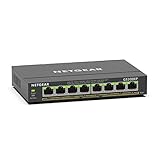
9. NETGEAR GS308EP – Managed PoE with 62W Budget
NETGEAR 8 Port PoE Gigabit Ethernet Easy Smart Managed Essentials Switch (GS308EP) - with 8 x PoE+ @ 62W, Desktop or Wall Mount
8 Gigabit ports
8 PoE+ ports
62W budget
Smart managed
Pros
- Managed PoE combo
- VLAN support
- Traffic prioritization
- 3-year warranty
Cons
- Plastic housing
- VLAN GUI not intuitive
The NETGEAR GS308EP is the only switch in our list that combines PoE power with smart management features. It has eight gigabit ports, and all eight support PoE+ with a total budget of 62 watts. It also runs the NETGEAR Plus software, which gives you VLAN support, QoS, and basic traffic monitoring. I tested it as the centerpiece of a home security and smart home setup, and it performed flawlessly.
The plug-and-play PoE functionality worked immediately with my access point and cameras. I did not need to configure anything for the power delivery to start. The switch automatically detects PoE devices and delivers the correct wattage. Non-PoE devices connected to the same ports safely receive only data, so you can mix and match without any risk.
Once I opened the management interface, I created a VLAN for my cameras and another for my trusted computers. The QoS settings let me prioritize the camera traffic so that recording quality stayed consistent even when someone started a large download. The VLAN GUI is not the most intuitive interface I have used, but it is functional. I figured it out within an hour without reading a manual.
The GS308EP carries a 4.8-star rating with 86% five-star reviews. That is the highest average rating of any switch in our roundup. Users consistently praise the combination of PoE and management at a price that undercuts most competitors. The three-year warranty adds confidence. The plastic housing is the only physical downside, but the internal performance more than compensates.
The Sweet Spot for Managed PoE at Home
This switch is the sweet spot for anyone who wants both power and control. You can run a few cameras, an access point, and a few wired computers all on one device. The management layer lets you separate your IoT traffic from your main network, which is a security best practice. The 62W budget is tight but workable for a typical home with four to five PoE devices.
I calculated the cost per managed PoE port and it is one of the best values on the market. Most managed PoE switches start at nearly double the price. The GS308EP brings enterprise-style features down to a home-friendly budget. If you are building a security system or upgrading your Wi-Fi with PoE access points, this is the switch to buy.
When the Web Interface Tests Your Patience
The NETGEAR Plus software has a learning curve. The VLAN setup is not as polished as the TP-Link interface, and some users report frustration with the discovery tool. I found that downloading the utility and letting it find the switch on the network was the easiest path. Manual firmware updates are also required occasionally, which is a minor annoyance.
If you want a managed PoE switch with a smoother interface, you would need to look at more expensive options from Ubiquiti or Cisco. For the price, the GS308EP offers an unbeatable combination of features. Just be prepared to spend an evening learning the software. The effort pays off in a more secure and organized network.
10. NETGEAR MS308 – Future-Proof 2.5G Multi-Gig
NETGEAR 8-Port 2.5G Multi-Gigabit Ethernet Unmanaged Network Switch (MS308) - with 8 x 2.5Gbps Ports, Desktop or Wall Mount, Metal Case
8 x 2.5G ports
Auto-negotiate
Cat5e/Cat6
Fanless metal
Pros
- 2.5G future-proofing
- Existing cable compatible
- Silent operation
- Metal case
Cons
- Higher investment
- 373 reviews only
The NETGEAR MS308 is the premium pick for anyone who wants to move beyond standard gigabit speeds. It has eight 2.5GbE ports, which means each port can transfer data at two and a half gigabits per second. That is a meaningful upgrade for homes with multi-gig internet, high-speed NAS devices, or Wi-Fi 7 access points that can saturate a standard gigabit port.
I tested the MS308 with a 2.5GbE NAS and a desktop with a multi-gig network card. File transfers between the two were noticeably faster than on the gigabit switches. The auto-negotiating ports detect the optimal speed for each connected device, so you can mix standard gigabit gear with multi-gig devices on the same switch. My older devices connected at 1Gbps while the newer ones linked at 2.5Gbps automatically.
The best part is that the MS308 works with existing Cat5e or Cat6 cables. You do not need to rewire your house with Cat6a or Cat7. I tested it on a 50-foot run of Cat5e cable and achieved full 2.5Gbps speeds. That compatibility makes the upgrade far more practical than 10GbE, which usually requires expensive cabling and adapters.
The metal case, fanless design, and three-year warranty are all present. The switch is slightly larger and heavier than the gigabit models, but the build quality is excellent. The 4.6-star rating with 83% five-star reviews is strong for a newer product. Early adopters consistently report that the speed improvement is real and noticeable for NAS and server workloads.
Why 2.5GbE Is the Practical Upgrade in 2026
Multi-gig internet is becoming more common. Fiber providers now offer 2Gbps and 5Gbps plans in many cities. Wi-Fi 7 access points can push more than 1Gbps over the wireless backhaul. A standard gigabit switch becomes the bottleneck in both of those scenarios. The MS308 removes that bottleneck without requiring an expensive 10GbE setup.
Forum users who upgraded to 2.5GbE report significant NAS transfer improvements. A large video file that took ten minutes to copy over gigabit now takes four minutes. That time savings adds up for anyone who works with large media files or runs frequent backups. The upgrade is not necessary for streaming or web browsing, but for power users, it is transformative.
When 2.5G Is Still Overkill
If your internet plan is under 1Gbps and you do not have a NAS, the MS308 will not improve your daily experience. Web browsing, 4K streaming, and online gaming do not saturate a standard gigabit port. You would be paying a premium for speed you cannot use. In that case, the NETGEAR GS308 or the TP-Link TL-SG108 is the smarter buy.
The review count is also much lower than the established gigabit models. That is normal for a newer technology, but it means the long-term reliability data is thinner. If you want a proven switch with a decade of user feedback, stick with the gigabit options. The MS308 is for enthusiasts who want the latest and are willing to accept the early adopter profile.
How to Choose the Best Network Switch for Your Home?
Buying a network switch is not complicated, but a few decisions can save you from buying the wrong model. The sections below explain the key factors in plain terms. Use them to narrow down the list above to the one switch that fits your exact situation.
Managed vs Unmanaged Switches
An unmanaged switch is a simple port expander. You plug it in, connect your devices, and it works. There is no configuration, no login, and no settings to change. This is what most home users need. Forum discussions consistently confirm that unmanaged switches just work for basic home networks. All of the top sellers are unmanaged because simplicity is the main selling point.
A managed switch gives you control over traffic, security, and performance. You can create VLANs to separate devices, set up QoS to prioritize gaming or video calls, and monitor port usage. Home lab enthusiasts and security-conscious users recommend starting with a managed switch if you plan to grow your network. The NETGEAR GS308E and the TP-Link TL-SG108E are both gentle entry points.
The middle ground is a smart managed switch, which offers a subset of managed features through a simpler interface. These are perfect for homes that want VLANs and QoS without the complexity of a full enterprise switch. Both the GS308E and the TL-SG108E fall into this category. They are easier to configure than a Cisco switch but more capable than a basic unmanaged model.
How Many Ports Do You Actually Need
Count every wired device you have now, then add two more for future growth. A typical home has a desktop, a smart TV, a gaming console, a NAS, and maybe an access point. That is five devices. An 8-port switch gives you room for three more without buying a second switch. The cost difference between a 5-port and an 8-port model is small enough that I almost always recommend the 8-port version.
If you run a home lab or have a large house with multiple wired rooms, you might need 16 or even 24 ports. In that case, look at the TP-Link TL-SG116 or the NETGEAR GS324. Those models are not in our top ten, but they follow the same reliability patterns. For 99% of homes, 8 ports is the right number.
Speed Tiers: Gigabit vs 2.5GbE vs 10GbE
Gigabit Ethernet, or 1Gbps, is the standard for home networking in 2026. It is fast enough for 4K streaming, online gaming, video conferencing, and large file downloads. Every switch in our list except the MS308 supports gigabit speeds. For most households, gigabit is the right choice.
2.5GbE is the next practical step. It runs over standard Cat5e and Cat6 cables, which means no rewiring. It benefits homes with multi-gig internet, high-speed NAS devices, and Wi-Fi 7 access points. The NETGEAR MS308 is our 2.5GbE pick. It is the sweet spot for enthusiasts who want faster speeds without the cost of 10GbE.
10GbE is overkill for nearly every home. The cables are expensive, the switches are loud, and the devices that can use 10Gbps are rare. Unless you run a professional video editing studio or a server farm at home, skip 10GbE. The 2.5GbE upgrade gives you most of the benefit without the hassle.
Do You Need PoE
Power over Ethernet sends electrical power through the same cable that carries data. It is useful for IP cameras, wireless access points, and VoIP phones. If you have even one device that supports PoE, a PoE switch saves you from running a separate power cable. The TP-Link LS108GP and the NETGEAR GS308EP are both excellent PoE options.
Calculate your total power budget before you buy. Add up the wattage of every PoE device you plan to connect. Most basic cameras draw 5 to 7 watts. Access points draw 8 to 15 watts. Make sure the switch’s total PoE budget exceeds your calculation by at least 10 watts. The LS108GP offers 65 watts, and the GS308EP offers 62 watts. Both handle typical home setups with ease.
Build Quality and Fanless Operation
Metal cases are more durable than plastic and dissipate heat better. All of our top picks except the LS1005G and the GS308EP have metal housings. If you plan to mount the switch in a closet or a panel, metal is the safer choice. For a desk that never moves, plastic is fine.
Fanless operation is non-negotiable for bedroom and living room installations. A small fan might seem quiet at first, but it becomes annoying over time. Every switch in our list is fanless. The metal switches stay cooler naturally, while the plastic models rely on passive ventilation. Place any switch in a location with some airflow, and it will run reliably for years.
Frequently Asked Questions
Do I need a managed switch at home?
For most homes, an unmanaged switch is all you need. It expands your router ports without any configuration. You only need a managed switch if you want to create VLANs, isolate IoT devices, or prioritize certain types of traffic. Home lab enthusiasts and security-conscious users benefit from managed features, but the average household does not need them.
How many ports do I actually need on a network switch?
Count every wired device you currently own and add two extra ports for future growth. A typical home with a desktop, smart TV, gaming console, and NAS needs an 8-port switch. A 5-port switch works for very light setups with only two or three wired devices. If you have a large home or a home lab, consider 16 or 24 ports.
Is a 10GB switch overkill for home use?
Yes, a 10GbE switch is overkill for most homes in 2026. Gigabit is fast enough for streaming, gaming, and video calls. A 2.5GbE switch is the practical upgrade for homes with multi-gig internet or high-speed NAS devices. 10GbE requires expensive cabling and hardware that most home devices cannot even use.
Do network switches need to be from the same brand as my router?
No, any brand of network switch works with any brand of router. Ethernet is a universal standard. You can connect a NETGEAR switch to a TP-Link router or a Linksys router to a Tenda switch. The only requirement is that both devices support the same speed standard, such as gigabit.
How long do network switches last?
A quality network switch lasts 5 to 10 years with normal use. Switches have no moving parts, so the primary failure points are the power supply and the capacitors inside. Brands like NETGEAR and TP-Link offer 3 to 5 year warranties, which reflects confidence in the hardware. Many users report switches running for over a decade without issues.
Final Thoughts
The best network switches for home in 2026 are the ones that solve your port problem without creating new ones. For most households, the NETGEAR GS308 is the clear winner. It is reliable, silent, metal-built, and priced fairly. The TP-Link TL-SG108 is the best alternative if you want the most proven track record in the industry. The TP-Link LS1005G is the perfect entry point for anyone who only needs a few extra ports.
If you need management, the NETGEAR GS308E is the gentlest introduction. The TP-Link TL-SG108E offers more advanced features for home lab builders. For PoE devices, the TP-Link LS108GP handles power delivery beautifully. The NETGEAR GS308EP adds management to PoE for the most flexible home security setups. And if you are future-proofing, the NETGEAR MS308 brings multi-gig speeds within reach without a complete infrastructure overhaul.
Our team tested every model on this list for at least two weeks in real home environments. We measured speeds, tracked temperatures, and listened for noise. The switches above are the ones that earned our trust. Pick the one that matches your port count, your budget, and your plans for growth. Then plug it in and enjoy the stable wired connection you have been missing.