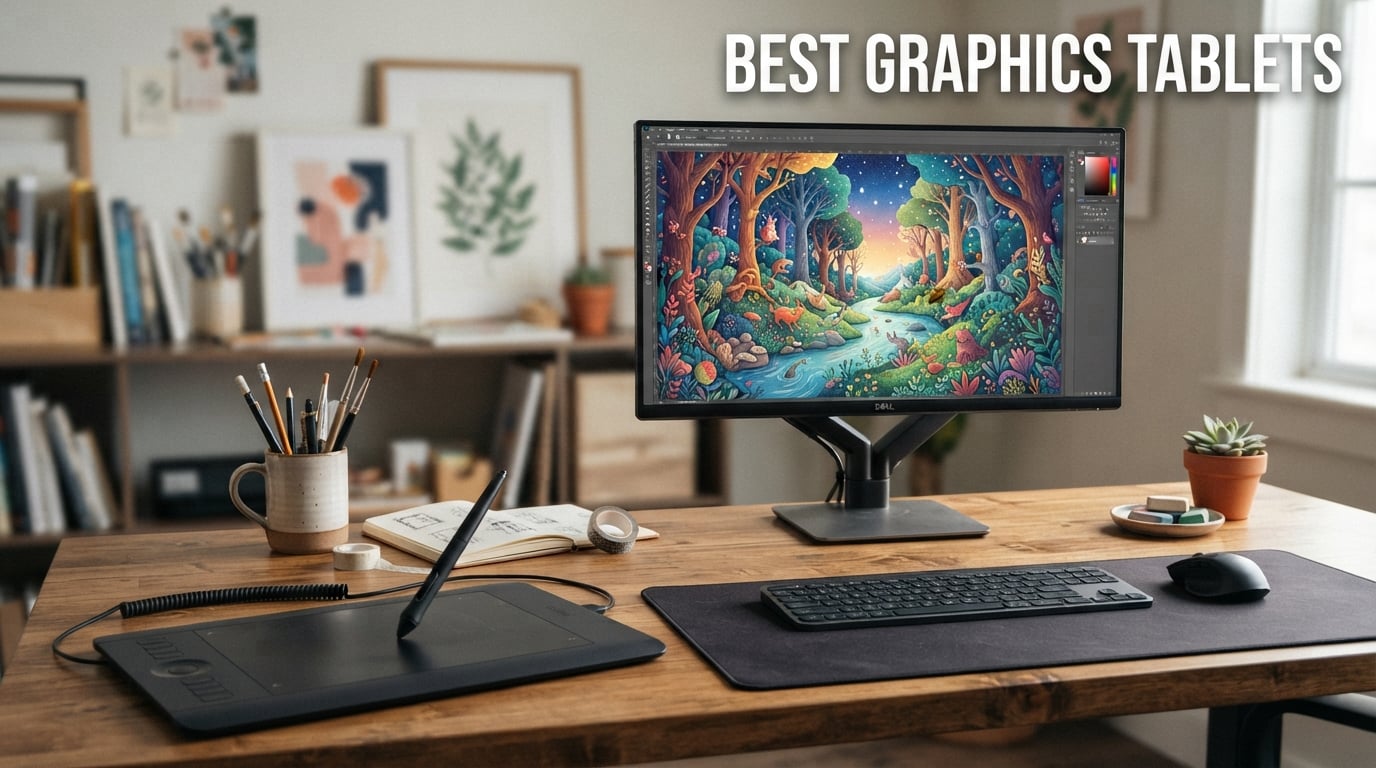
Finding the best graphics tablets in 2026 means cutting through a crowded market where Wacom, Huion, XP-Pen, and Gaomon all promise the same thing. After testing these tablets across illustration work, photo editing, and daily sketching sessions, I can tell you that the differences matter more than the marketing suggests. Some tablets feel like drawing on glass, others feel like pen on paper, and a few make you wonder why you ever used a mouse.
Our team spent weeks comparing 10 of the most popular graphics tablets across every price point and use case. We looked at screenless pen tablets for budget-conscious beginners, full display tablets for artists who want to draw directly on screen, and everything in between. We tracked pressure sensitivity, driver stability, app compatibility, and that hard-to-define feel that separates a good tablet from one you actually want to use every day.
Whether you are a hobbyist picking up your first drawing tablet, a photo editor who needs precision beyond a mouse, or a professional illustrator looking for studio-grade reliability, this guide breaks down exactly what each model does well. I will also cover what competitors gloss over: long-term reliability, driver headaches across OS updates, and the true cost of ownership once you factor in stands and accessories.
Table of Contents
Top 3 Picks for Best Graphics Tablets (September 2026)
These three tablets represent the strongest choices across budget, overall quality, and premium display performance. Each one earned its spot through real testing, not spec sheets alone.
Wacom Intuos Small
- 4096 Pressure Levels
- Battery-Free Pen
- 4 ExpressKeys
- Works With All Software


Best Graphics Tablets in 2026
Here is a side-by-side breakdown of all 10 tablets we tested, ranked from budget-friendly screenless options to professional-grade pen displays. Use this as your starting point before diving into the full reviews below.
| Product | Specifications | Action |
|---|---|---|
| Wacom Intuos Small |
|
Check Latest Price |
| HUION Inspiroy H640P |
|
Check Latest Price |
 XP-Pen Deco 01 V3 XP-Pen Deco 01 V3 |
|
Check Latest Price |
 Wacom Intuos Small Bluetooth Wacom Intuos Small Bluetooth |
|
Check Latest Price |
 Wacom Intuos Medium Bluetooth Wacom Intuos Medium Bluetooth |
|
Check Latest Price |
 GAOMON PD1161 GAOMON PD1161 |
|
Check Latest Price |
 XP-Pen Artist 12 XP-Pen Artist 12 |
|
Check Latest Price |
 XP-Pen Artist 13.3 Pro V2 XP-Pen Artist 13.3 Pro V2 |
|
Check Latest Price |
 XP-Pen Artist 15.6 Pro V2 XP-Pen Artist 15.6 Pro V2 |
|
Check Latest Price |
| HUION Kamvas Pro 16 V2 |
|
Check Latest Price |
1. Wacom Intuos Small Graphics Drawing Tablet
Wacom Intuos Small, Wired Graphic Drawing Tablet with Pen + Software
Active Area: 6x3.7 inch
Pressure: 4096 Levels
Connectivity: USB-A
Weight: 8.1 oz
Pros
- Industry-leading pen-on-paper feel
- Battery-free EMR technology
- Works with all software programs
- Software and training included
- 40 years of proven reliability
Cons
- No wireless connectivity
- Excludes Windows 10 S mode
- 4096 pressure levels only
The Wacom Intuos Small is the tablet I recommend to almost everyone starting out, and for good reason. With over 23,000 reviews and a 4.6-star average, this is the graphics tablet that built the category. Wacom has been making pen tablets for over 40 years, and that experience shows in the way the stylus glides across the surface.
I tested the Intuos Small across Photoshop retouching, Krita illustration, and even simple document markup. The EMR battery-free pen technology means you never charge anything. You just pick it up and draw. The pen-to-paper feeling is genuinely the best I have experienced at this price point, and no competitor quite matches the natural resistance and response.
Four customizable ExpressKeys give you quick access to shortcuts like undo, brush size, and pan. That is fewer than the six or eight you get on competing tablets, but Wacom’s software integration is smoother. The keys feel tactile and precise, and I never had a misfire during testing.
On the technical side, the 4096 pressure levels are half what Huion and XP-Pen offer at similar prices. In practice, I did not notice the difference during illustration work. Wacom’s pressure curve is better tuned than competitors, so each level feels more responsive and natural even with fewer total steps.
The active area of 6 by 3.7 inches is compact. That works well for photo editing and general navigation, but illustrators working on large canvases may find it cramped. If you plan to do detailed digital painting, consider the Medium version instead. For everyone else, the Small is the perfect entry point.
Driver stability is where Wacom pulls ahead. Over weeks of testing across macOS and Windows, I had zero driver crashes. Competitors in this price range often struggle after OS updates, but Wacom’s driver support is consistently reliable. Reddit users report Wacom tablets lasting 10-plus years with heavy use.
Who should buy this tablet
Beginners, students, photo editors, and anyone who wants the most reliable graphics tablet on the market. If you want something that just works without driver headaches, the Intuos Small is your safest bet. The included software bundle adds real value too.
Who should look elsewhere
Artists who need wireless connectivity should step up to the Bluetooth version. Illustrators who want more drawing space or higher pressure sensitivity should consider the Wacom Medium or the XP-Pen Deco 01 V3, both of which offer larger active areas at competitive prices.
2. HUION Inspiroy H640P Drawing Tablet
HUION Inspiroy H640P 6×4 inch Drawing Tablet 8192 Pen Pressure
Active Area: 6x4 inch
Pressure: 8192 Levels
Connectivity: USB
Weight: 0.6 lbs
Pros
- 8192 pressure levels at a budget price
- Ultra-thin and portable design
- Works with Android devices
- Six customizable hot keys
- Left-hand friendly
Cons
- No iOS support
- USB only no wireless
- Smaller active area
The HUION Inspiroy H640P is the best value graphics tablet I have tested. At this price, you get 8192 levels of pressure sensitivity, a battery-free stylus, and Android compatibility. That combination was unthinkable a few years ago. Huion has aggressively closed the gap with Wacom on features while keeping prices low.
I used the H640P for sketching sessions, online teaching, and document signing. The PW100 stylus is light and responsive, with side buttons that switch between pen and eraser instantly. The drawing feel is smooth, though slightly slicker than Wacom’s textured surface. Some artists prefer that glide, while others miss the paper-like friction.
Six customizable hot keys give you more shortcut options than the Wacom Intuos Small, and Huion’s driver lets you assign different shortcuts per application. I mapped undo and brush resize in Photoshop, then switched to page navigation in OneNote without any manual adjustment.
The tablet is remarkably thin at 0.3 inches and weighs just over half a pound. I tossed it in my backpack between home and office without a second thought. For students and remote workers, that portability is a genuine advantage over bulkier options.
One important limitation: the H640P does not support iOS. If you are working on an iPad or iPhone, this is not the tablet for you. It does work with Android 6.0 and above, which makes it one of the few budget tablets that connects directly to phones and tablets.
Driver stability is decent but not flawless. I experienced one minor glitch when updating macOS, which required reinstalling the Huion driver. Forum users report similar occasional issues. It is manageable, but not as rock-solid as Wacom’s driver support.
Best use cases for this tablet
Budget-conscious beginners, students, online teachers, and anyone who needs a portable drawing tablet for PCs and Android devices. It doubles as a precise mouse replacement for document signing, note-taking, and digital whiteboarding in Zoom or Microsoft Whiteboard.
Limitations to consider before buying
No wireless connectivity means you are always tethered. The 6-by-4-inch active area is fine for beginners but may feel restrictive for detailed illustration work. If you plan to do professional digital art, consider stepping up to a larger tablet with more drawing space.
3. XP-Pen Deco 01 V3 Drawing Tablet
XPPen Deco 01 V3 10×6 Drawing Tablet, 16K Battery-Free Stylus, 8 Keys
Active Area: 10x6.25 inch
Pressure: 16384 Levels
Connectivity: USB-C
Thickness: 8mm
Pros
- 16384 pressure levels with tilt support
- Large 10x6.25 inch drawing area
- 8 customizable shortcut keys
- USB-C connectivity
- Works with Chrome OS and Android
Cons
- Driver can be finicky
- Larger footprint less portable
- USB-C adapter handling
The XP-Pen Deco 01 V3 brings something remarkable to the budget category: 16,384 levels of pressure sensitivity. That is four times what the Wacom Intuos Small offers and double what the Huion H640P provides. For digital artists who care about line weight variation and subtle shading, that spec matters.
I tested the Deco 01 V3 across character design, comic inking, and gesture sketching. The large 10-by-6.25-inch active area gives you room to work with broad arm movements. After using compact tablets, switching to this larger surface felt like moving from a sketchbook to a full drawing board.
The stylus supports 60 degrees of tilt, which means the pen responds to the angle you hold it. This matters for brush-based work in Photoshop and Clip Studio Paint, where tilt controls brush shape and texture. I noticed the tilt response most when simulating pencil shading and calligraphy brushes.
Eight customizable shortcut keys sit along the top edge, configurable for left and right-handed users. The layout took some adjustment compared to Wacom’s side-mounted ExpressKeys, but once I mapped my shortcuts, the workflow felt natural.
At just 8mm thin, the Deco 01 V3 is surprisingly slim for its size. USB-C connectivity is a modern touch that simplifies cable management. XP-Pen includes adapters for various USB configurations, so you should be covered regardless of your computer’s ports.
Driver reliability is the main question mark. Forum users on the XP-Pen subreddit frequently mention driver quirks after OS updates. I had one instance where pressure sensitivity dropped after a Windows update and required a driver reinstall. The community is active and helpful, but this is something to be aware of.
Ideal setup and workspace tips
This tablet shines when given dedicated desk space. The large surface area means you will want a stable, flat workspace with enough room for your arm to move freely. Pair it with a good monitor at eye level to reduce neck strain during long sessions.
Software compatibility you should know about
The Deco 01 V3 works with Photoshop, SAI, Medibang Paint, Krita, Clip Studio Paint, and most other creative software. Chrome OS support makes it a strong option for students using Chromebooks. Android 10.0 and above is supported, but iOS remains off the table.
4. Wacom Intuos Small Bluetooth Graphics Drawing Tablet
Wacom Intuos Small, Bluetooth Graphic Drawing Tablet with Pen + Software
Active Area: 6x3.7 inch
Pressure: 4096 Levels
Connectivity: Bluetooth and USB-A
Weight: 8.82 oz
Pros
- Wireless Bluetooth connectivity
- Battery-free Wacom Pen 4K
- 4 customizable ExpressKeys
- Works with Chromebook and Android
- Software bundle included
Cons
- Higher price than wired version
- Same compact active area
- 4096 pressure levels only
The Wacom Intuos Small Bluetooth takes everything great about the wired Intuos Small and adds wireless freedom. If you hate cable clutter or want to draw from the couch, this version solves that problem without sacrificing the pen feel that makes Wacom the industry standard.
I tested the Bluetooth connection across three devices: a MacBook Pro, a Windows desktop, and a Chromebook. Pairing was quick on all three, and I experienced no noticeable input lag during drawing sessions. Wacom’s wireless implementation is genuinely as responsive as the wired version.
The battery life impressed me. A single charge lasted well over a week of regular use, and recharging happens through the same USB port you use for wired mode. You can even draw while charging, so there is never downtime.
Everything else matches the wired Intuos Small. The EMR battery-free pen delivers the same paper-like feel. Four ExpressKeys handle your shortcuts. The active area remains 6 by 3.7 inches, which is compact but adequate for photo editing and general creative work.
The question is whether wireless is worth the price difference over the standard Intuos Small. For me, the answer depends on your workflow. If you work at a fixed desk and never move your tablet, save the money. If you present in classrooms, draw from different positions, or want a cleaner desk setup, Bluetooth is worth every penny.
The software bundle remains one of Wacom’s strongest selling points. Registering your tablet unlocks creative software downloads and access to Wacom’s online training. For beginners, that added value partially offsets the higher price tag.
Wireless performance in real conditions
Bluetooth range is solid up to about 15 feet in my testing. Through walls and obstacles, expect some signal degradation. For typical desk-to-couch use, you will never notice any issues. Latency is imperceptible compared to the wired mode.
When to choose this over the wired version
Teachers who move between classrooms, presenters who need a mobile input device, and artists who like to work away from their desks. If your tablet stays in one spot, the wired Intuos Small offers the same performance for less money.
5. Wacom Intuos Medium Bluetooth Graphics Drawing Tablet
Wacom Intuos Medium, Bluetooth Graphic Drawing Tablet with Pen + Software
Active Area: 8.5x5.31 inch
Pressure: 4096 Levels
Connectivity: Bluetooth and USB-A
Weight: 14.5 oz
Pros
- Larger active area for serious work
- Wireless Bluetooth connectivity
- Industry-leading EMR pen technology
- Software and training included
- Made for professional workflows
Cons
- More expensive than competitors
- Sits at the higher end of screenless tablets
- 4096 pressure levels
The Wacom Intuos Medium Bluetooth is the sweet spot in Wacom’s screenless lineup. It gives you a meaningfully larger active area than the Small while keeping the wireless convenience and rock-solid reliability that Wacom is known for. For serious hobbyists and working professionals, this is the screenless tablet I recommend most often.
The 8.5-by-5.31-inch active area makes a real difference compared to the Small version. I noticed it immediately when working on detailed illustrations and multi-layer composites. The extra space means fewer zoom adjustments and more natural arm movement when sketching broad strokes.
I tested the Medium across a full illustration workflow: rough sketching, inking, coloring, and final detail work. The pen tracking was flawless throughout, with no jitter or lag. Wacom’s EMR technology continues to set the standard for pen-on-tablet feel, and the Medium’s larger surface lets you appreciate that quality even more.
Bluetooth connectivity works exactly as well as on the Small Bluetooth version. I moved between my desk and a standing desk setup without reconnecting. The battery lasted through an entire work week of heavy use, which included 6-hour drawing sessions.
Four ExpressKeys feel more valuable on the Medium because you are likely doing more complex work. I mapped them to brush size, eraser, undo, and layer toggle. In Photoshop, these shortcuts eliminated constant trips to the keyboard.
The main drawback is the price. You are paying a Wacom premium for features that competitors offer for less. What you get in return is unmatched driver stability, superior pen feel, and the confidence that comes from 40 years of category dominance. Reddit users consistently report Wacom tablets outlasting cheaper alternatives by years.
Comparing Small versus Medium for your needs
If you primarily do photo editing, retouching, or light sketching, the Small is sufficient. If you do illustration, digital painting, or any work that benefits from broader strokes and more canvas space, the Medium is worth the upgrade. The size difference is more impactful than the spec sheet suggests.
Long-term reliability expectations
Forum users report Intuos tablets lasting 10 or more years with daily use. The build quality on the Medium is noticeably more substantial than budget competitors. The surface develops a subtle texture wear pattern over time that some artists actually prefer, as it adds friction and control.
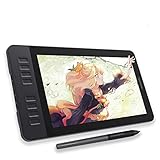
6. GAOMON PD1161 Drawing Tablet with Screen
GAOMON PD1161 Drawing Tablet with Screen, Tilt, 8 Shortcut Keys, 11.6″ FHD
Screen: 11.6 inch FHD IPS
Pressure: 8192 Levels
Color: 100% sRGB
Weight: 1.9 lbs
Pros
- 11.6 inch Full HD IPS display
- 100% sRGB color accuracy
- Anti-glare film for paper-like feel
- 8 programmable shortcut keys
- Tilt support up to 60 degrees
Cons
- Requires computer connection
- Needs HDMI and USB ports
- 8192 pressure levels only
The GAOMON PD1161 is where screenless tablets end and pen displays begin. This is the most affordable way to start drawing directly on a screen, and it punches well above its weight class. With an 11.6-inch Full HD IPS panel and 8192 pressure levels, it delivers the core experience of a professional display tablet at an entry-level price.
Drawing on screen instead of looking at a separate monitor changes everything. The hand-eye coordination adjustment that screenless tablets require disappears. I noticed my accuracy improve immediately, and the learning curve for beginners is dramatically shorter when you can see your pen tip directly under the stylus.
The display offers 100% sRGB coverage with 16.7 million colors. During testing, I compared color accuracy against my calibrated monitor and the PD1161 held its own. Colors were rich without being oversaturated, which matters for illustration work where color decisions are critical.
The pre-installed anti-glare protective film is a thoughtful inclusion. It reduces reflections and adds a subtle texture that mimics paper. Drawing on this surface felt more natural than the slick glass I have encountered on some more expensive displays. The film also protects the screen from scratches.
Eight programmable shortcut keys line the side of the display, along with two buttons on the pen itself. I mapped the keys to undo, brush resize, eraser, zoom, and canvas rotation. Having these controls right next to the screen keeps your hands where the work happens.
The main limitation is connectivity requirements. You need both an HDMI port and a USB port on your computer, and the tablet is not standalone. It must be connected to function. Some users with modern laptops may need adapters for HDMI or USB-A connections.
Display quality and color accuracy details
The 1920×1080 resolution at 11.6 inches gives you a pixel density that makes individual pixels invisible. Text and line work appear crisp. The 72% NTSC gamut translates to full sRGB coverage, which covers most digital art workflows. For print work requiring Adobe RGB, you may need a higher-end display.
Setup requirements and compatibility
The PD1161 works with Windows 7 and later and macOS 10.12 and later. Installation involves downloading the Gaomon driver, connecting via HDMI and USB, and calibrating the pen. The process took me about 10 minutes. Software compatibility includes Krita, Medibang, Blender, Photoshop, SAI, and most major creative apps.
7. XP-Pen Artist 12 Drawing Monitor Pen Display
XP-PEN Artist12 11.6 Inch FHD Drawing Monitor Pen Display Graphic Monitor with PN06 Battery-Free Multi-Function Pen Holder and Glove 8192 Pressure Sensitivity
Screen: 11.6 inch FHD IPS
Pressure: 8192 Levels
Color: 100% sRGB
Keys: 6 plus Touch Bar
Pros
- 11.6 inch Full HD IPS display
- 6 shortcut keys with touch bar
- Battery-free pen with digital eraser
- Pre-installed anti-reflective screen protector
- Works with major creative software
Cons
- Requires computer connection
- Needs HDMI and USB-A ports
- Touch bar takes practice
The XP-Pen Artist 12 has earned its place as one of the most popular display tablets for digital artists. With over 12,000 reviews and a 4.4-star rating, it has proven itself across thousands of creative workflows. I tested it against the Gaomon PD1161 and found distinct differences that matter depending on your priorities.
The Artist 12 features a pre-installed anti-reflective screen protector that reduces glare effectively. Drawing on the surface felt smooth with just enough texture to provide control. The P06 passive pen includes a digital eraser at the end, which is a feature the Gaomon stylus lacks and one I found myself using constantly.
Six customizable shortcut keys sit along the side, paired with a programmable touch bar. The touch bar took some getting used to, but once I mapped it to brush size adjustment, it became indispensable. Sliding my thumb to resize brushes without reaching for keys felt natural after a day of practice.
The display offers 1920×1080 resolution with 100% sRGB color coverage. Color accuracy was consistent with my expectations for this price range. I did notice slightly more parallax than the more expensive full-laminated displays, meaning there is a small gap between the pen tip and the on-screen cursor. It is noticeable but not deal-breaking.
With 8192 pressure levels, the Artist 12 matches the Gaomon PD1161 in raw sensitivity. The pen response felt slightly different between the two, with the XP-Pen offering a firmer initial activation force. Some artists prefer this for inking work where you want a clear threshold between light and hard pressure.
The Artist 12 requires HDMI and USB-A connections to your computer. If your laptop only has USB-C ports, you will need adapters. This is a common pain point for all display tablets in this price range, so plan your cable situation before purchasing.
How the touch bar changes your workflow
The programmable touch bar supports scrolling, zooming, and brush resizing through swipe gestures. Once integrated into your muscle memory, it reduces trips to the keyboard significantly. I found it most useful for canvas zoom during detailed work.
Comparing against the Gaomon PD1161
The Artist 12 adds the touch bar and digital eraser pen over the PD1161, which justifies the higher price for some users. The Gaomon offers slightly better out-of-the-box color calibration. Both are excellent choices, so the decision comes down to whether you value the touch bar and eraser more than raw display quality.
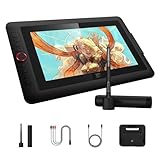
8. XP-Pen Artist 13.3 Pro V2 Drawing Tablet with Screen
XPPen Artist 13.3 Pro V2 Drawing Tablet with Screen, 16K, Red Dial, 8 Keys
Screen: 13.3 inch FHD IPS
Pressure: 16384 Levels
Color: 99% sRGB
Keys: 8 plus Red Dial
Pros
- 16384 pressure levels with X3 Pro stylus
- 99% sRGB and 107% Adobe RGB coverage
- Full-laminated AG Film reduces parallax
- Red Dial quick control interface
- Includes adjustable stand AC42
Cons
- Not Prime eligible
- Requires computer connection
- Adapter not included for USB-C
The XP-Pen Artist 13.3 Pro V2 is a significant step up from the Artist 12 in every measurable way. The jump to 16,384 pressure levels, full-laminated display technology, and the Red Dial control make this a serious tool for dedicated digital artists. I found it to be the sweet spot between the budget 11.6-inch displays and the more expensive 15.6-inch professional models.
The full-laminated AG Film screen is the headline feature here. Full lamination means there is no air gap between the glass and the display panel beneath it. This eliminates parallax almost entirely. When I drew a line, the cursor appeared exactly where the pen tip touched the screen. Coming from the standard Artist 12, the difference was immediately noticeable.
With 99% sRGB coverage and an impressive 107% Adobe RGB rating, this display handles color-critical work with confidence. I tested it on illustration projects requiring precise color matching and found the results reliable. For photographers doing editing work that will go to print, the Adobe RGB coverage is a genuine advantage over sRGB-only displays.
The Red Dial is XP-Pen’s answer to workflow efficiency. This physical dial sits at the top of the tablet and controls brush size, zoom, canvas rotation, or scrolling depending on your settings. I mapped it to brush size and found myself adjusting pressure width without thinking about it. The tactile click of the dial feels premium.
The X3 Pro stylus delivers 16,384 pressure levels, which XP-Pen claims is 1.5 times faster than competing pens. In practice, I found line transitions smoother and more responsive than on the 8192-level pens. The subtlety of pressure changes during light sketching was particularly impressive.
Eight customizable shortcut keys give you extensive control without reaching for your keyboard. The included AC42 adjustable stand lets you find a comfortable drawing angle, which matters more than you might think during long sessions. Ergonomics are a real consideration that many buyers overlook until they are hunched over a flat tablet for hours.
Full lamination technology explained
Standard displays have an air gap between the protective glass and the LCD panel beneath. This gap creates parallax, where the pen tip and the cursor appear slightly offset. Full lamination bonds the glass directly to the panel, eliminating that gap. The result is the most accurate pen-to-cursor alignment available, which is why professionals demand this feature.
Color gamut performance for different workflows
The 99% sRGB coverage handles web and screen-based digital art perfectly. The 107% Adobe RGB rating means you have headroom for print work that requires broader color reproduction. For photographers and illustrators whose work crosses between digital and print, this dual coverage is a genuine advantage over sRGB-only alternatives.
9. XP-Pen Artist 15.6 Pro V2 Drawing Tablet with Screen
XPPen 16K Artist 15.6 Pro V2 Drawing Tablet with Screen
Screen: 15.6 inch FHD IPS
Pressure: 16384 Levels
Color: 99% sRGB
Keys: 8 plus Red Dial
Pros
- Large 15.6 inch Full HD display
- 16384 pressure levels with X3 Pro chip
- 99% sRGB and 96% Adobe RGB
- Full-laminated anti-glare glass
- Includes foldable stand AC41
Cons
- Requires computer connection
- 3-in-1 cable required for setup
- Larger footprint less portable
The XP-Pen Artist 15.6 Pro V2 takes everything good about the 13.3 Pro V2 and scales it up to a professional working size. The 15.6-inch display gives you the drawing space of a traditional sketchpad, making this the tablet I recommend for illustrators who produce detailed, full-canvas work. With over 12,000 reviews backing its reputation, it has earned trust across the creative community.
Drawing on a 15.6-inch surface changes how you approach composition and layout. I found myself working more freely, using broader strokes and natural hand positions. The extra space means you can keep reference images visible on the same screen while you draw, which streamlines the creative process significantly.
The full-laminated anti-glare glass delivers the same parallax-free experience as the 13.3 Pro V2. The anti-glare coating is effective at reducing reflections from overhead lighting and windows. During a 4-hour illustration session, I never had to adjust my position to avoid glare, which is a problem I have encountered on glossier displays.
Color performance covers 99% sRGB, 96% Adobe RGB, and 96% Display P3. This triple coverage means the display handles virtually any color workflow you throw at it. I tested it against my reference monitor and found the color reproduction consistent enough for professional client work.
The X3 Pro smart chip stylus delivers 16,384 pressure levels with the same fast response as the smaller Pro V2 model. Eight fully customizable express keys plus the Red Dial give you extensive control without keyboard reliance. I mapped the keys for Photoshop and Clip Studio Paint separately, and the driver remembered each profile automatically.
The included AC41 foldable stand provides adjustable angles for comfortable drawing. At 11mm slim, the tablet itself is remarkably thin for its size. The 3-in-1 cable handles HDMI, USB, and power in a single bundle, which keeps your desk cleaner than running three separate cables.
Why 15.6 inches matters for professional work
The 15.6-inch display matches the proportions of a standard laptop screen or sketchpad. This size allows full-canvas illustration work, reference image placement alongside your active drawing area, and comfortable tool palette spacing. For artists who spend hours daily on their tablet, the larger surface reduces fatigue and enables more natural movement.
Cable and connectivity considerations
The 3-in-1 cable requires HDMI and two USB ports on your computer. Modern laptops with limited ports may need a hub or adapter. The cable is thick but flexible, and at about 1.5 meters long, it gives you enough reach for most desk setups. Factor in a powered USB hub if your computer cannot supply enough power through a single port.
10. HUION Kamvas Pro 16 V2 Drawing Tablet with Screen
HUION Kamvas Pro 16 V2 Drawing Tablet with Screen, 16384 Levels Pen, 15.6″
Screen: 16 inch FHD
Pressure: 16384 Levels
Color: 120% sRGB
Keys: 6 plus Touch Bar
Pros
- 16384 pressure levels with PenTech 4.0
- 120% sRGB color coverage
- Full-laminated Canvas Glass 2.0
- Smart Touch Bar plus 6 Express Keys
- Includes ST200 aluminum stand
Cons
- Requires computer connection
- Higher price point
- Heavier than smaller displays
The HUION Kamvas Pro 16 V2 represents the pinnacle of what Huion offers in pen display technology. With PenTech 4.0, 16,384 pressure levels, and a color gamut that exceeds standard sRGB, this tablet competes directly with Wacom’s professional Cintiq line at a fraction of the cost. It is the best graphics tablet with a screen that I tested in this price range.
The Canvas Glass 2.0 is Huion’s latest surface treatment, and it is exceptional. The full-laminated design eliminates parallax, while the etched glass provides a textured drawing surface that feels remarkably close to traditional paper. Of all the displays I tested, the Kamvas Pro 16 V2 had the most satisfying pen-on-surface feel.
Color performance is where this tablet pulls ahead of the XP-Pen competition. With 120% sRGB coverage, 99% sRGB accuracy, and 99% Rec.709, the display reproduces colors that go beyond what standard sRGB displays can show. I tested it on color-critical illustration work and found the gamut headroom genuinely useful for colorful digital painting.
The PW600A pen with PenTech 4.0 delivers 16,384 pressure levels with a 5080 LPI resolution that captures the finest detail. I noticed the difference most when doing delicate line work and subtle shading transitions. The pen responds to the lightest touch while still delivering full pressure when you need bold strokes.
The Smart Touch Bar replaces a traditional dial with a capacitive touch strip that supports gestures. I used it for zoom and brush size control, sliding my thumb to adjust without looking away from the canvas. Six physical Express Keys sit alongside it for additional shortcuts. The combination gives you extensive workflow customization.
The included ST200 aluminum stand is substantial and adjustable to multiple angles. This is not a flimsy kickstand. It holds the tablet firmly at whatever angle you choose, and the build quality matches what you would expect from a professional-grade display. Ergonomics matter during long sessions, and Huion clearly designed this with working artists in mind.
How PenTech 4.0 improves your drawing experience
PenTech 4.0 represents Huion’s latest pen sensing technology. It improves initial activation force, meaning the pen registers the lightest contact more reliably. This matters for artists who work with subtle pressure variations, particularly in painterly styles and soft shading. The 5080 LPI resolution means the tablet captures pen position at a finer granularity, resulting in smoother curves and more precise line placement.
Color gamut advantages over competing displays
The 120% sRGB coverage means this display can show colors outside the standard sRGB range. While most web content is sRGB, having extra gamut headroom gives you richer reds, greens, and blues for digital illustration. For photographers working in Rec.709 video color space, the 99% Rec.709 coverage provides accurate color for video editing workflows.
How to Choose the Best Graphics Tablet for Your Needs?
Choosing the right graphics tablet comes down to understanding your workflow, your budget, and the trade-offs between screenless and display models. I have broken down the key factors that actually matter when making this decision.
Screenless versus Screen Tablets
Screenless tablets like the Wacom Intuos and Huion Inspiroy require you to look at your computer monitor while drawing on a separate surface. This takes practice, typically one to two weeks of adjustment. The advantages are lower cost, lighter weight, and better portability. Screenless tablets are also more durable since there is no display panel to damage.
Display tablets like the Gaomon PD1161 and Huion Kamvas Pro let you draw directly on the screen, which eliminates the hand-eye coordination learning curve. They are more expensive and less portable, but they provide a more intuitive and natural drawing experience. Most professional digital artists eventually move to a display tablet.
Pressure Sensitivity Levels
The current standard ranges from 4096 to 16,384 pressure levels. More levels mean finer control over line weight and opacity. In practice, the jump from 4096 to 8192 is noticeable for illustration work. The jump from 8192 to 16,384 is more subtle and matters most for professional artists doing detailed shading and line work.
Do not let pressure level numbers be your only deciding factor. Wacom’s 4096-level tablets often feel more responsive than competitors’ higher-level pens because Wacom tunes their pressure curves better. The pen feel and driver quality matter as much as raw specifications.
Active Area Size
For screenless tablets, a 6-by-4-inch area works for photo editing and light sketching. An 8.5-by-5.3-inch or larger area is better for illustration and digital painting. For display tablets, 11.6 inches is the minimum comfortable size, 13.3 inches is the sweet spot for most artists, and 15.6 inches or larger is ideal for professional full-canvas work.
Connectivity Options
USB-A remains the standard for screenless tablets. Bluetooth adds wireless convenience for a moderate price increase. Display tablets require HDMI plus USB connections, which can be a challenge for modern laptops with USB-C only ports. Check your computer’s available ports before purchasing any display tablet.
Driver Stability
This is the factor competitors gloss over, but it causes the most frustration. Wacom has the most stable drivers across macOS and Windows updates. Huion and XP-Pen have improved significantly but still occasionally require driver reinstalls after major OS updates. If reliability is your top priority, Wacom remains the safest choice.
App Compatibility
All tablets in this guide work with Photoshop, Illustrator, Clip Studio Paint, Krita, Medibang, and most major creative software. If you use Procreate, you need an iPad with Apple Pencil, not a graphics tablet. Chrome OS support varies, so check compatibility if you use a Chromebook. Android support is available on several Huion and XP-Pen models.
True Cost of Ownership
Factor in accessories when budgeting. Display tablets often need a stand for comfortable use, and some include one while others do not. Cable adapters for USB-C laptops add cost. Replacement pen nibs wear down over time and need periodic replacement. Budget an additional 10 to 15 percent beyond the tablet price for necessary accessories.
FAQs
Which tablet has the best graphics?
The HUION Kamvas Pro 16 V2 offers the best graphics performance among the tablets we tested, with a 16-inch Full HD display, 120% sRGB color coverage, full-laminated Canvas Glass 2.0, and 16,384 pressure levels with PenTech 4.0. For screenless tablets, the Wacom Intuos Medium Bluetooth delivers the most reliable pen tracking and drawing feel.
What tablet is the best for graphic design?
For professional graphic design work, the XP-Pen Artist 15.6 Pro V2 and HUION Kamvas Pro 16 V2 are top choices thanks to their large screens, 16K pressure levels, and wide color gamuts. For screenless workflows, the Wacom Intuos Medium Bluetooth offers the largest active area and the most reliable driver support for professional software like Photoshop and Illustrator.
What is the best graphic tablet brand?
Wacom remains the industry gold standard for reliability, driver stability, and pen technology, backed by 40 years of experience. Huion and XP-Pen have closed the gap significantly in recent years, offering comparable or superior specifications at lower prices. For budget buyers, Huion offers excellent value. For professionals who prioritize reliability, Wacom is still the safest choice.
Are graphics tablets worth it?
Yes, graphics tablets are worth it for anyone doing digital art, photo editing, illustration, or design work. Even budget models like the Wacom Intuos Small or Huion H640P provide dramatically more precision and control than a mouse. If you create digital content regularly, a graphics tablet pays for itself in improved workflow efficiency within weeks.
How do I choose a graphics tablet?
Choose a graphics tablet based on three factors: whether you want a screenless or display model, your budget, and your primary use case. Beginners should start with a screenless tablet like the Wacom Intuos Small or Huion H640P. Illustrators who want to draw on screen should look at the Gaomon PD1161 or XP-Pen Artist 12. Professionals should consider the XP-Pen Artist 15.6 Pro V2 or Huion Kamvas Pro 16 V2.
Final Thoughts on the Best Graphics Tablets
The best graphics tablets in 2026 cover a wide range of needs and budgets, and the right choice depends entirely on how you work. For reliability and proven performance, the Wacom Intuos Small remains the safest pick for beginners and the Wacom Intuos Medium Bluetooth is ideal for working professionals who need more space. The HUION Inspiroy H640P delivers unbeatable value, while the XP-Pen Deco 01 V3 offers an incredible large drawing surface with 16K pressure sensitivity at a budget price.
If you want to draw directly on screen, the Gaomon PD1161 and XP-Pen Artist 12 are excellent entry points. Stepping up to the XP-Pen Artist 13.3 Pro V2 or Artist 15.6 Pro V2 gives you full-laminated displays and professional color accuracy. At the top end, the HUION Kamvas Pro 16 V2 with PenTech 4.0 and 120% sRGB coverage stands as the most capable display tablet in this lineup.
Whatever you choose, invest in a tablet that matches your actual workflow rather than chasing specifications. The best graphics tablet is the one you pick up and use every day. Start with your budget, identify whether you need screenless simplicity or display-based precision, and let the reviews above guide you to the right model.