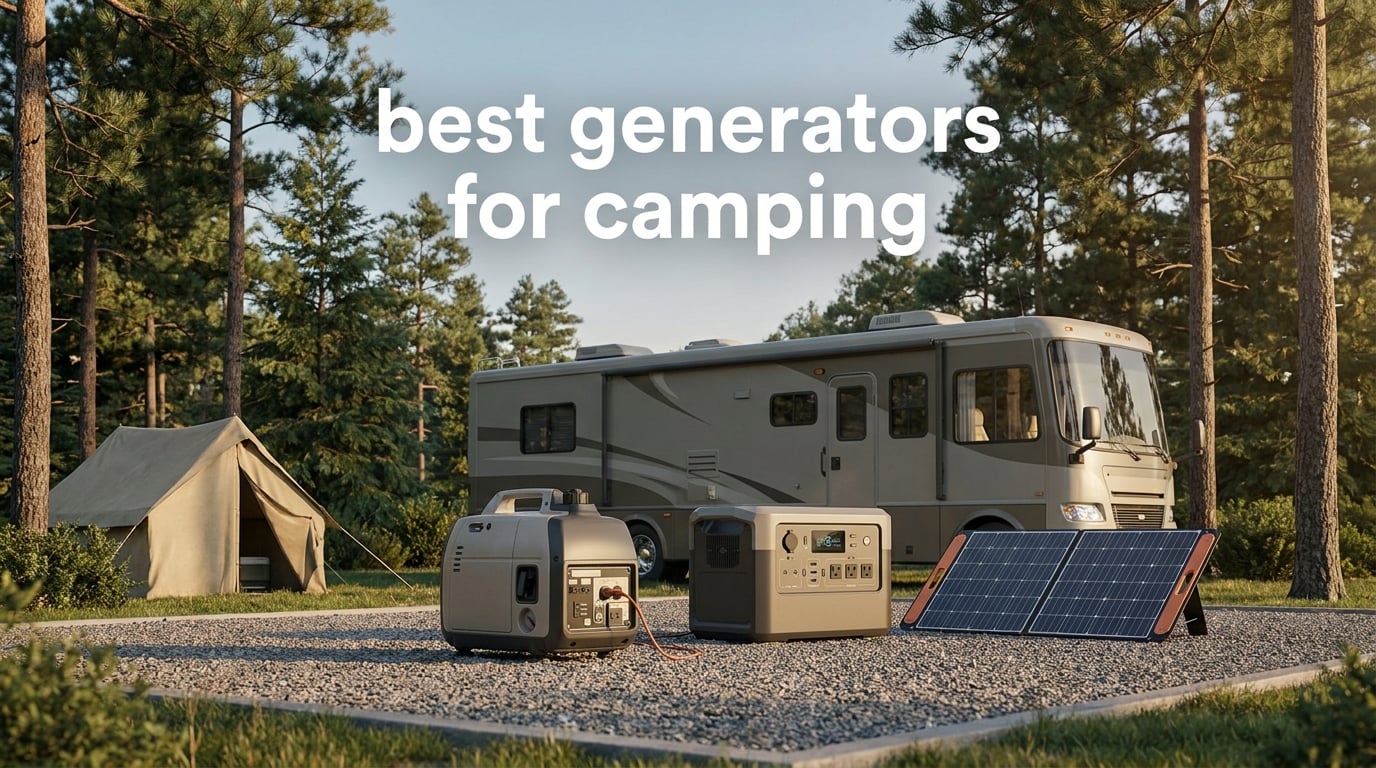
The best generators for camping are not all engine-powered machines. This list separates quiet battery power stations from gasoline inverter generators, because a tent camper charging lights and phones has a very different job from an RV camper running a larger appliance.
For 2026, my first rule is simple: choose the lowest-output option that covers your actual starting and running watts. That decision keeps carrying weight, campsite noise, fuel handling, and unused capacity in proportion to the trip.
The eight picks below include five battery-based portable power stations and three gasoline inverter generators. A battery power station runs silently at camp and creates no exhaust; a gas inverter generator can run much longer with fuel available and gives substantially higher continuous output on the models here.
I based the recommendations on the supplied product specifications, listed features, and available customer-rating data rather than pretending every model has been field-tested under identical conditions. The forum research is still useful context: campers repeatedly flag neighbor-friendly noise, liftable weight, enough power for air conditioning, seasonal reliability, and carbon-monoxide safety as the choices that matter after the product page closes.
One non-negotiable point comes before any comparison: never run a gasoline generator in a tent, RV, vehicle, enclosed shelter, or near openings. CO shutoff is a helpful feature, not permission to relax placement and ventilation rules.
Table of Contents
Top 3 Picks for Best Generators for Camping (September 2026)
The EF ECOFLOW DELTA 2 is my broadest recommendation when silent electricity, many outlets, and solar charging matter more than indefinite engine runtime. The Champion is the more fitting RV generator when a gasoline model, an RV-ready setup, and CO auto shutoff are priorities.
The GRECELL takes the smallest-lift role at 17 pounds, though its 1,000-watt continuous limit makes it a better match for electronic gear and modest appliance loads than high-demand RV equipment. Those are deliberately different recommendations rather than three versions of the same camping generator.
Best Generators for Camping in 2026
| Product | Specifications | Action |
|---|---|---|
 EF ECOFLOW DELTA 2 EF ECOFLOW DELTA 2 |
|
Check Latest Price |
 Jackery Explorer 1000 v2 Jackery Explorer 1000 v2 |
|
Check Latest Price |
 Anker SOLIX C1000 Gen 2 Anker SOLIX C1000 Gen 2 |
|
Check Latest Price |
 OUPES Mega 1 OUPES Mega 1 |
|
Check Latest Price |
 PowerSmart 3600W PowerSmart 3600W |
|
Check Latest Price |
 GRECELL 999Wh GRECELL 999Wh |
|
Check Latest Price |
 Oxseryn 4400W Oxseryn 4400W |
|
Check Latest Price |
 Champion 4000W Champion 4000W |
|
Check Latest Price |
Read the battery capacity and output as two separate numbers. Watt-hours describe stored energy, while watts describe how much equipment the unit can supply at one time; both numbers need to fit the trip.
The gas choices list runtime and sound figures, while the battery choices bring silent operation at the campsite. None of the supplied product records identifies a dual-fuel model, so this is not a list for a camper whose must-have feature is switching between gasoline and propane.
1. EF ECOFLOW DELTA 2 is the best all-round silent power station for multi-device camps.
EF ECOFLOW Portable Power Station Delta 2, 1024Wh, 1800W, LiFePO4 Battery
1024Wh LFP battery
1800W AC output
27 lb
15 outlets
Pros
- 1800W output
- 0-80% charge in 50 minutes
- 3000+ cycle LFP battery
- 15 outlets
- solar input
Cons
- Extended trips may need extra batteries
- Battery capacity is finite
The DELTA 2 pairs a 1,024Wh LiFePO4 battery with 1,800W AC output, which is a useful balance for a campsite that has several modest loads at once. Its 15 outlets give it more flexibility than a device charger, and the listed 500W solar input offers a way to replenish energy away from an outlet.
I would put this at the top of the list for campers who want to keep an area quiet while powering phones, lights, a laptop, and selected appliances within the 1,800W output ceiling. The 27-pound weight is portable enough for many people to move, but it is still a two-hand carry rather than a pocket-size backup.
The supplied data says it can charge from zero to 80% in 50 minutes via AC and can expand from 1kWh to 3kWh. That expansion route matters more for a multi-night base camp than for an overnight tent trip, where starting with a fully charged 1,024Wh unit may be the cleaner plan.
The available feedback is strong: it carries a 4.7 rating from 5k+ reviews, and the review summary praises charging speed, expandable capacity, and battery life. I treat that as a useful ownership signal, not a substitute for calculating your own load list.
The DELTA 2 fits campers who need quiet, flexible power below 1,800 watts.
Choose it for quiet-hours-sensitive campgrounds, electronics-heavy setups, and solar generator for camping use where no exhaust is acceptable. The LFP chemistry is listed for 3,000+ cycles, which also makes repeated seasonal use more appealing than a unit intended only for occasional emergencies.
It also suits RV campers who need a portable indoor power source for loads that stay within its AC output. A battery station is not a replacement for a 30-amp RV generator outlet when the RV’s needs exceed the station’s inverter rating.
The DELTA 2 is not the answer for unattended long runtime or very high-wattage equipment.
Stored energy is consumed once; solar recharging depends on having compatible panels, usable sunlight, and time. Campers planning to run a large sustained load should look at a gasoline option or build a larger battery system rather than assume 1,024Wh is limitless.
The data also notes that some owners may need additional batteries for extended use. That is a practical limitation to settle before departure, not after the battery indicator starts dropping.
2. Jackery Explorer 1000 v2 is the light, fast-charging choice for organized battery campers.
Jackery Explorer 1000 v2 Portable Power Station,1070Wh,1500W
1070Wh LFP battery
1500W AC output
23.8 lb
100W USB-C
Pros
- 23.8 lb weight
- 1-hour fast charging
- 4000+ charge cycles
- 100W USB-C
- app control
Cons
- Fast-charge mode needs app activation
- Jackery solar-panel compatibility only
Jackery’s Explorer 1000 v2 has 1,070Wh of battery capacity and 1,500W of AC output in a 23.8-pound package. That slightly lower output than the DELTA 2 comes with a lighter stated weight, which is meaningful if one person regularly loads the camp generator into a vehicle.
The power station provides a 3,000W surge peak, a 100W USB-C output, and seven total outlets in the detailed record. I like that mix for charging a laptop directly over USB-C while reserving AC outlets for the equipment that actually needs them.
Its fast-charge claim is one hour through the Jackery App emergency mode, and the listed LFP battery is rated for 4,000+ cycles with a stated 10-year lifespan retaining 70% capacity. The important qualifier is in the product data: activating that super-charging mode requires the app each time.
It has a 4.7 rating from 3k+ reviews, with supplied feedback praising fast charging and expected lifespan. The solar limitation is equally real: the record says it is compatible only with Jackery solar panels, so do not buy panels first and check compatibility later.
The Explorer 1000 v2 works best for a camper who carries power solo and charges USB-C gear.
This is a convincing portable generator for camping when quiet operation and manageable lifting count as much as output. It makes particular sense for a car-camping workstation, a van setup, or a tent camp with camera batteries, lights, and small electronics.
The app provides smart control and multiple modes, according to the listing. For campers who already use an app to track battery status, that may be convenient; for someone who wants every function controlled from the front panel, it is a detail to weigh.
The Explorer 1000 v2 does not suit campers who need unrestricted solar-panel choice.
The compatible-panel restriction can shape the whole solar setup. I would confirm the required accessories and expected charging method before treating this as a complete off-grid solar system.
Its 1,500W output is substantial but not universal. Add the running watts of equipment and allow for motor starting loads before deciding it can replace a larger RV generator.
3. Anker SOLIX C1000 Gen 2 is the high-output battery pick for fast recharging.
Anker SOLIX C1000 Gen 2 Portable Power Station, 1,024Wh, 2,000W, Camping
1024Wh LFP battery
2000W output
49 min recharge
5-year warranty
Pros
- 2000W continuous output
- 49-minute recharge
- 3000W peak
- 600W solar input
- 5-year warranty
Cons
- No rating data available
- 11.3 kg carry weight
The Anker SOLIX C1000 Gen 2 raises the continuous output to 2,000W and the peak output to 3,000W while keeping 1,024Wh of stated capacity. For a battery station, that is the clearest option here for a camper whose individual appliance needs are closer to the boundary where a 1,500W inverter may be limiting.
Its listed 1,600W input can fully recharge the unit in 49 minutes, and the solar input is listed at 600W with a 1.8-hour recharge figure. I would read those as capability claims under suitable charging conditions, not as a promise that a campsite solar panel will always reach the same result.
The product data lists 11.3 kilograms of weight, nine total power outlets, 4,000 cycles with 80% capacity retention, and a five-year warranty. A 10-millisecond UPS switchover also makes it relevant to backup use, although that feature is less central to a normal camp night than its output and recharging options.
There is no rating or review count available in the supplied record. That absence is why I would select it on its documented specifications and warranty rather than presenting unverified owner consensus.
The SOLIX C1000 Gen 2 suits battery campers who need 2,000 watts without engine noise.
It is a serious choice for a camper running a larger compatible AC appliance alongside charging gear, provided the combined load stays under 2,000W. The 3,000W peak figure gives extra headroom for brief startup demand, not permission to operate 3,000W continuously.
Fast AC replenishment is especially helpful when a trip includes a reliable place to recharge between camps. Its solar input offers an off-grid option, but solar production remains weather and panel dependent.
The SOLIX C1000 Gen 2 needs more owner data before it earns a consensus recommendation.
The product is described in the review record as newer with limited available feedback. I would not rank a blank rating as better or worse than the reviewed models; it simply leaves less public ownership evidence to examine.
Like every 1,024Wh station, it has a finite energy store. Plan in watt-hours for run time and in watts for simultaneous loads, then leave a margin rather than designing around the maximum label.
4. OUPES Mega 1 is the expandable 2,000-watt station for a growing campsite system.
OUPES Mega 1 Portable Power Station 1024Wh 2000W (4500W Surge)
1024Wh LFP battery
2000W output
Expands to 5kWh
27.8 lb
Pros
- 2000W continuous power
- expands to 5120Wh
- 0-80% in 36 minutes
- 3500+ cycles
- dual 100W USB-C
Cons
- Only four listed outlets
- No customer-image data
The OUPES Mega 1 starts at 1,024Wh and 2,000W continuous output, then offers a stated expansion path to 5,120Wh with two B2 batteries. I see that as its defining advantage: it can begin as a manageable 27.8-pound camping power station and later become part of a much larger stored-energy setup.
Fast recharging is another standout in the product record. It lists zero to 80% in 36 minutes on AC or 26 minutes with combined AC and solar input, plus 3,500+ lifecycle rating and a smart BMS system.
The unit has a 4.6 rating from 1k+ reviews, and the summary credits its charging speed and expandability. There are only four listed power outlets, however, so I would count the actual plugs you need rather than being distracted by capacity alone.
It also includes dual 100W USB-C PD ports and a stated under-20-millisecond UPS transfer. Those features make it convenient for a mixed device load, especially if direct USB-C charging can keep AC outlets free.
The OUPES Mega 1 is right for campers who expect their battery capacity needs to grow.
A family camp, repeated road trips, or a future backup plan can all justify choosing an expandable platform. It offers more headroom than a fixed 1kWh station without requiring the full expanded system from the first trip.
The 2,000W continuous and 4,500W surge figures should be read with the same discipline as any inverter rating. Verify the running load first and treat surge output as short-duration startup support.
The OUPES Mega 1 is less convenient when a campsite needs many AC outlets at once.
Four listed outlets may be enough for a focused setup, but a group charging many devices can need a more deliberate outlet plan. Do not overload a power strip merely to make a small outlet count feel larger.
The expansion batteries are also separate components rather than energy that comes inside the core unit. For a short trip, I would decide whether the base capacity alone meets the expected watt-hour draw.
5. PowerSmart 3600W is the quiet gasoline inverter pick for higher running loads.
PowerSmart 3600 Watt Portable Inverter Generator for Camping or Home Use
3200W running
3600W peak
59 dBA
8 hr at 25% load
Pros
- 3200W running power
- 59 dBA rating
- THD under 3%
- 8-hour runtime
- parallel capable
Cons
- 50.7 lb weight
- Gasoline only
- Recoil start
The PowerSmart is a gasoline-powered inverter generator rated at 3,200 running watts and 3,600 peak watts. That is a substantial step up from the battery stations and is why it belongs on the list for campers who need stronger sustained AC capacity.
It lists 59 dBA, eight hours of runtime at 25% load from a 1.3-gallon tank, and clean power with THD under 3%. Those figures address the two issues campers raise most often: can it handle electronics, and will its sound spoil the campsite?
I would still avoid treating a single dBA number as the complete noise story. The supplied number does not state a measurement distance, while forum users report that roughly 50-60 dB feels broadly acceptable and louder equipment can create friction; terrain, load, and placement all influence what neighbors hear.
The 50.7-pound weight and recoil start are practical tradeoffs. It is transportable, but solo lifting may not be comfortable for every camper, and a recoil starter asks for a basic startup routine after storage.
The PowerSmart 3600W fits RV or base-camp users who need quiet inverter output above 3,000 watts.
The 30A L5-30R twist-lock outlet, household outlet, DC port, and dual USB ports support a varied setup. Check the connector and electrical requirements of your RV or appliance instead of assuming that a 30-amp outlet is automatically the same as every RV connection.
Parallel capability is valuable for a camper who may want to add capacity later. The listing says the parallel kit is not included, so that future path has an additional component to research.
The PowerSmart 3600W is not a silent or fuel-free camping solution.
At 59 dBA it is quieter on paper than the other listed gas models, but a gasoline engine still creates audible sound and exhaust. Run it only outdoors in a location that keeps exhaust away from people, tents, RV windows, and neighboring sites.
Runtime is quoted at 25% load, so a larger load will change the result. I would plan fuel with a margin and never count on the advertised light-load runtime for an appliance-heavy night.
6. GRECELL 999Wh is the easiest-to-carry battery option for modest power needs.
GRECELL 999Wh Portable Power Station 1000W for Outdoor & Home Backup
999Wh LFP battery
1000W continuous
2000W peak
17 lb
Pros
- 17 lb weight
- 10 ports
- pure sine wave AC
- Triple MPPT solar
- 2000+ cycles
Cons
- 1000W continuous limit
- AC charging takes 8-12 hours
At 17 pounds, the GRECELL 999Wh is the lightest battery station in this roundup. Its 1,000W continuous and 2,000W peak figures make it a focused option for a generator for tent camping, where portability and silent charging often beat high-output appliance support.
The unit provides 999Wh of capacity, 10 ports, pure sine wave AC, a 60W USB-C PD port, wireless charging, and a 12V car port. I like its port selection for a group that has many small devices, provided the total demand does not push past the 1,000W continuous limit.
It has a 4.6 rating from 126 reviews, and the supplied summary says customers like the capacity and port count. The record also lists 2,000+ cycles and triple MPPT solar charging technology, which may appeal to campers building a small solar generator for camping setup.
The key drawback is AC charging time: the product data says eight to 12 hours. That means it rewards advance planning far more than it rewards a last-minute top-up before leaving home.
The GRECELL 999Wh is best for light, silent camps with lots of small devices.
A tent camp with lights, phones, a camera, a laptop, and low-demand compatible gear is its natural role. The 17-pound carry weight directly answers the forum concern that larger generators can be too heavy to move alone.
Pure sine wave AC is noted in the listing for sensitive electronics. Even so, each device’s power draw still matters, and a clean output does not increase the station’s 1,000W continuous capacity.
The GRECELL 999Wh is not built for a high-demand RV appliance load.
Its 2,000W peak is a temporary surge figure, not a 2,000W running rating. A motorized appliance can have a high startup draw, so check both its starting and running requirements before connecting it.
The long AC recharge time is a second limitation on multi-day trips without solar. Start full, reduce unnecessary loads, and treat solar charging as a planned energy source rather than an emergency guess.
7. Oxseryn 4400W is the longest-runtime gasoline option for RV-ready camps.
Oxseryn Power Equipment 4400 Watts Inverter Generator Gas Powered, Portable Open Frame Generator, Low Noise with ECO Mode, RV Ready, Emergency Home Backup
3400W running
4400W peak
14 hr at 25%
RV outlet
Pros
- 3400W running power
- 14-hour listed runtime
- RV-ready outlet
- ECO mode
- fuel gauge
Cons
- Under-72-dBA rating is louder
- 56 lb weight
- Gasoline only
The Oxseryn supplies 3,400 running watts and 4,400 starting watts, the highest running figure among the gasoline picks here. It is aimed at campers who need a stronger RV-ready power source and are willing to accept an open-frame gasoline generator’s weight and sound.
The listing claims up to 14 hours at 25% load with ECO mode, a two-gallon tank with fuel gauge, and cold-start technology. That combination makes it appealing for a longer base camp where refueling access is limited, but the 25% load qualifier remains central to any runtime plan.
Noise is specified as under 72 dBA from 23 feet. That is materially above the 50-60 dB context campers in the forum research describe as acceptable, so I would classify it as a power-first option rather than a quiet generator for camping.
At 56 pounds, this is also the heaviest listed gas unit. I would plan a two-person lift or a stable way to move it rather than treating “portable” as a promise of easy solo carrying.
The Oxseryn 4400W suits campers who place runtime and RV-ready output ahead of low noise.
Its multiple outputs include two 120V AC outlets, 12V DC, and an RV outlet, according to the supplied features. Verify your RV’s power requirements and use the proper cord and campsite connection practices before relying on any generator.
The fuel gauge is useful for visual checks, while ECO mode can support a lower-load runtime plan. Neither feature eliminates the need to bring enough gasoline and monitor the equipment while it operates.
The Oxseryn 4400W is a poor fit for close-quarter tent camping and quiet-hour sites.
An under-72-dBA figure at 23 feet is not subtle in a crowded campground. Place it as far away as safety rules and cord management permit, never build a sound enclosure around a running generator, and follow the campground’s stated quiet hours.
The data notes that a factory-test smell may be present. Read the manual, inspect the unit, and perform any required pre-use checks outdoors before building a trip around it.
8. Champion 4000W is the safety-focused RV inverter for campers who want CO shutoff.
Champion 4000-Watt RV Ready Portable Inverter Generator
3000W running
4000W starting
64 dBA
CO Shield shutoff
Pros
- CO Shield auto shutoff
- 3000W running power
- 64 dBA rating
- 48.1 lb weight
- 3-year warranty
Cons
- Gasoline only
- Recoil start
- Parallel kit is separate
Champion’s 4000-watt RV-ready inverter generator delivers 3,000 running watts and 4,000 starting watts at a stated 48.1 pounds. It is lighter than the other gasoline choices in this guide while still providing an output level that can make sense for RV camping and more demanding off-grid loads.
Its defining feature is CO Shield, a carbon-monoxide auto shutoff system. I give that meaningful weight because CO safety is a consistent concern in both competitor content and camping discussions, but I would never treat an automatic shutoff as a replacement for outdoor placement.
The supplied record lists 64 dBA from 23 feet, up to 10 hours of run time, a three-year limited warranty, and free lifetime technical support. It also reports a 4.5 rating from 362 reviews, with feedback praising the lightweight design and quiet operation.
At 64 dBA, it is above the PowerSmart’s listed 59 dBA but below the Oxseryn’s under-72-dBA figure. That makes it a reasonable compromise when CO shutoff, RV readiness, and comparatively manageable weight matter more than pursuing the quietest gasoline specification.
The Champion 4000W works best for RV campers who want CO auto shutoff and inverter power.
This is the gasoline option I would choose first when the safety feature is a major deciding factor. The supplied data also says it is parallel-kit compatible, which can be helpful to someone who wants a path to more power later.
Its 48.1-pound weight is still a serious lift, but it is the lightest 4,000-watt inverter in the supplied product record. That distinction matters to campers who have to load and unload equipment often.
The Champion 4000W still requires outdoor placement and a realistic noise plan.
CO Shield reacts to a hazard; it does not make a tent, RV compartment, or enclosed space safe for operation. Keep exhaust well away from people and openings, and use a working carbon-monoxide alarm in sleeping areas where applicable.
Its runtime figure does not identify the test load in the supplied details, so I would not make a precise overnight fuel promise. Check the manual’s load-specific guidance and refuel only after proper shutdown and cooling procedures.
A good camping generator starts with a wattage list, then matches fuel, noise, and carry weight.
For tent camping, a 1,500-2,500W range is a useful general starting point from the search research, but the correct size is the sum of what you will actually run. A battery station can be more appropriate when the list is mostly lights, phones, cameras, and low-demand electronics.
For RV camping or a setup with a large motor-driven appliance, start by reading the appliance labels and the RV manual. Add the running watts for equipment that will operate together, then account for the largest starting-watt demand rather than adding every possible surge at once.
The 80% rule means planning normal generator use below 80% of rated running output.
Keep a generator’s expected continuous load at or below about 80% of its running-watt rating to leave room for startup surges and changing conditions. For example, a 3,000W running generator is more comfortably planned around 2,400W of sustained load than at its full label rating.
This is planning guidance, not a reason to ignore the manufacturer’s limits. Battery stations have the same need for headroom: their continuous inverter rating, peak rating, and stored watt-hours all place separate limits on a camp setup.
Inverter generators are the better camping type when lower noise and electronics matter.
An inverter generator conditions its electrical output and typically adjusts engine speed with demand, while a battery power station uses an inverter to convert battery power to AC. The PowerSmart explicitly lists THD below 3%, and the GRECELL lists pure sine wave AC; those are product-specific signals for electronics-conscious buyers.
A standard open-frame generator can supply high power, but it is usually less suited to quiet campground use. The three gasoline models here are all described as inverter generators, yet their stated noise figures still differ enough to matter.
Gasoline offers refuelable runtime, while battery and solar power offer silent operation with finite energy.
A gasoline generator can keep operating as long as you can safely store and add the correct fuel, subject to its maintenance needs and campsite rules. The PowerSmart lists eight hours at 25% load, while the Oxseryn lists up to 14 hours at 25% load; neither number predicts every load level.
Battery stations make no exhaust and no engine noise at camp. Their tradeoff is stored energy: a 999Wh, 1,024Wh, or 1,070Wh pack will eventually need AC, vehicle, or solar recharging.
Dual-fuel flexibility is frequently requested by campers, but none of these eight supplied listings is identified as dual-fuel or propane-powered. Do not infer propane capability from an RV outlet, and do not use a fuel a manufacturer has not approved.
Noise planning matters more at a campground than a single decibel number suggests.
At 23 feet, the Champion is listed at 64 dBA and the Oxseryn at under 72 dBA; the PowerSmart lists 59 dBA without a stated measurement distance. Those figures are helpful comparisons, but they are not directly identical tests.
Use ECO or low-load modes where available, place an approved generator well away from camp, route cords to avoid trip hazards, and observe quiet hours. Never place a running unit in an enclosed box to reduce sound because that creates an overheating and exhaust danger.
CO safety requires outdoor placement, distance from openings, and working alarms.
Never operate a gasoline generator inside or near a tent, camper, garage, vehicle, or other enclosed or partly enclosed area. Exhaust can move toward openings, so evaluate wind direction and keep people out of the exhaust path.
CO auto shutoff, like Champion CO Shield, adds a layer of protection but is not the whole plan. Follow the product manual, campground rules, and local guidance, and keep carbon-monoxide alarms in sleeping areas where they are appropriate.
Cold weather and seasonal storage need preparation before the trip, not a repair at the campsite.
The Oxseryn lists cold-start technology, but every gasoline unit still benefits from following its manual for fuel, oil, startup, and storage. A common forum frustration is a generator that will not start after months away, so do the prescribed maintenance and a pre-trip function check outdoors.
For a battery power station, charge according to the manufacturer’s storage instructions and protect it from avoidable moisture and physical damage. A fully planned camp kit includes cords, adapters, charging hardware, and a load list, not only the generator itself.
FAQs
What is the 80% rule for generators?
The 80% rule is planning guidance: keep continuous demand at or below roughly 80% of a generator’s rated running watts. The margin helps accommodate startup loads and changing demand. Always follow the generator manual and never exceed its rated output.
How long will a 250 gallon propane tank run a Generac generator?
There is no single accurate answer because runtime depends on the specific Generac model, its load, fuel-consumption rating, and tank conditions. Use the manufacturer’s propane-consumption chart at your expected load, then consult a qualified propane supplier. A 250-gallon tank is not a typical portable camping fuel setup.
What’s a good size generator for camping?
For tent camping, 1,500 to 2,500 watts is a useful general starting range when you need more than device charging. Add the running watts of simultaneous loads, account for the largest appliance startup demand, and choose a quiet battery station when stored energy meets the need. RVs and air-conditioning loads may need more capacity.
What is the 20 20 20 rule for generators?
There is no universal manufacturer 20 20 20 rule that replaces a generator manual or campsite safety rules. Follow the manual’s instructions for placement, refueling, maintenance, and load limits. For gasoline generators, operate outdoors, keep exhaust away from people and openings, and use carbon-monoxide alarms where appropriate.
The right camping generator is the one that meets your load without making camp harder.
For the best generators for camping in 2026, I would start with the EF ECOFLOW DELTA 2 when silent, flexible battery power is the goal. The GRECELL is the easy-lift choice for modest loads, while the Jackery, Anker, and OUPES each offer a different blend of output, recharge speed, and expansion.
When a gasoline-powered RV generator is the practical answer, the PowerSmart has the lowest listed sound figure, the Oxseryn offers the longest listed light-load runtime, and the Champion adds CO Shield with a lighter stated weight than the other gas models. Calculate your wattage first, respect noise and campground rules, and put outdoor CO safety ahead of convenience.