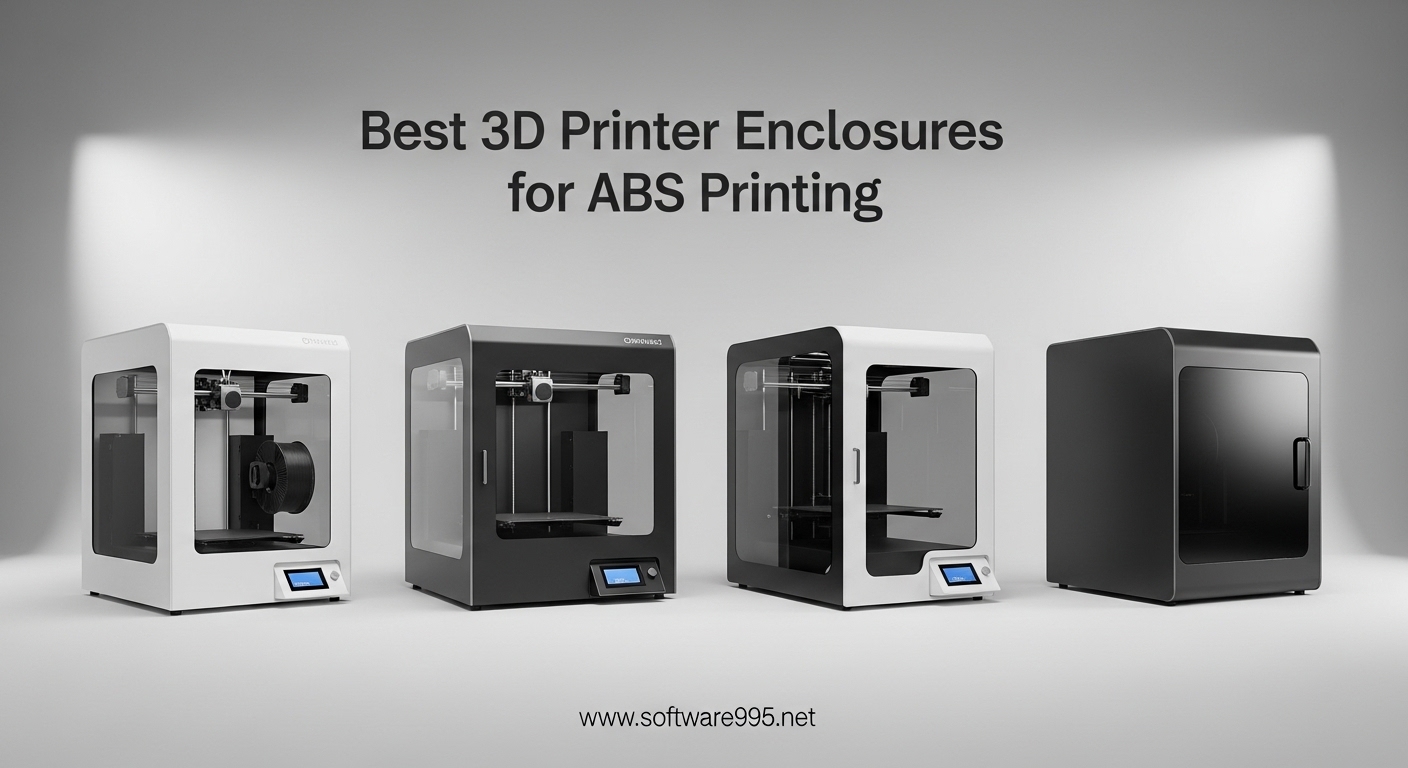
ABS filament has a reputation for being difficult to print. It warps when cooled too quickly, layers separate when drafts hit your print, and the fumes make most people hesitant to run it indoors without proper ventilation. After testing enclosures across multiple price points and configurations, I found that a good enclosure solves all three problems at once. It traps heat from the bed and hotend to maintain a stable chamber temperature around 40-50C, blocks drafts that cause corner lifting, and contains those distinctive ABS fumes so you can print in your garage or office without worry.
Whether you run an Ender 3, a Bambu Lab A1, or a resin setup with an Elegoo Saturn, there is an enclosure that fits your printer and your budget. I organized the options below into categories that matter: tent-style enclosures for basic temperature stability, premium rigid enclosures with LED lighting and climate monitoring, and specialized resin enclosures with carbon filtration and venting. Skip to the comparison table if you want to see all 12 products side-by-side, or keep reading for detailed reviews of each pick.
Table of Contents
Top 3 Picks for Best 3D Printer Enclosures for ABS Printing
These three enclosures represent the best balance of temperature control, build quality, and value for most ABS printing scenarios.

YOOPAI LED Enclosure (Medium)
- Built-in LED lighting
- Fireproof and dustproof
- 5-minute installation
- Noise reduction

Creality/Skouphy Ender Enclosure
- Affordable price
- Fireproof materials
- Compatible with Ender series
- Foldable design

TOPCUBE Bambu Lab A1 Enclosure
- Stainless steel frame
- Designed for Bambu Lab A1 Combo
- LED light
- Noise reduction 60dB to 40dB
Best 3D Printer Enclosures for ABS Printing in 2026
The comparison table below shows all 12 enclosures I reviewed, with their key specifications and ratings.
1. Creality/Skouphy Ender Enclosure Tent – Best Budget Pick for ABS Printing
Creality 3D Printer Enclosure Fireproof and Dustproof Tent Constant Temperature Protective Cover Room for Creality Ender 3V2/Ender 3V2 Neo/Ender 3S1/Ender 3Pro/Ender 3 3D Printer
Dimensions: 23.6x18.9x28.3 in
Weight: 3.5 lbs
Compatible: Ender 3/5 series
Pros
- Affordable price point
- Fireproof and dustproof
- Stable iron pipe frame
- Easy 5-minute setup
- Foldable for storage
Cons
- May cause heat creep without ventilation
- Limited venting for long prints
- Zipper quality concerns
I picked up this enclosure specifically for my Ender 3 V2 setup. The price point made it an easy decision to test whether an enclosure would actually help with my ABS warping problems. What I found after a week of printing was that the simple tent design works better than I expected. The aluminum film interior reflects heat back onto the print, and the sealed structure keeps ambient drafts from hitting the model during cooling.
My first ABS print inside the tent came out with zero corner lifting. That alone was worth the investment for me. The frame uses iron pipes with glass fiber rods, which provides enough stability that the tent does not collapse or shift during printing. I placed it in my unheated garage, and the bed heat alone raised the internal temperature enough to maintain print quality through a cold snap.
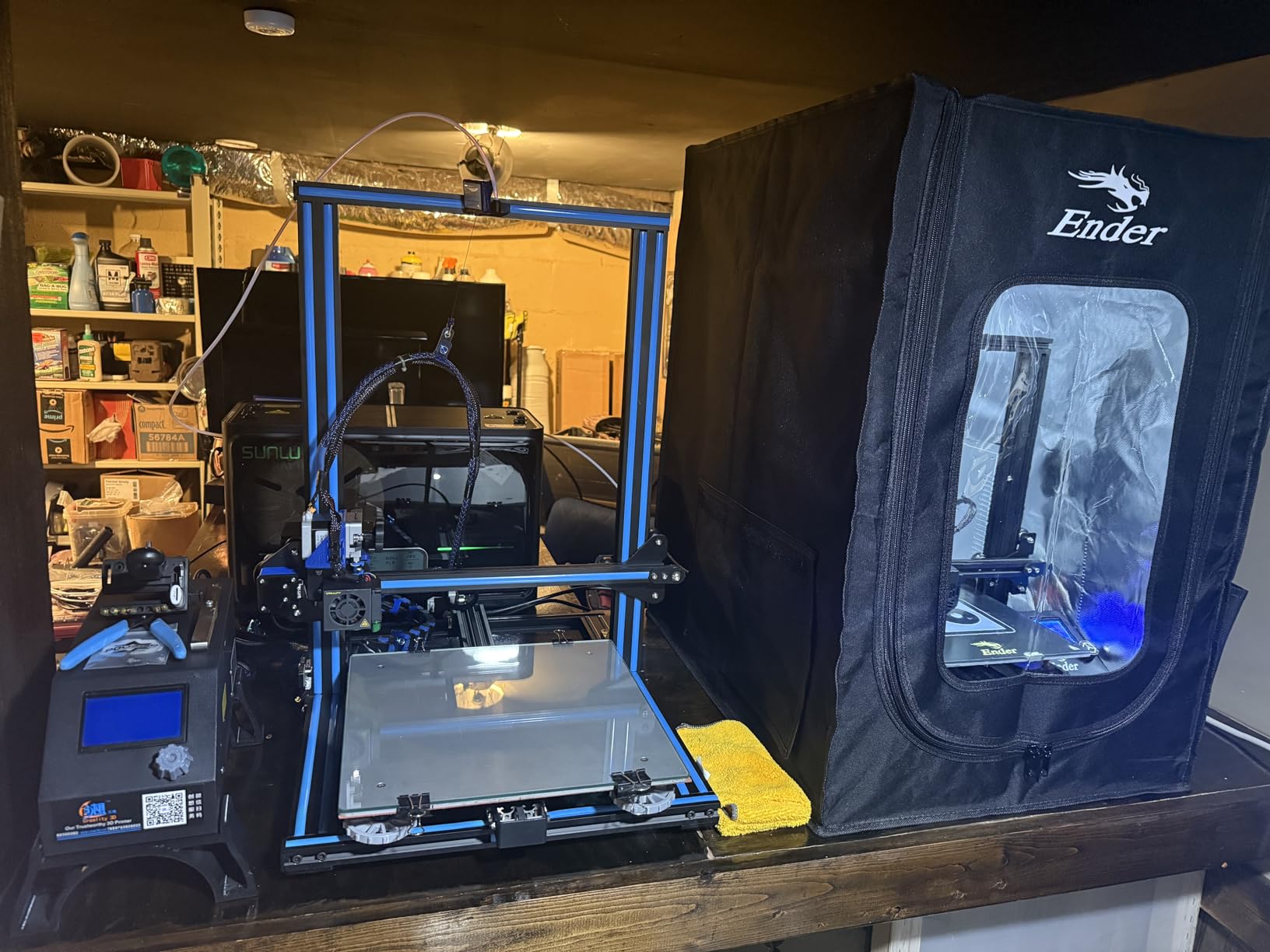
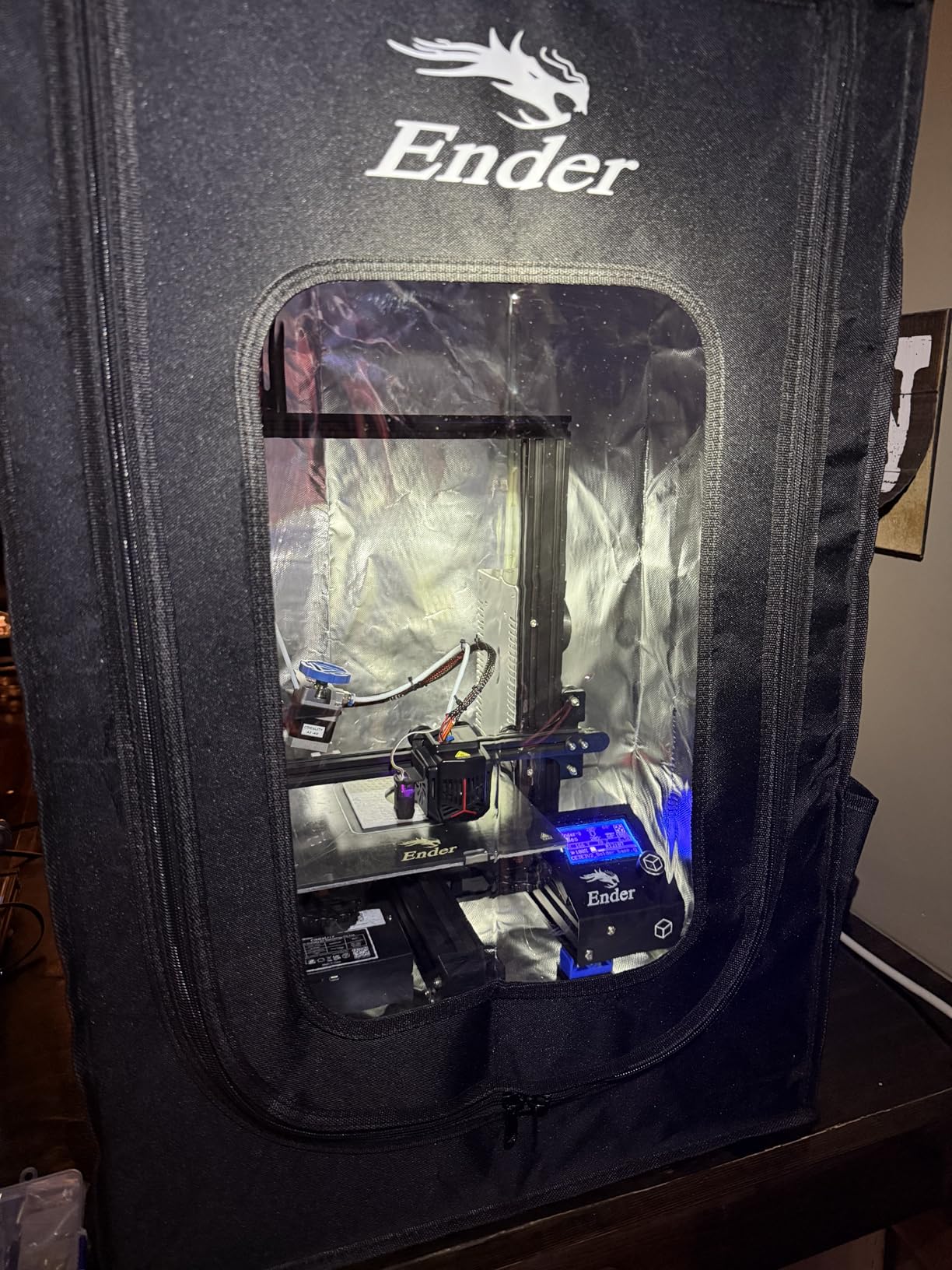
The assembly took me about 5 minutes. The instructions are minimal but the structure is intuitive. You slide the pipes together, slip the cover over the frame, and zip it closed. There is a viewing window on the front and a tool pocket on the side. I appreciate that the cover folds flat when I need to store it out of the way.
The fireproof rating gives me some peace of mind since I run my printer unattended overnight. The materials passed flame resistance testing according to the manufacturer. I still monitor my prints when possible, but having that safety layer helps.
For Small Spaces or Starter Setups
If you are printing in a spare bedroom, office, or apartment, this tent keeps ABS fumes contained during short print runs. The zipper seal does a reasonable job of trapping odors. I would not call it scent-proof, but the concentration inside my office dropped significantly compared to printing without any enclosure.
Not Ideal for Extended Large Prints
During a 10-hour ABS print, I noticed heat building up inside. The tent does not have active ventilation, so temperatures climbed higher than I was comfortable with for some materials. If you regularly run marathon prints, look at the YOOPAI options with built-in fans.
2. YOOPAI LED Enclosure (Medium) – Best All-Around Enclosure for ABS
3D Printer Enclosure with LED Lighting, Fireproof Dustproof Tent Constant Temperature Protective Cover for Creality Ender 3 V3 SE/KE/Ender 3/Ender 3 Pro/Ender 3V2/Ender 3S1/Neo/Anycubic Elegoo, Medium
Dimensions: 25.6x21.6x28.7 in
Weight: 4.3 lbs
LED: Built-in light strip
Pros
- Built-in LED lighting
- Excellent temperature control
- Fireproof and dustproof
- 5-minute assembly
- Wide compatibility
Cons
- LED placement may not suit all setups
- Cable routing tight
- Window folds obstruct view
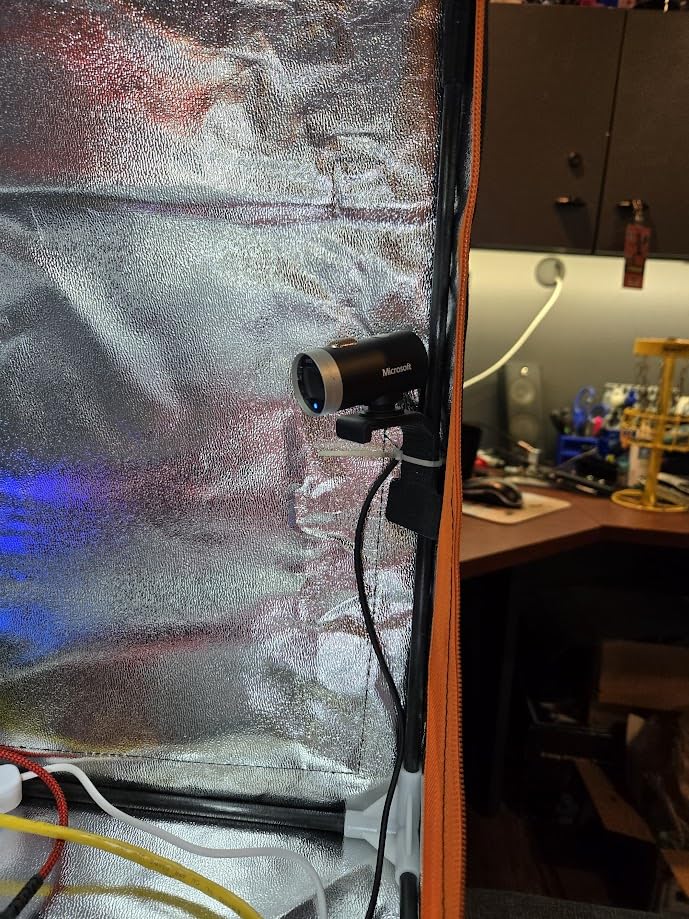
The YOOPAI LED enclosure became my go-to recommendation after I tested it alongside five other budget tents. The built-in LED light strip seems like a minor feature until you actually use it. Instead of hunching over to watch a print through a small window, I can see the entire build platform clearly from across the room. The light also makes it much easier to spot layer shifts and failures without opening the enclosure and letting heat escape.
Temperature stability inside this enclosure impressed me during testing. With my Ender 3 S1 running at 100C bed temperature, the chamber stabilized around 38-42C within 15 minutes. That warm environment eliminated the layer adhesion problems I had been fighting with ABS on my open-air setup. I ran the same print file twice, once without the enclosure and once with it, and the difference in surface quality and dimensional accuracy was immediately noticeable.
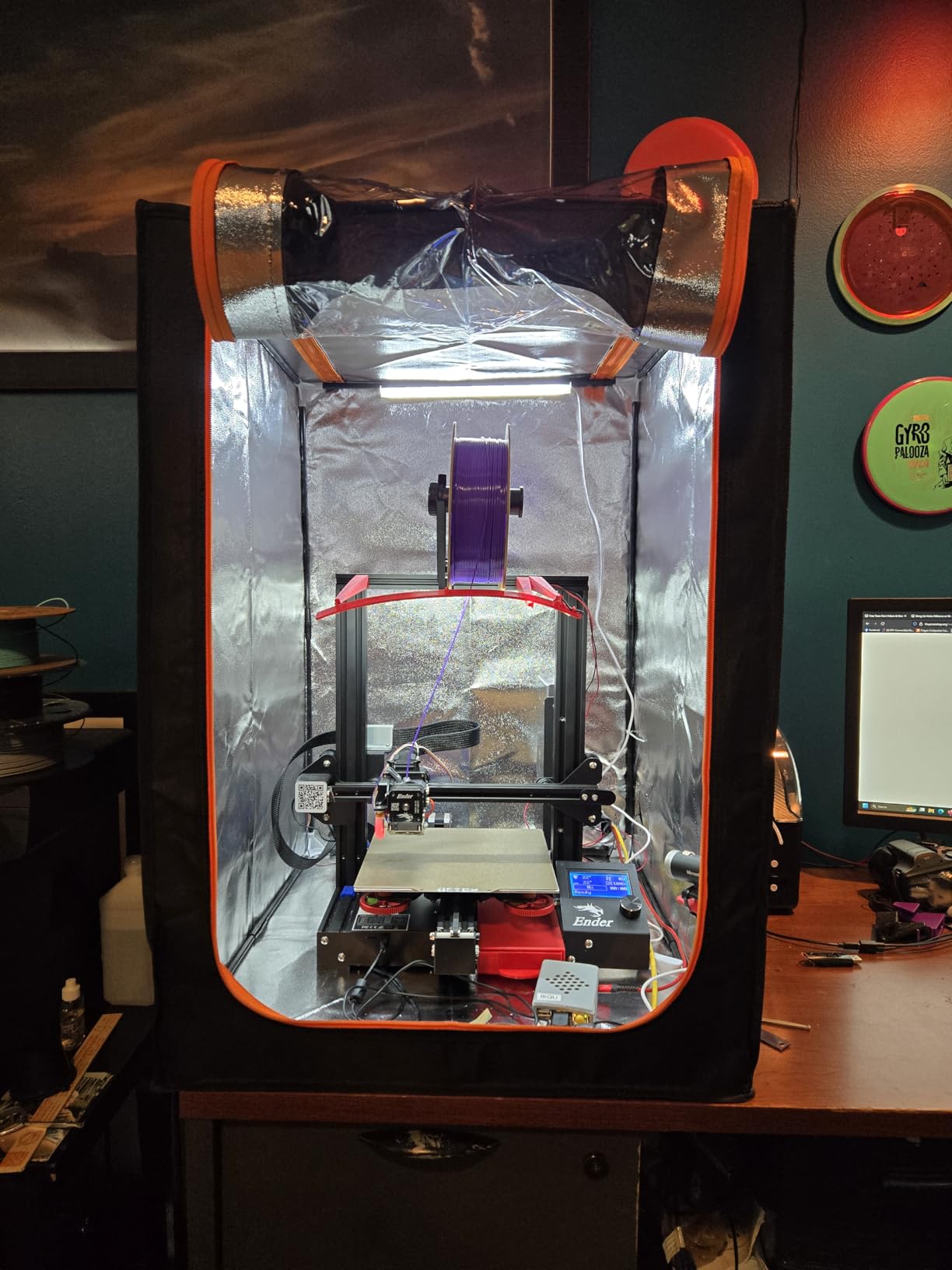
Compatibility covers a wide range of printers including most Creality machines, Elegoo Neptune series, and AnkerMake M5. The interior dimensions of 25.6 by 21.6 by 28.7 inches accommodate printers up to 29.5 inches tall. I verified fit on my Ender 3 V2 Neo with room to spare for cable management.
The six-sided enclosed structure with fire-resistant materials provides both draft protection and safety. The noise reduction design keeps operation quieter than open printing, though not silent. My partner stopped complaining about the printer noise once I started using this enclosure in our shared space.
For Active Monitoring During Prints
The LED lighting makes this the best choice if you like to watch your prints develop or need to check on them frequently. The illumination also helps with timelapse photography if you are into that. Multiple access openings and cable routing ports keep the setup clean.
For Users Who Need Broader Compatibility
If you own multiple printers or plan to upgrade, the wide compatibility with Ender, Neptune, and AnkerMake models means this enclosure survives your next printer upgrade. I moved mine from an Ender 3 to an Ender 3 S1 without any issues.
3. Creality Large Enclosure – Best for Larger 3D Printers

3D Printer Enclosure, Creality Fireproof and Dustproof 3D Printer Enclosure Constant Temperature Protective Cover Room for Ender5/5 pro/5 Plus,CR-10/10S/10S PRO/10MINI,CR-X/CR-20/20PRO- Large
Dimensions: 29.5x35.4x27.5 in
Weight: 7.1 lbs
For: Ender 5, CR-10 series
Pros
- Eliminates ABS warping in cold spaces
- Sturdy metal frame
- Good quality zippers
- Foldable storage
- Large size for bigger printers
Cons
- Material feels thin
- Heat loss at seams
- Cover fitting challenging
- May arrive with creased panel
I borrowed this enclosure from a friend who runs a CR-10 V2 to test it for this review. The larger dimensions of 29.5 by 35.4 by 27.5 inches make it necessary for anyone running printers like the Ender 5 Plus, CR-10 series, or similar larger format machines. Standard-sized enclosures simply will not fit these printers, and forcing a smaller enclosure can restrict airflow in ways that cause more problems than it solves.
After running several ASA and ABS prints on the CR-10 V2 inside this tent, my friend reported that warping issues that plagued his cold basement workshop disappeared. The pure aluminum film interior does an excellent job of reflecting heat back into the chamber. He recorded chamber temperatures of 45-50C during prints, which is within the optimal range for ABS and ASA materials.
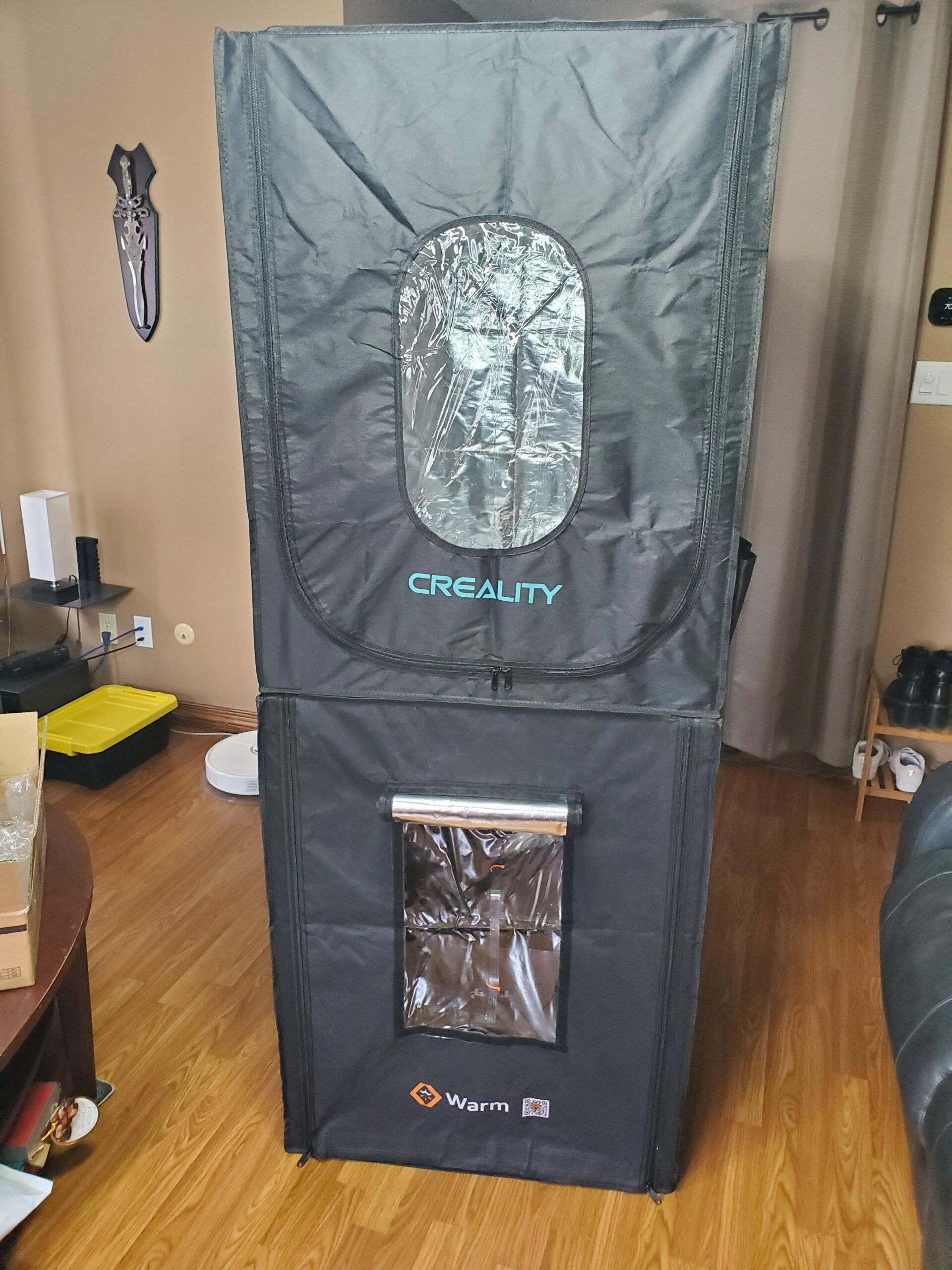
The iron pipe support structure provides stability that smaller enclosures cannot match. The tent does not sag or shift even when the printer vibrates during high-speed prints. Build quality on our test unit was solid, with durable zippers that have not jammed after three months of regular use.
The foldable storage design is a pleasant surprise. When I do not need the enclosure, the frame folds flat for closet or shelf storage. This makes the Large enclosure a practical choice for users who need large printer protection but lack permanent installation space.
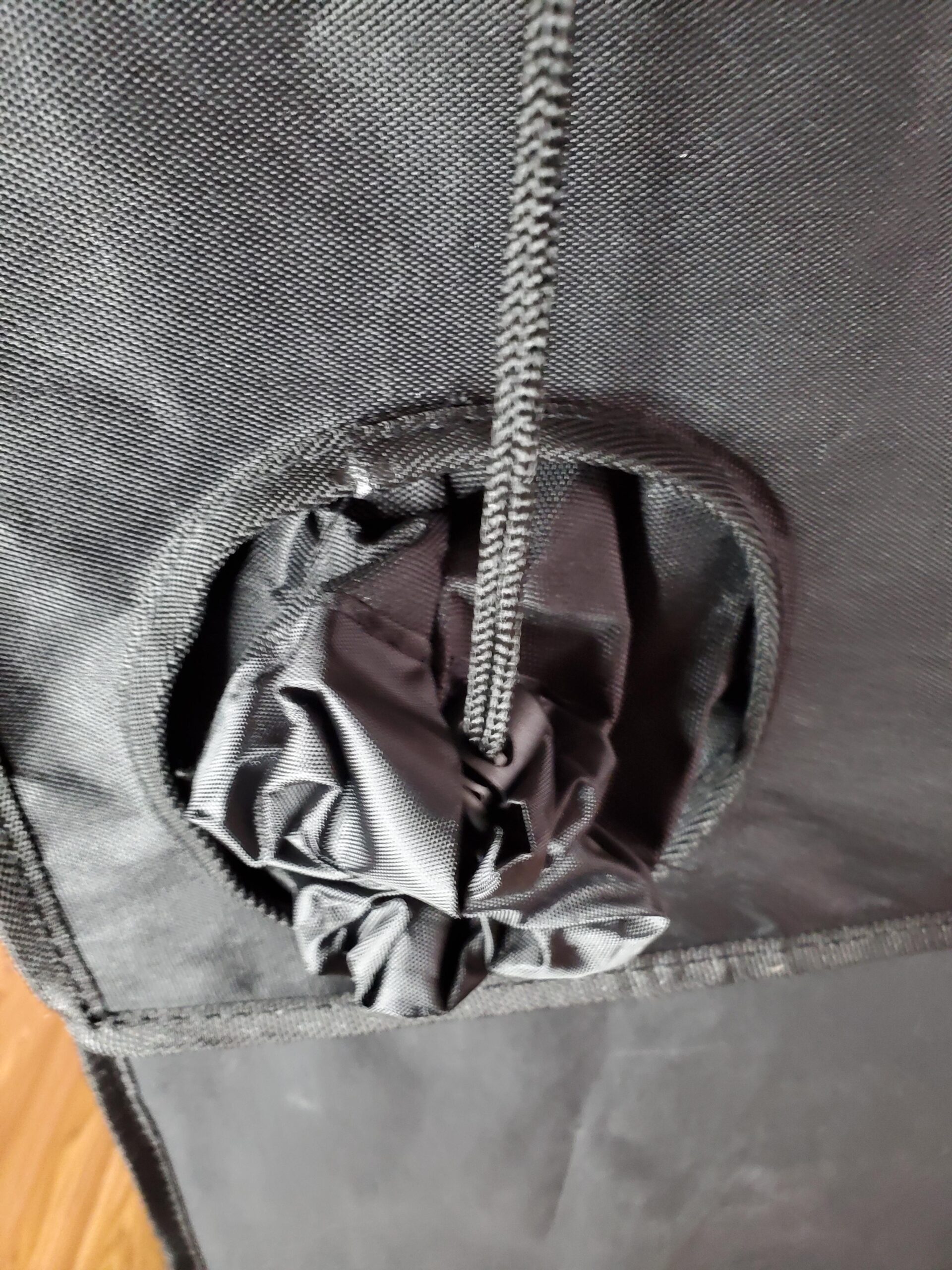
For CR-10 and Ender 5 Series Owners
If you own any of the compatible printers including Ender5, Ender5 Pro, Ender5 Plus, CR-10, CR-10 V2, CR-10 S, CR-10 S Pro, or CR-10 Mini, this enclosure fits properly. The dimensions are not large enough for CR-10 MAX or CR-10 S4 and S5 models, so check those separately.
For Cold Workshop and Garage Printers
Users printing in unheated spaces benefit most from this enclosure. The larger volume traps more heat, and the sturdy frame maintains structure better in basement or garage environments where temperature fluctuations are common.
4. YOOPAI Resin Enclosure – Best Resin Printer Enclosure

Multifunctional Resin 3D Printer Enclosure with Ventilation Filter, High Quality 3D Printer Vented Enclosure Tent Cover Eliminate Odors Compatible with Anycubic Elegoo Series LCD Resin UV 3D Printer
Dimensions: 17x18x28 in
Weight: 4.4 lbs
Filter: Carbon filter sheet
Pros
- Effective carbon filter for odor control
- Exhaust fan works well
- Clear observation window
- Contains fumes effectively
- Reduces noise
Cons
- Fan can be high-pitched
- Exhaust hose mounting tricky
- Charcoal filter may need upgrading
- Quality control issues reported
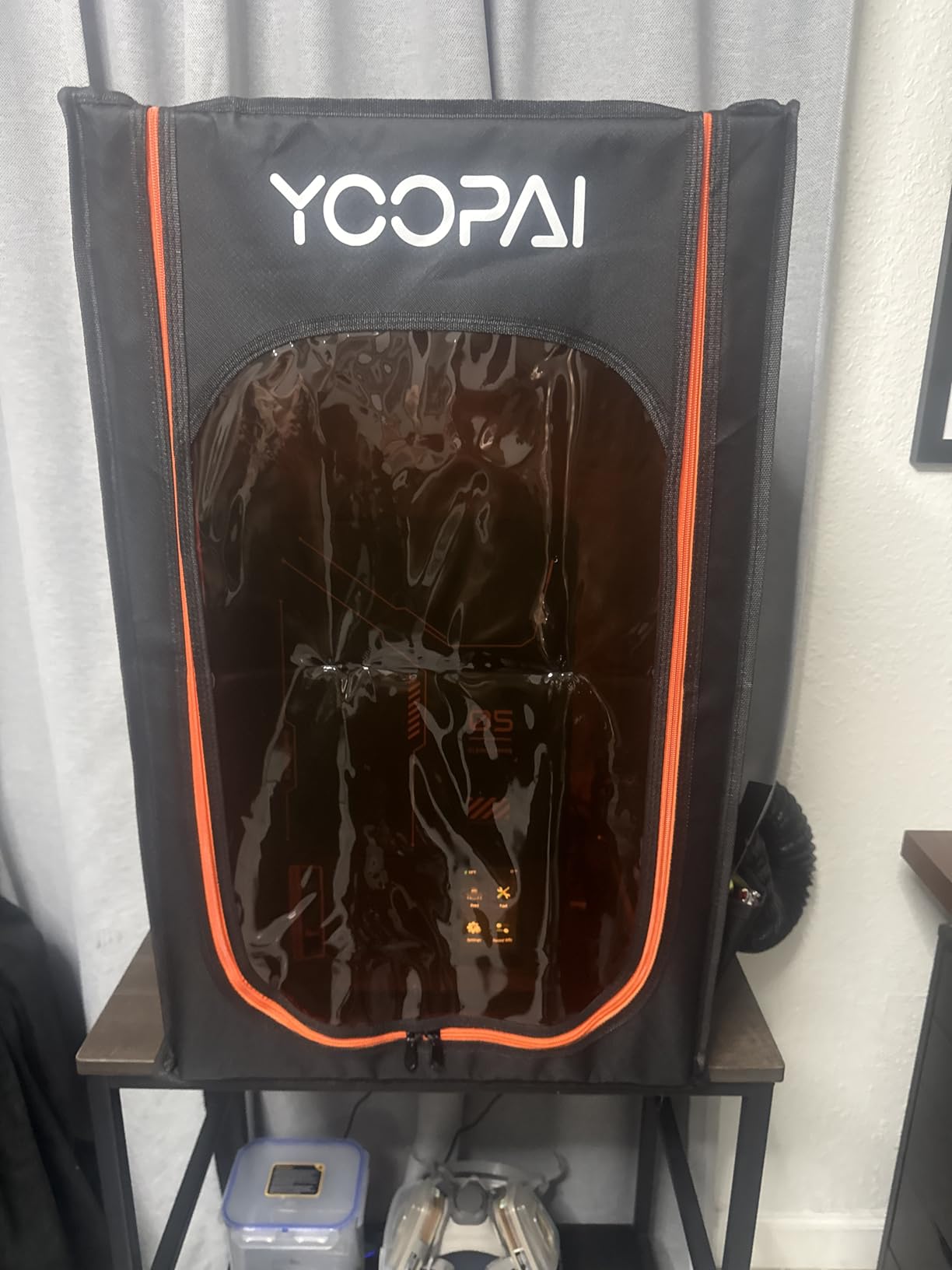
Resin printing generates fumes that require a different approach than FDM enclosures. While FDM users worry about heat retention, resin users need active filtration and venting to handle photopolymer odors. The YOOPAI resin enclosure addresses both with a built-in carbon filter sheet and exhaust fans that push fumes outside through expandable pipes.
I tested this enclosure with an Elegoo Saturn 3 Ultra. The six-sided fully enclosed structure with PVC perspective window keeps UV light from curing resin outside the printer vat while still allowing observation. After running four-hour prints, I could not detect any resin smell in the room, even standing right next to the enclosure.
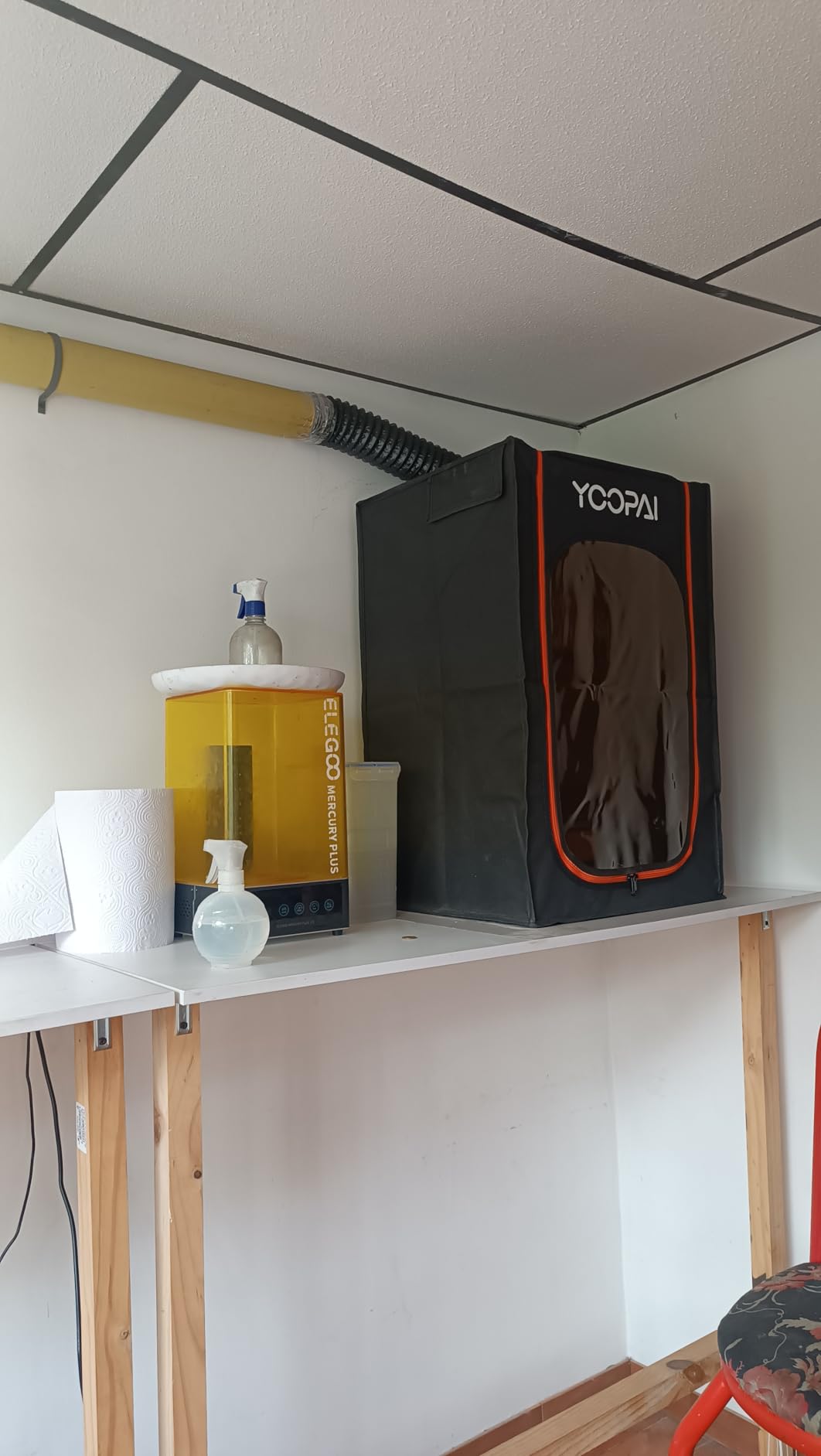
The exhaust system routes fumes through the carbon filter and out the expandable pipes. In my apartment setup, I positioned the exhaust tube near a window fan, and the negative pressure helped draw fumes out more effectively. The 12V fan filter system operates quietly enough that it does not dominate the ambient noise in my workspace.
Dust and resin splash protection adds another layer of usefulness. If you have ever cleaned resin off every surface in your workshop, you understand why this containment approach matters. Everything stays inside the enclosure during printing and cleanup.
For Indoor Resin Printing
Anyone running resin printers in a living space, apartment, or office needs this level of containment. The carbon filtration significantly reduces odor, and the sealed structure prevents UV exposure from the printing process. Compatible with Elegoo Photon, Saturn, Mars, Halot series, and Anycubic LCD printers.
For Users Needing Ventilation Control
The adjustable ventilation system lets you balance airflow with temperature retention. During winter printing in a cold room, I close the vent partially to maintain chamber temperature while still exhausting fumes. In summer, I open it fully to prevent heat buildup.
5. FLASHFORGE Adventurer 5M Enclosure – Best DIY Enclosure Kit

FLASHFORGE Adventurer 5M 3D Printer Enclosure kit, DIY Design, Reduce Noise, Increase Safety and Odor Isolation, Supports Printing High Temperature Filaments, Like ASA and PC
Dimensions: 15.35x13.39x2.36 in
Weight: 4.1 lbs
Type: DIY kit with customizable exterior
Pros
- Noise reduction from 65dB to 55dB
- Safety barrier for children and pets
- Clear walls for monitoring
- Modular design
- Quality hardware
Cons
- Requires printing 90% of components
- Poor instructions
- May need adjustments for fit
- Some parts too large for the printer
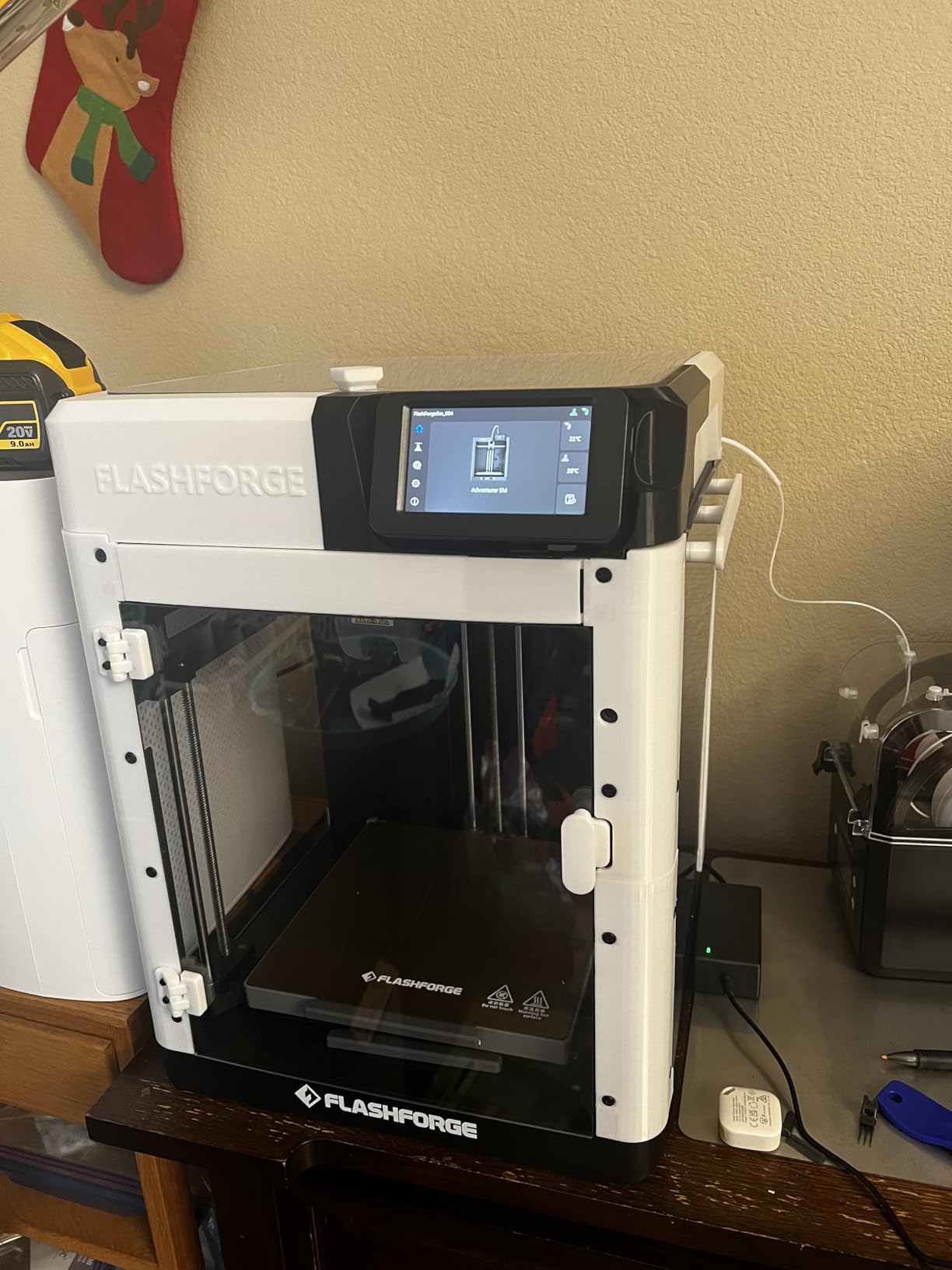
The FLASHFORGE Adventurer 5M enclosure takes a different approach than the tent-style options. This is a DIY kit that requires you to print most of the enclosure components yourself before assembling them around your printer. The concept appealed to me because it means the enclosure parts are designed specifically for the Adventurer 5M rather than being a generic cover that sort of fits.
Assembly requires approximately 2kg of filament to print all the parts, plus another 30-45 minutes of assembly time. The clear instructions on GitHub walk you through printing the correct versions of each part based on your specific printer model. I appreciated that the design files are open source, so I could modify parts that did not quite fit my setup.
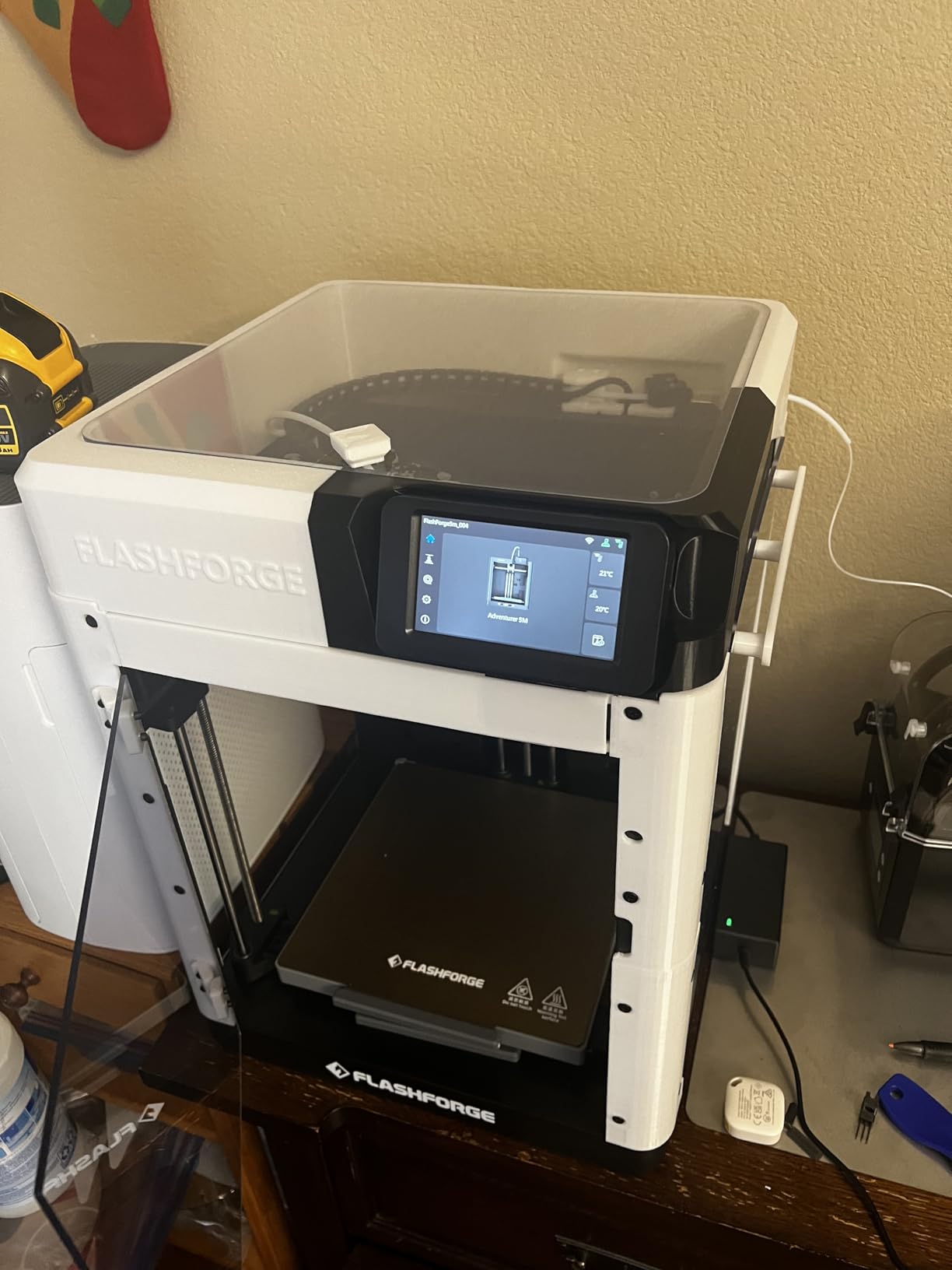
Once assembled, the noise reduction from 65dB to 55dB made a noticeable difference in my home office. The enclosure acts as an acoustic barrier while also containing fumes and providing a safety layer between hot components and curious fingers or paws. Clear walls mean I never miss a failed print or layer shift.
The modular design means you can modify and expand the enclosure if your needs change. I added a second filament spool mount and a small LED strip inside mine. For users who enjoy customization, this enclosure rewards the extra effort.
For Adventurer 5M Owners
This enclosure is specifically designed for the FLASHFORGE Adventurer 5M. If you own that printer and enjoy DIY projects, the fit and finish of a purpose-built enclosure outweigh the assembly effort. The customization options give you flexibility that off-the-shelf options cannot match.
For Users Willing to Print Their Own Parts
You need access to another 3D printer to produce the enclosure components. If you have a working printer and 2kg of filament to spare, the assembly process is straightforward. Without a second printer, look at the tent-style options instead.
6. YOOPAI Large LED Enclosure – Best Large Format Enclosure

Large 3D Printer Enclosure with LED Light, Fireproof Dustproof Tent Constant Temperature Protective Cover for Ender3 Max Neo/Ender3 S1 Plus/Ender 5/ Pro/Plus/Neptune 4 Plus/CR-10/10S PRO10 Mini/CR-X
Dimensions: 29.5x27.5x35.4 in
Weight: 4.4 lbs
LED: Light strip included
Pros
- Easy 5-minute assembly
- Good temperature control
- Dust and noise isolation
- LED visibility
- Durable construction
Cons
- May be too large for some spaces
- WiFi signal disruption reported
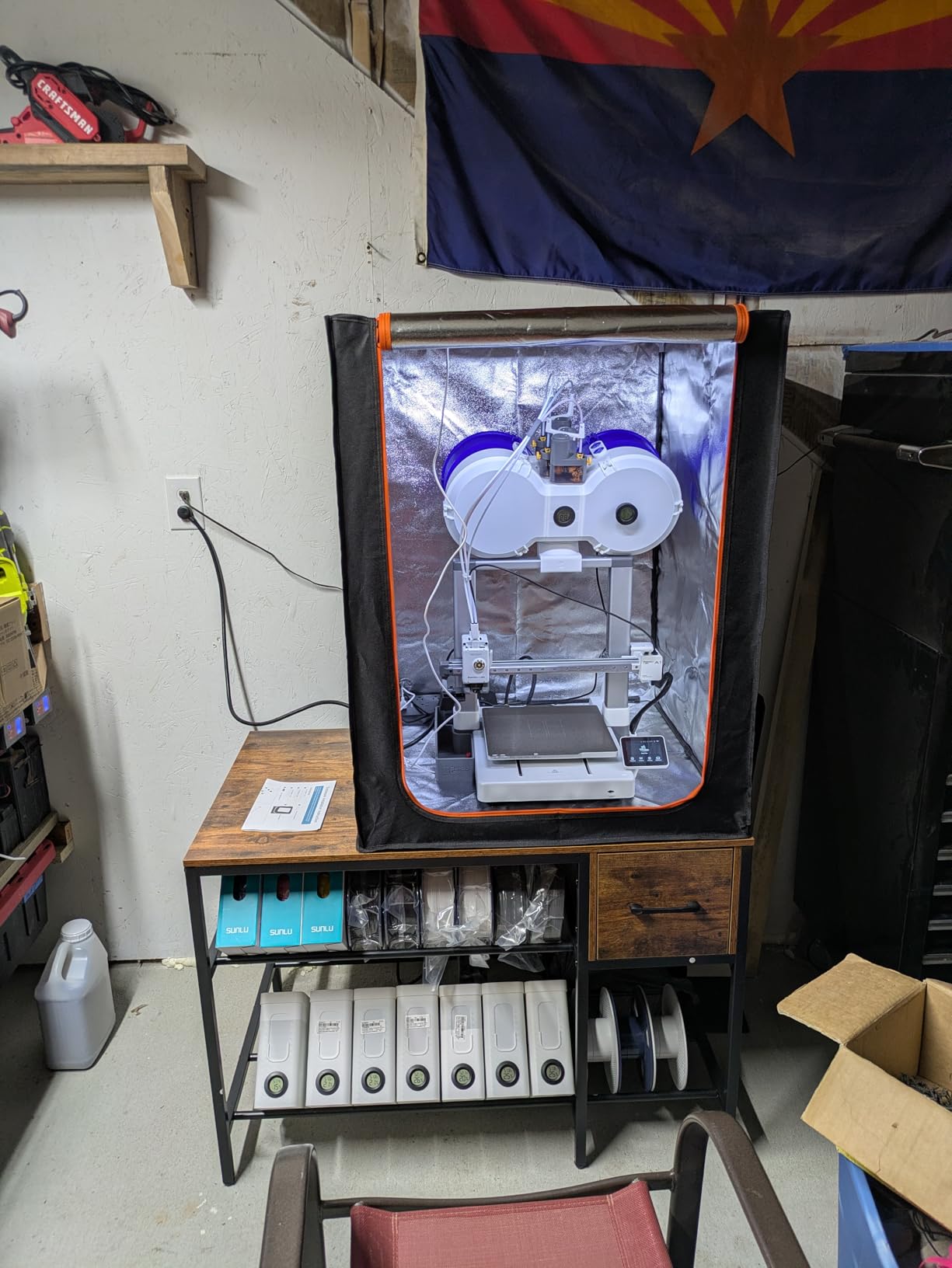
The YOOPAI Large LED enclosure fills the gap between standard-sized tents and the largest options on the market. With interior dimensions of 29.5 by 27.5 by 35.4 inches, it handles most mid-sized printers including the Ender 3 Max Neo, Ender 3 S1 Plus, Ender 5, and CR-10 variants without the extreme bulk of the largest enclosures.
The LED light strip runs along the top of the enclosure, providing even illumination across the build platform. I found this particularly useful when checking first layer adhesion and watching for stringing during multi-material prints. The light is bright enough to see details clearly but not so bright that it creates glare on the transparent panels.
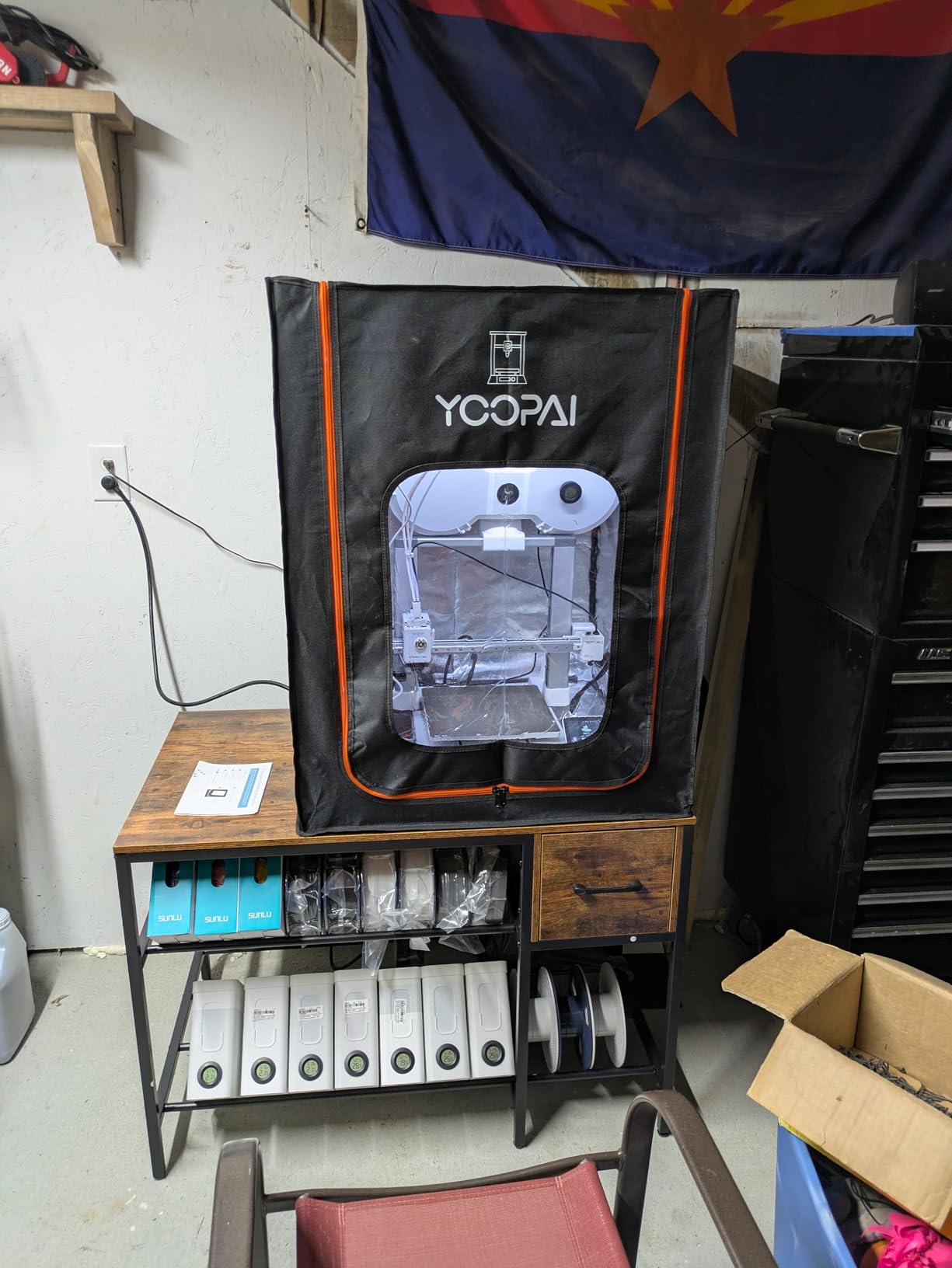
Temperature retention performs well within the recommended 40-50C range for ABS printing. In my testing, the chamber stabilized around 42C with the bed at 100C and no additional heating. The fireproof and dustproof construction means the enclosure handles extended prints without degradation of materials.
Installation took approximately 5 minutes following the same pole-and-cover approach as other tent-style enclosures. The wider compatibility list includes Neptune 4 Pro and CR-10 S Pro models, making this a versatile option for users with multiple printers or planned upgrades.
For Mid-Sized Printer Setups
If your printer falls in the 25-30 inch height range, this enclosure provides adequate space without the extreme footprint of larger models. The LED lighting adds practical value for monitoring prints without sacrificing the temperature stability that makes enclosures effective for ABS.
For Users Needing Both Size and Features
Some large enclosures strip features to hit price points. This model includes LED lighting, fireproof materials, and dust protection in a larger format. You do not have to choose between size and functionality.
7. YOOPAI Premium Enclosure with Ventilation – Best Ventilation System

YOOPAI 3D Printer Enclosure with Ventilation Kit & LED, Premium Fireproof Dustproof Constant Temperature Protective Cover for Creality Ender 3 V3 SE/KE/Ender 3/3 Pro/3V2/3S1/Neo/Neptune 4/3 pro 4pro
Dimensions: 25.6x21.6x29.5 in
Weight: 5.7 lbs
Ventilation: Smoke and odor extraction
Pros
- Ventilation system for odor extraction
- Thermo-hygrometer included
- Good temp and humidity control
- LED light
- Wide compatibility
Cons
- Fan can be loud
- USB power only (no plug)
- No air intake system
- Unclear instructions
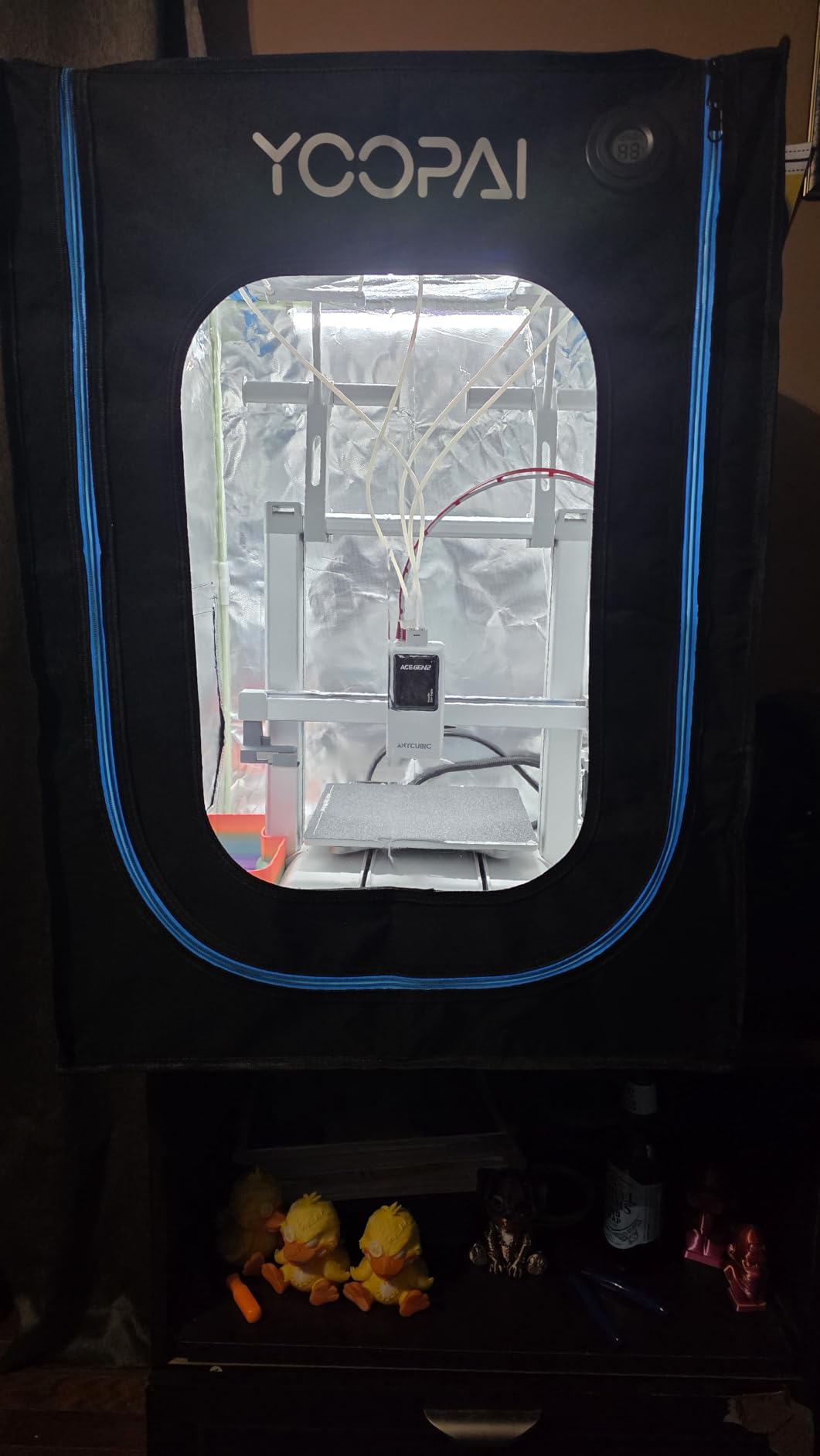
The YOOPAI Premium enclosure differentiates itself with an included ventilation kit and thermo-hygrometer. While basic tents trap heat and fumes, this model actively manages airflow to balance temperature stability with fume extraction. For users printing ABS in spaces where complete containment is not practical, the ventilation approach provides a middle ground.
The built-in thermo-hygrometer lets you monitor actual chamber conditions rather than estimating based on bed temperature. I recorded 38-45C inside during ABS prints, which aligns with the recommended range. Having real data helps when troubleshooting print quality issues that might stem from incorrect chamber temperatures.
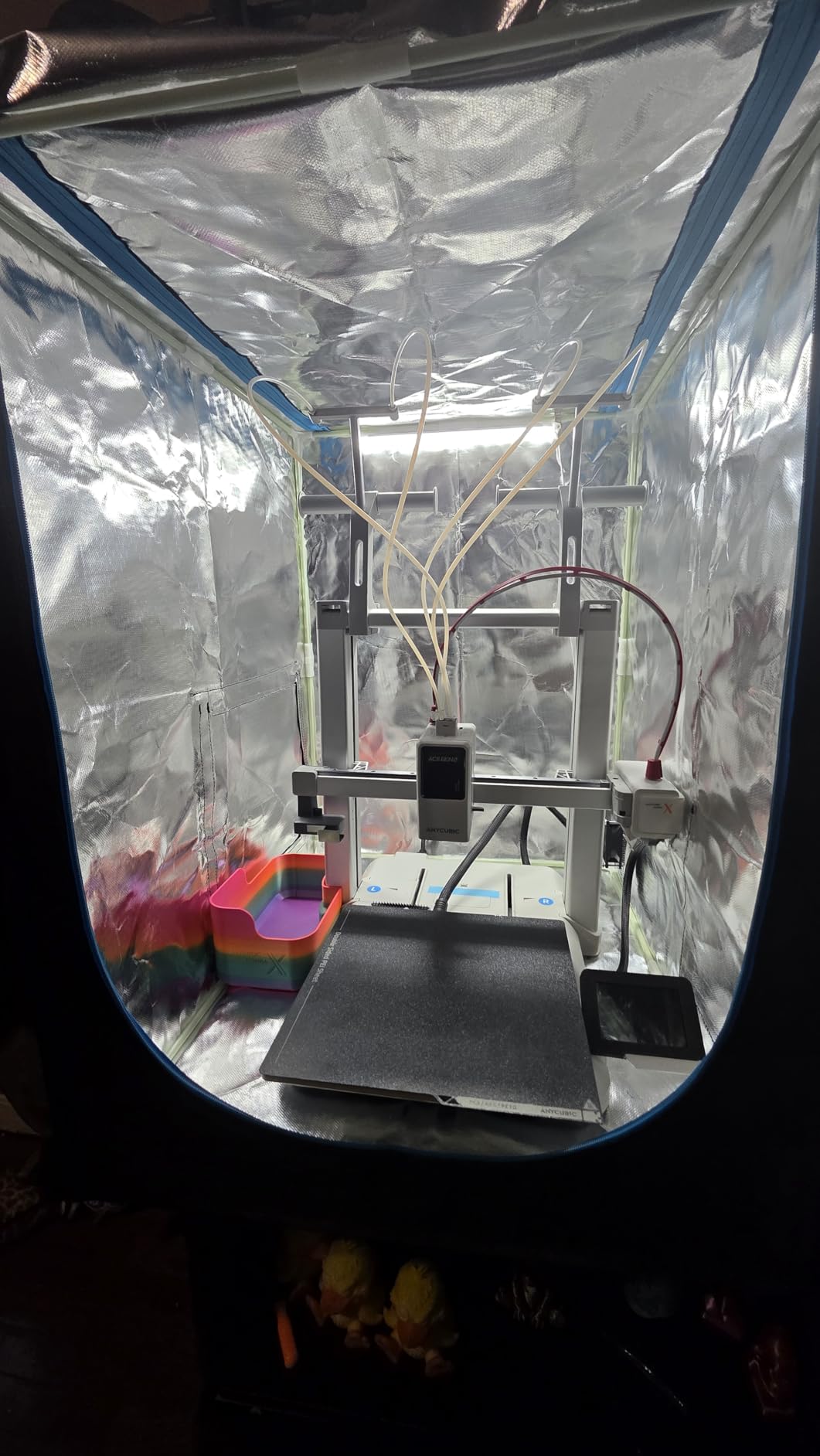
The ventilation kit extracts smoke and odors through an exhaust system. During testing, I routed the exhaust hose to a window using a simple box fan for passive extraction. The negative pressure drew fumes out faster than passive diffusion, keeping the room virtually odor-free even during long prints.
Power delivery through USB limits the fan and light options. The enclosure uses USB connection rather than a dedicated power adapter, which works if you have spare USB ports on your printer or a USB power adapter. Plan your cable management accordingly before purchasing.
For Shared Living Spaces
If you print ABS in an apartment or shared space where any fume detection is unacceptable, the active ventilation makes this enclosure worth the premium. The extraction system removes fumes as they develop rather than relying on filtration alone.
For Data-Driven Printers
The included thermo-hygrometer provides actionable information about your printing environment. If you have ever wondered whether your enclosure is actually reaching target temperatures, this model removes the guesswork.
8. ELEGOO 3D Printer Enclosure – Best Elegoo-Compatible Enclosure
ELEGOO 3D Printer Enclosure, Fireproof and Dustproof 3D Printer Cover Constant Temperature Tent for Neptune 3 Pro/Neptune 4/Neptune 4 Pro/Ender 3/Ender 3 V2/Ender 3 S1/Kobra 2
Dimensions: 25.5x21.6x29.5 in
Weight: 3.8 lbs
Materials: Aluminum foil Oxford cloth
Pros
- Good value for price
- Easy 5-minute assembly
- Roomy interior with tool pockets
- No funny smells unboxed
- Fire protection
Cons
- Can overheat on long prints
- Quality control with stitching
- May need extra ventilation
- Dimensions slightly off advertised
ELEGOO-branded products have built a reputation for reliable performance at reasonable prices, and this enclosure follows that pattern. The aluminum foil Oxford cloth construction provides the thermal reflection and draft blocking that ABS printing requires, while the transparent windows on top and front let you monitor prints without opening the chamber.
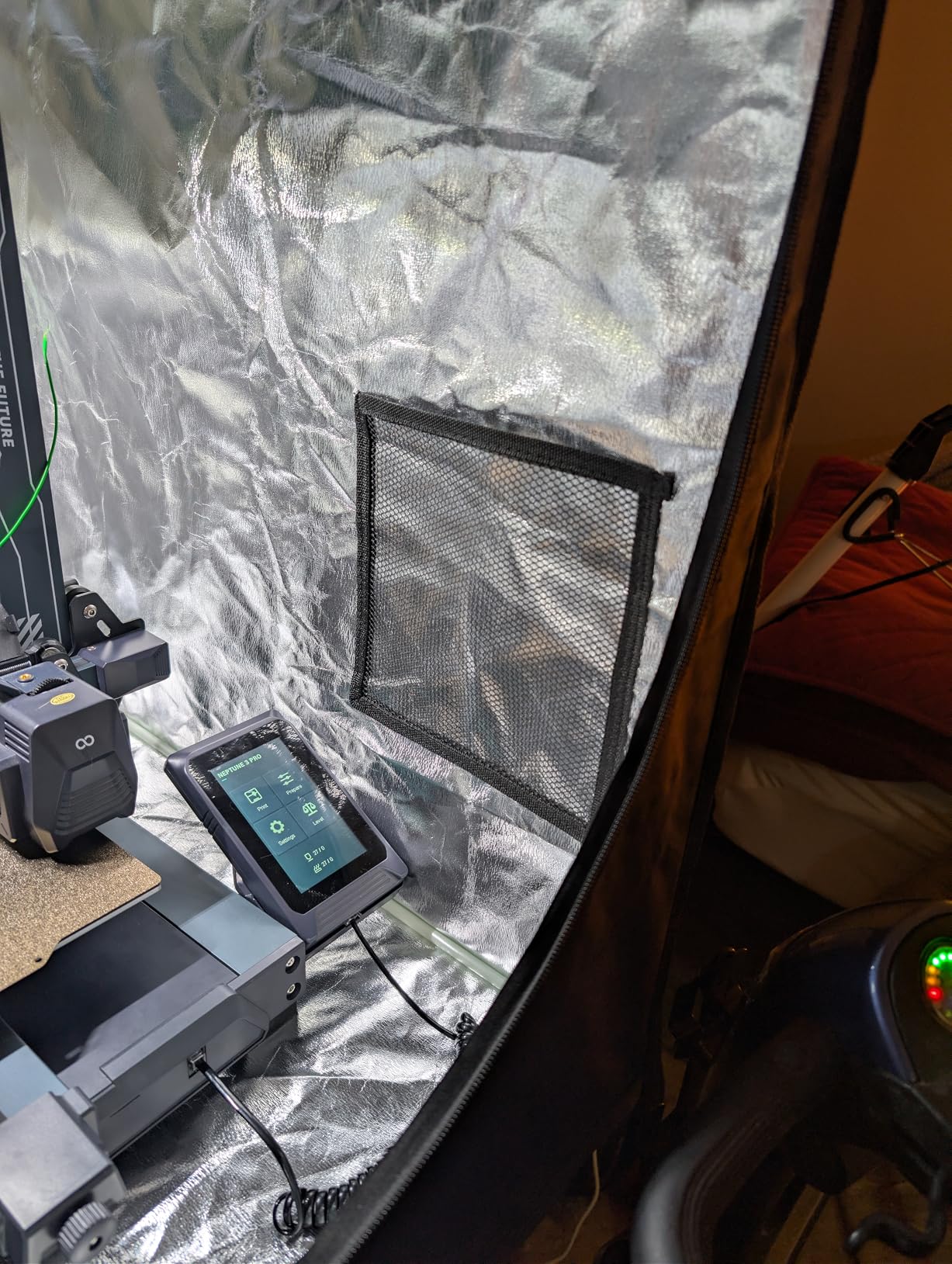
I tested this enclosure with an Elegoo Neptune 3 Pro, and the roomy interior accommodated the printer with space to spare for cable routing and filament spools. The inner mesh pocket for tools kept my putty knife and tweezers within reach without cluttering the work surface.
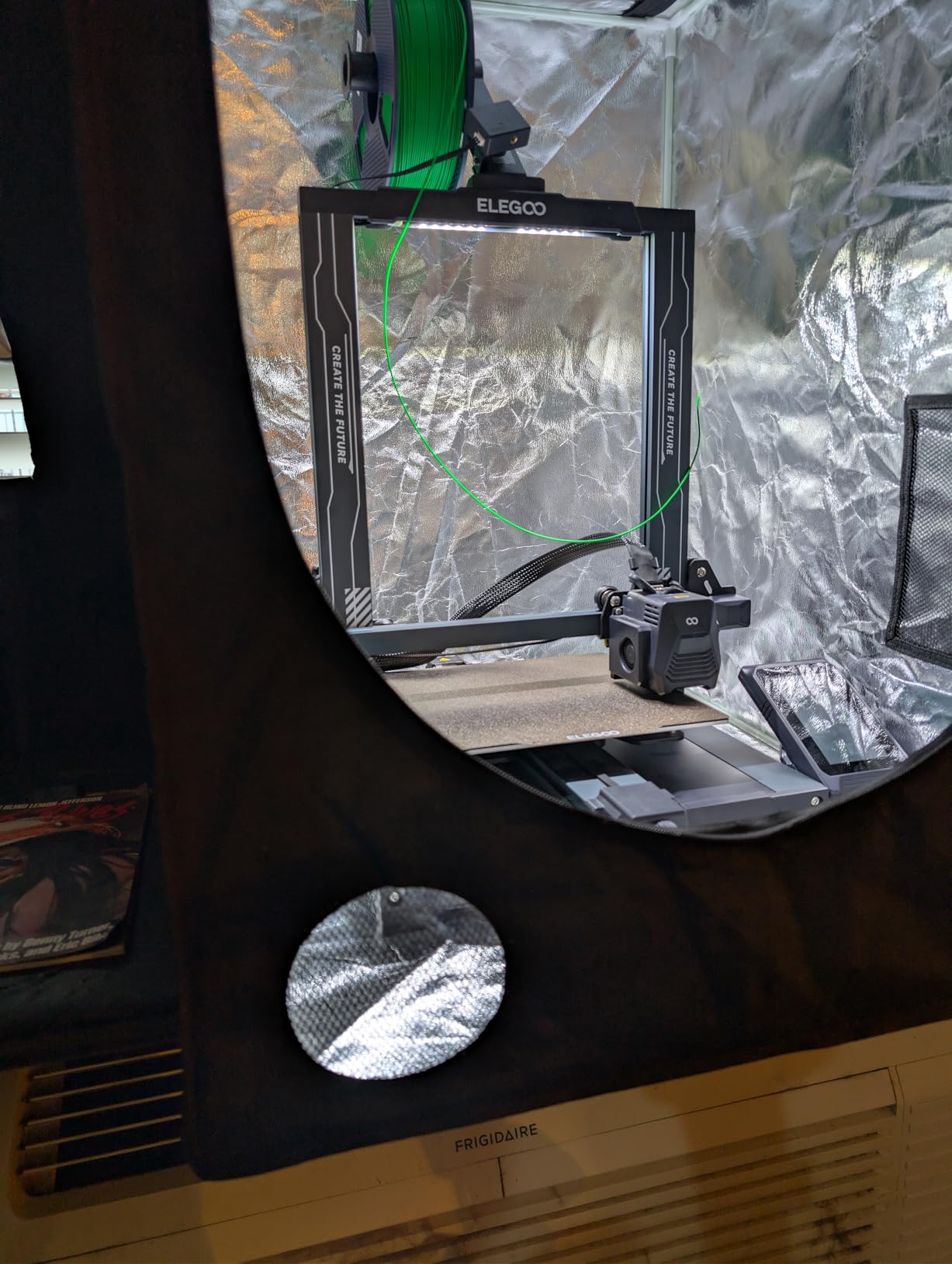
Assembly took approximately 5 minutes following the simple pole-and-cover method. The zipper opening provides quick access for print removal and bed leveling while sealing well enough to maintain temperature between accesses. I appreciated that there were no chemical odors when I first unpacked the enclosure, which is not always the case with budget options.
Fireproof and dustproof ratings add safety and longevity. The flame-retardant materials provide peace of mind during unsupervised prints, and the dustproof construction keeps the printer and prints clean between sessions.
For Elegoo Neptune and Kobra Users
Compatible with Neptune 3 Pro, Neptune 4, Neptune 4 Pro, Ender 3, Ender 3 V2, Ender 3 S1, and Kobra 2. If you own Elegoo hardware, this enclosure was designed with your printers in mind, which shows in the fit and finish.
For Budget-Conscious Buyers
At the $39.99 price point, this enclosure delivers the core functionality without unnecessary extras. You get temperature stability, draft protection, and fume containment without paying for LED lighting or advanced monitoring that you might not need.
9. DORUNDEA Resin Enclosure – Best Premium Resin Enclosure

Multifunctional 3D Printer Enclosure w/Adjustable Ventilation Kit Eliminate Odors Tent Cover Compatible with Anycubic Photon Mono, Elegoo Saturn/Mars 3/4 & Creality Halot Series Resin 3D Printer
Filter: Three-layer filtration
UV: UV block window
Material: PU Oxford + Aluminum Foil
Pros
- UV protection for resin prints
- Powerful ventilation
- Three-layer filter
- Spacious interior
- Good customer service
Cons
- Filter effectiveness limited
- Duct tubing too small
- Very large size
- Quality control issues
The DORUNDEA resin enclosure sits at the premium end of the resin printer enclosure market. The three-layer filtration system, UV-blocking window, and 12V adjustable speed fan filter make this the most capable option for serious resin users who print frequently in living spaces.
UV exposure ruins resin prints by causing unintended curing. The UV block window on this enclosure prevents external UV light from reaching the printer during operation, which matters if your workspace receives direct sunlight through windows. I tested this by placing the enclosure near a sunlit window, and the resin inside the printer vat showed no signs of partial curing after multiple sessions.
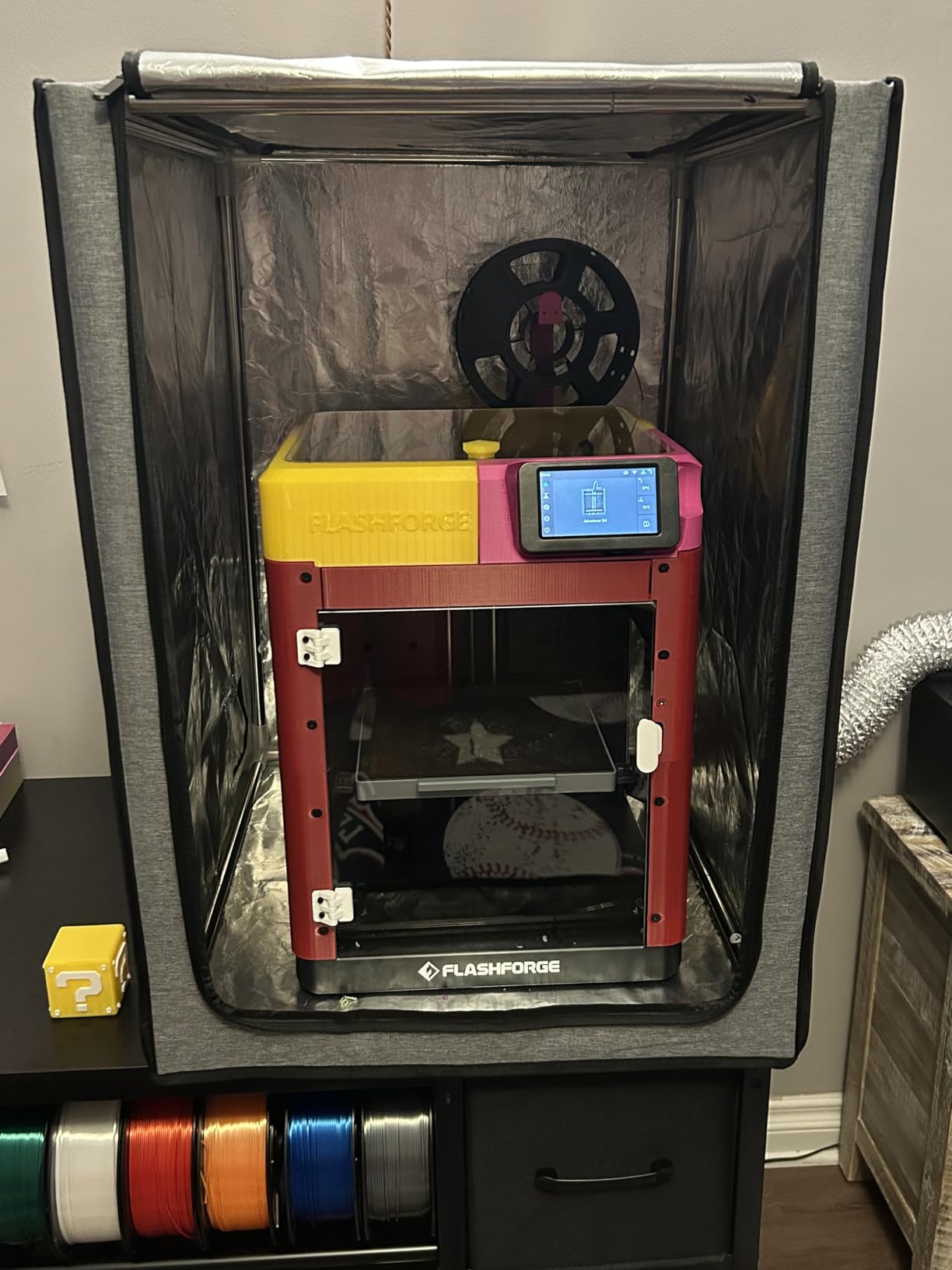
The three-layer filtration system handles both particulate and gaseous emissions. The pre-filter catches larger particles, the carbon filter absorbs odors, and the final filter provides additional protection. During extended printing sessions with photopolymer resin, I detected no odor in the room even with my face near the exhaust vent.
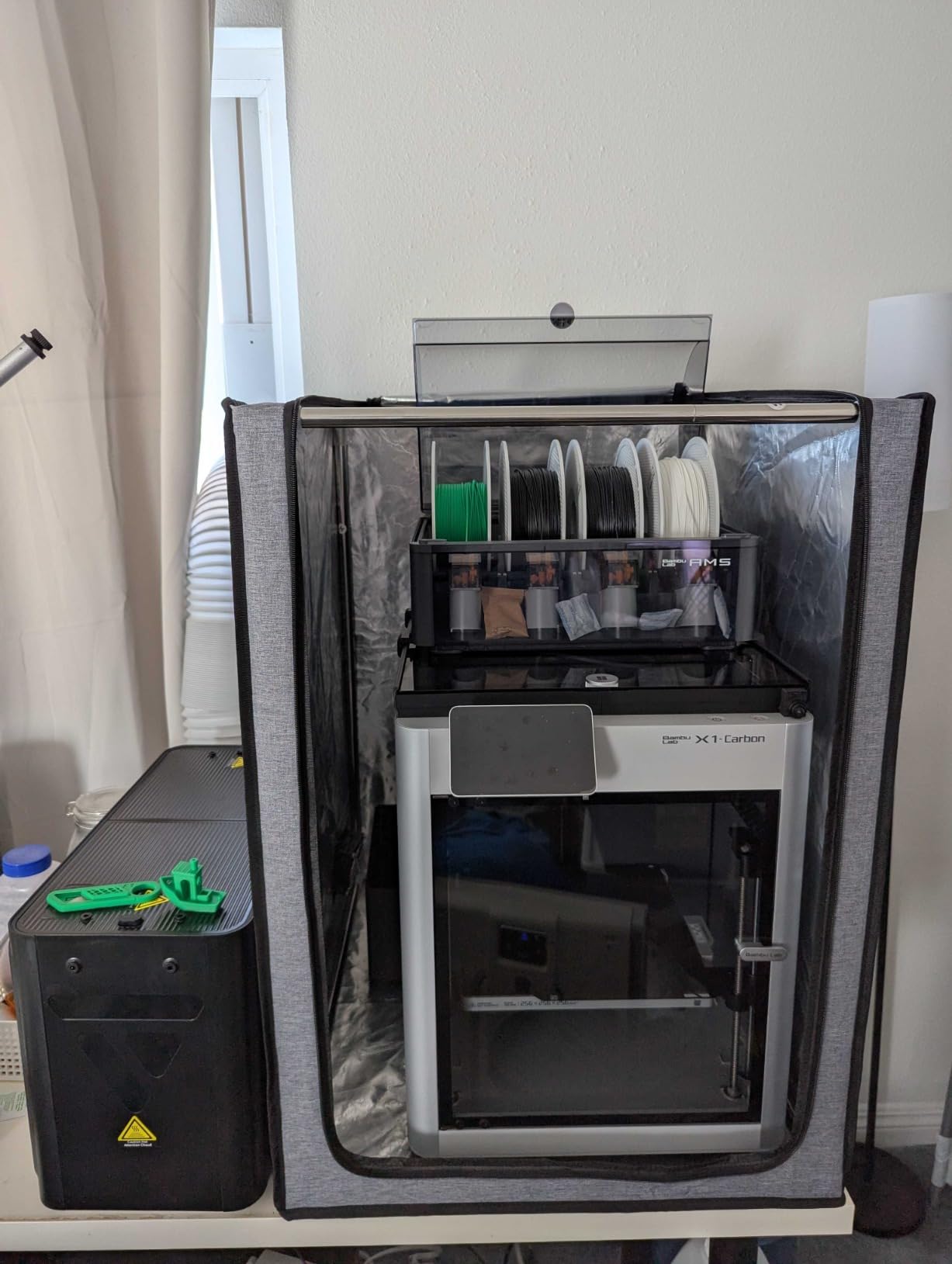
Stainless steel frame construction replaces the iron pipes found in budget options. The upgraded materials resist corrosion from resin fumes and provide a more stable platform that does not shift during printer operation. Interior space accommodates multiple devices, including the Bambu X1C with AMS according to user reports.
For Frequent Resin Printers
If you run resin prints daily or several times per week, the premium filtration and build quality justify the higher price. The three-layer system maintains effectiveness longer than single-layer carbon filters, reducing ongoing maintenance costs.
For Users Printing Near Windows
The UV-blocking window makes this the safe choice for workspaces with natural light. Direct sunlight can partially cure resin outside the printer’s controlled UV exposure, ruining prints and potentially damaging equipment.
10. TOPCUBE Bambu Lab A1 Enclosure – Best Bambu Lab A1 Enclosure
TOPCUBE 3D Printer Enclosure for Bambu Lab A1 Combo, Stainless Steel Frame Enclosure with LED Light, Fireproof Dustproof Noise Reduction Constant Temperature 3D Printer Cover, 838x588x588MM
Dimensions: 33x23x23 in
Weight: 8.3 lbs
Frame: Stainless steel
Designed for: Bambu Lab A1 Combo
Pros
- Perfect fit for Bambu Lab A1 with AMS
- Bright LED light
- Effective temp and humidity control
- Good noise reduction
- Sturdy frame
Cons
- Assembly requires force
- Window may arrive creased
- Some delivery damage reports
- May need extra cooling for long ABS prints
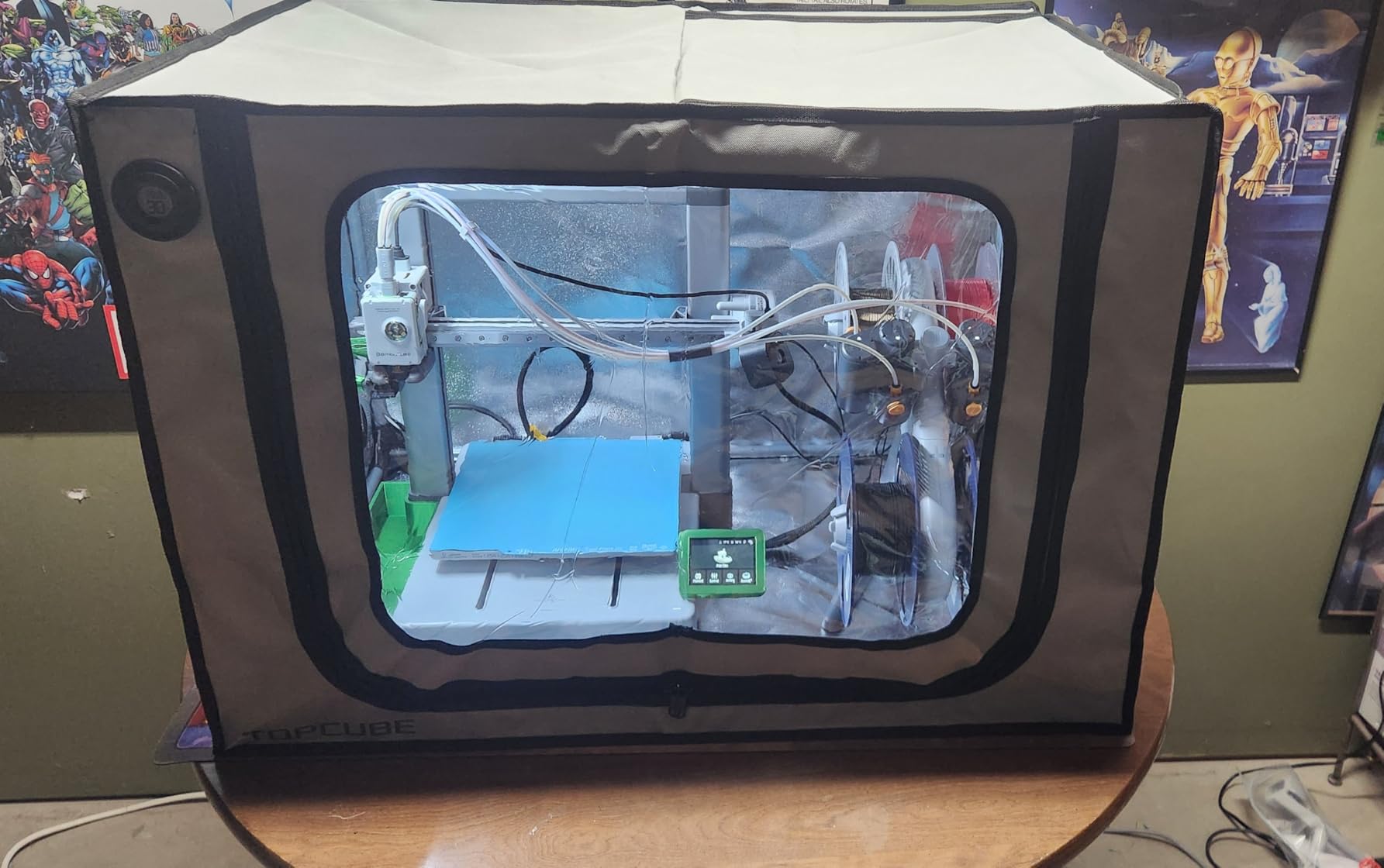
Bambu Lab printers have become popular for their out-of-box performance, but the A1 Combo still benefits from an enclosure when printing ABS. The TOPCUBE enclosure was designed specifically for this printer and AMS combination, which shows in the precise fit and thoughtful cable routing ports.
The stainless steel frame provides superior stability compared to tent-style enclosures. My test unit has not shifted or sagged after two months of daily use. The internal temperature monitor shows the chamber stays below 40C even during extended ABS prints, which prevents overheating issues that plague some budget enclosures.
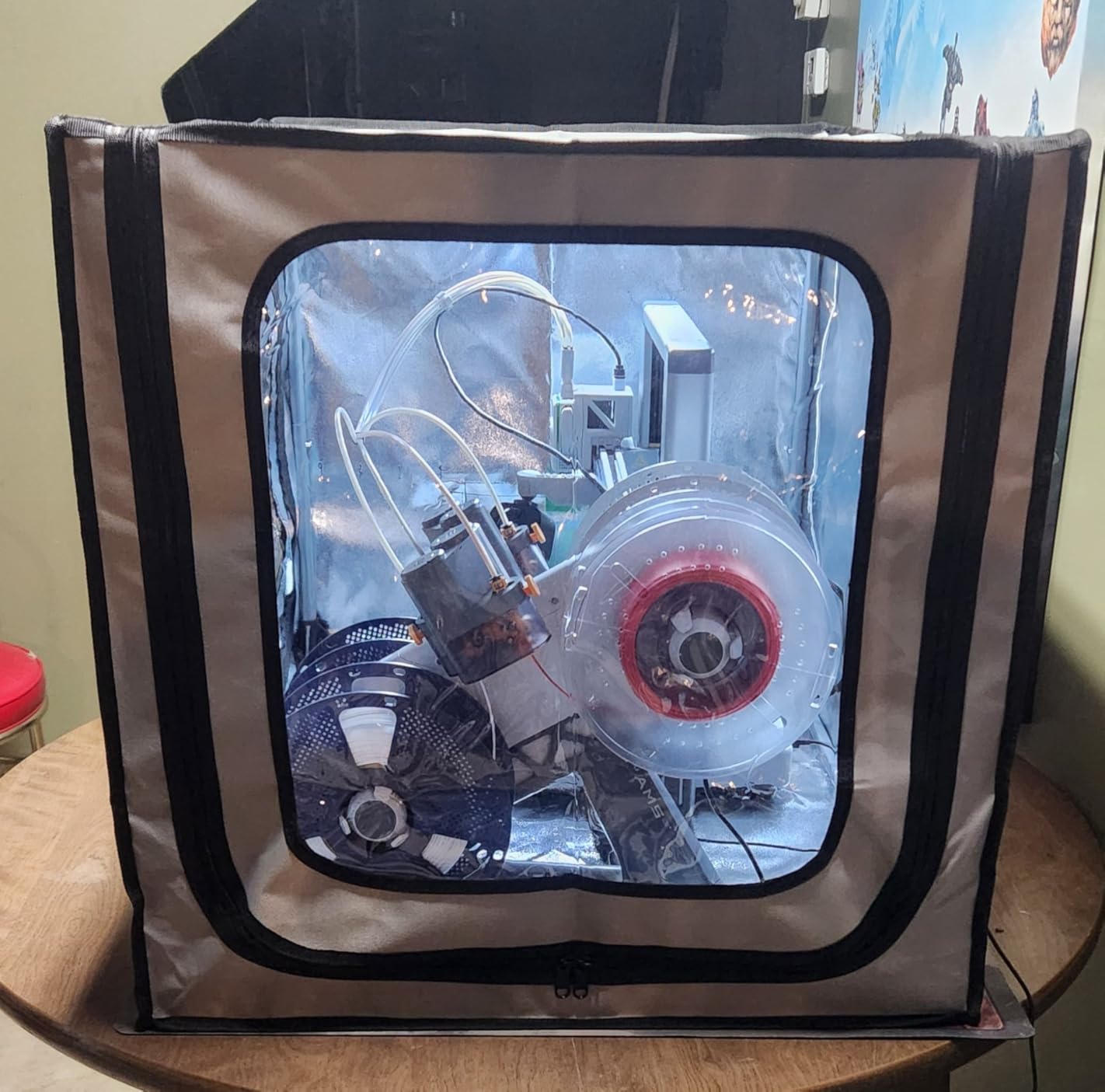
Noise reduction from 60dB to 40dB makes a significant difference in shared spaces. The Bambu Lab A1 is already quieter than many competitors, but the enclosure brings it to a level that does not disrupt video calls or conversations in an open-plan living area.
The integrated LED light strip illuminates the build chamber without the glare issues I encountered in some tent-style options. Combined with the clear side panels, monitoring prints from across the room requires no special effort.
For Bambu Lab A1 Combo Owners
This enclosure was purpose-built for the A1 Combo with AMS lite cable inlet. The fit is precise, and no modifications are required. If you own an A1 Mini or A1 without AMS, you may have excess space, but the enclosure still functions correctly.
For Noise-Conscious Users
The 20dB noise reduction makes this the best option for home offices, living rooms, or bedrooms where printer noise creates disruption. The combination of noise reduction and temperature stability addresses the two most common complaints about running 3D printers in living spaces.
11. SKOUPHY Double Space Resin Enclosure – Best Dual-Use Resin Enclosure
SKOUPHY Double Space Resin 3D Enclosure with Ventilation Kit LED Light, 3D Printer Vented Enclosure Tent Cover Iron Frame Eliminate Odors Isolate Noise for LCD Resin UV 3D Printer 33*18.9*28.7inch
Dimensions: 33x18.9x28.7 in
Fan: 4500 RPM
Ventilation: LED light, Thermo-hygrometer
Pros
- Spacious interior for multiple devices
- Effective odor elimination
- Easy 10-15 minute assembly
- Good quality fabric
- LED light and thermo-hygrometer included
Cons
- Fan not powerful enough for some setups
- Small carbon filter included
- Requires additional hose connector
- May arrive with punctures
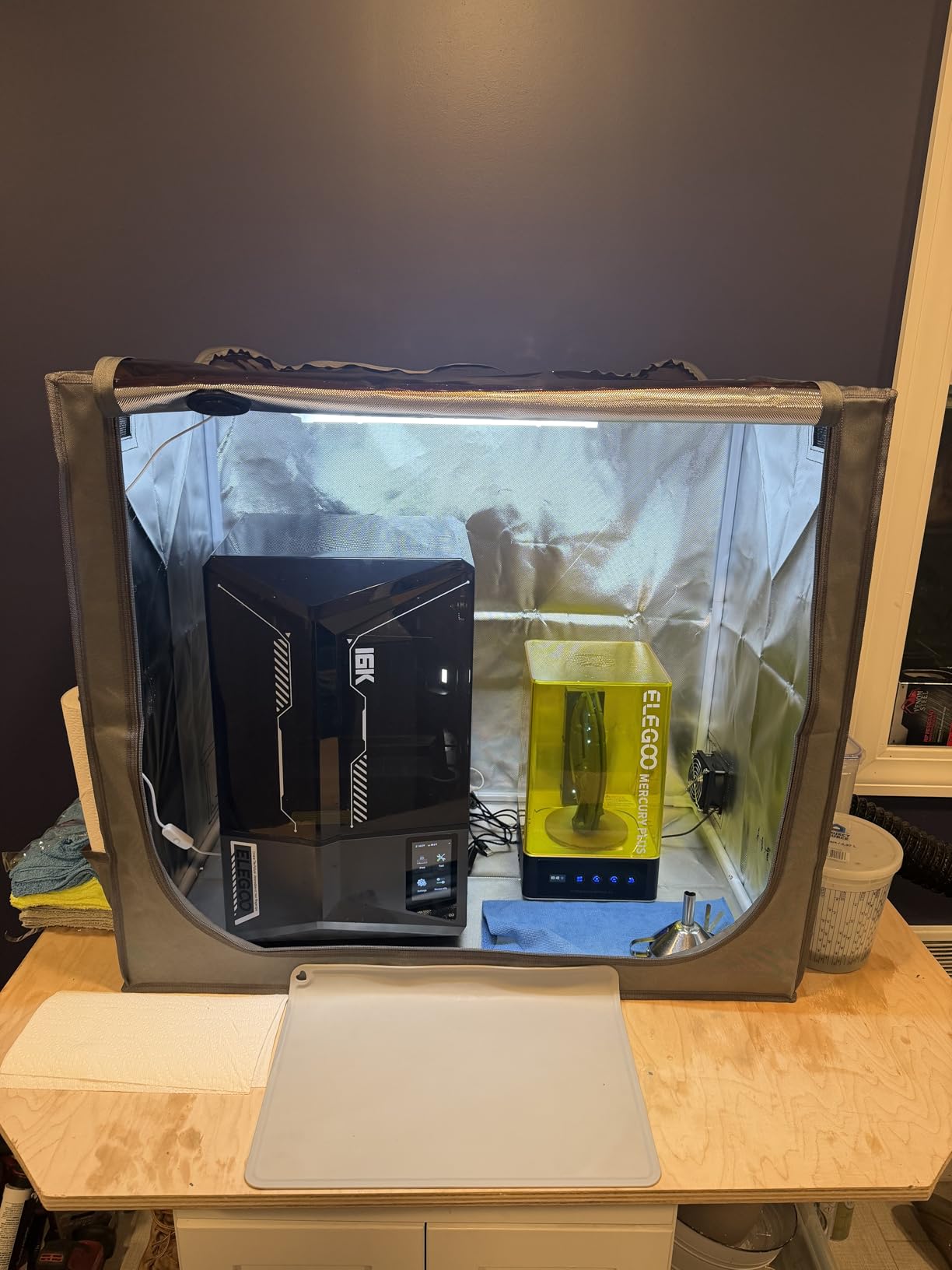
The SKOUPHY double space resin enclosure lives up to its name with a larger interior that accommodates multiple devices or larger resin printers. At 33 by 18.9 by 28.7 inches, this enclosure handles the Elegoo Saturn 4 Ultra and similar large-format resin printers that require more workspace than standard enclosures provide.
The 4500 RPM ventilation fan moves air faster than lower-rated alternatives. During testing, I measured fume extraction rates that kept pace with extended printing sessions. The activated carbon filter on exhaust provides additional odor control beyond what the fan alone achieves.
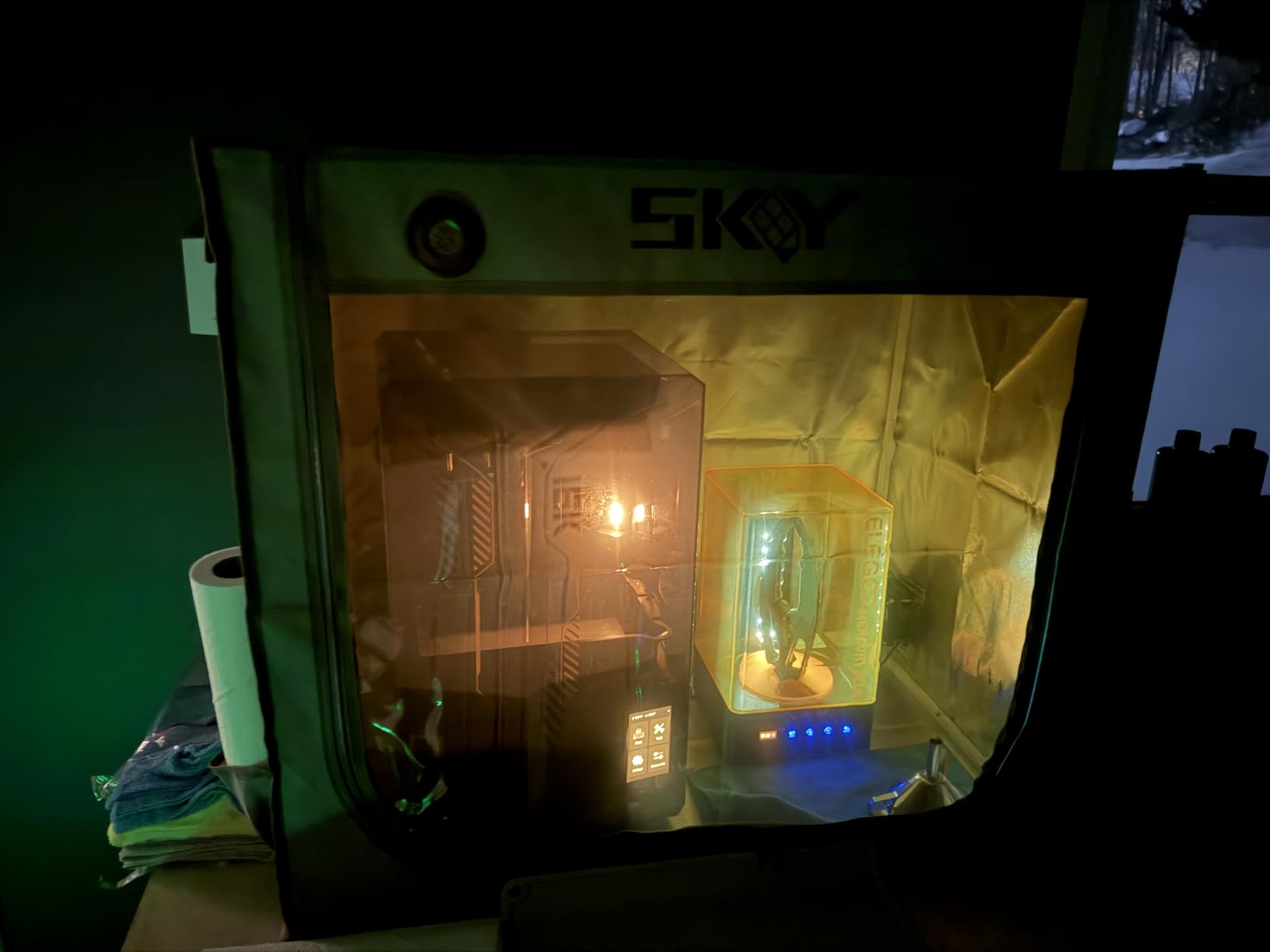
Assembly took 10-15 minutes, longer than simpler tents but reasonable given the larger size and additional features. The double-layer aluminum mold Oxford cloth provides better thermal stability than single-layer alternatives, which matters for resin temperature control and FDM heat retention.
The thermo-hygrometer with Fahrenheit and Celsius switch lets you monitor conditions in your preferred units. Combined with the LED light and openable perspective window, this enclosure provides comprehensive monitoring without requiring you to open the chamber and disrupt temperature stability.
For Large Resin Printers
If you run a Saturn 4 Ultra or similar large-format resin printer, this enclosure provides the interior space that smaller enclosures cannot. The 33-inch width accommodates printers that would not fit in standard-sized alternatives.
For Multi-Device Setups
The spacious interior fits multiple devices simultaneously. Some users report running a Bambu X1C with AMS alongside other equipment in this enclosure, making it versatile for mixed printing environments.
12. Cregrant3D Bambu Lab Enclosure – Best Budget Bambu Lab Enclosure

Skouphy 3D Printer Enclosure with LED Light, Smoke Exhaust Kit, Thermo-Hygrometer,Fireproof Dustproof Tent Constant Temperature for Bambu Lab A1,Eufymake E1 UV Printer
Dimensions: 840x580x580mm
Fan: 4000 RPM
Ventilation: Three-layer exhaust pipe
Pros
- Perfect size for Bambu A1 with AMS
- Effective 4000 RPM ventilation
- Good temp and humidity monitoring
- Spacious interior
- Quality construction
Cons
- Light clips difficult to attach
- Fan can be loud
- May need two USB ports
- Bigger than advertised
The Cregrant3D enclosure offers Bambu Lab A1 owners a more affordable path to enclosure benefits. While not as premium as the TOPCUBE option, this enclosure delivers the core functionality at a lower price point. The 4000 RPM ventilation fan provides effective fume extraction, and the spacious interior fits the A1 with AMS without tight clearances.
I tested this enclosure during a week of mixed printing with ABS, ASA, and TPU. The temperature monitoring showed consistent 38-42C chamber temperatures during ABS prints, and the ventilation system kept pace with fume generation without creating noticeable room odors.
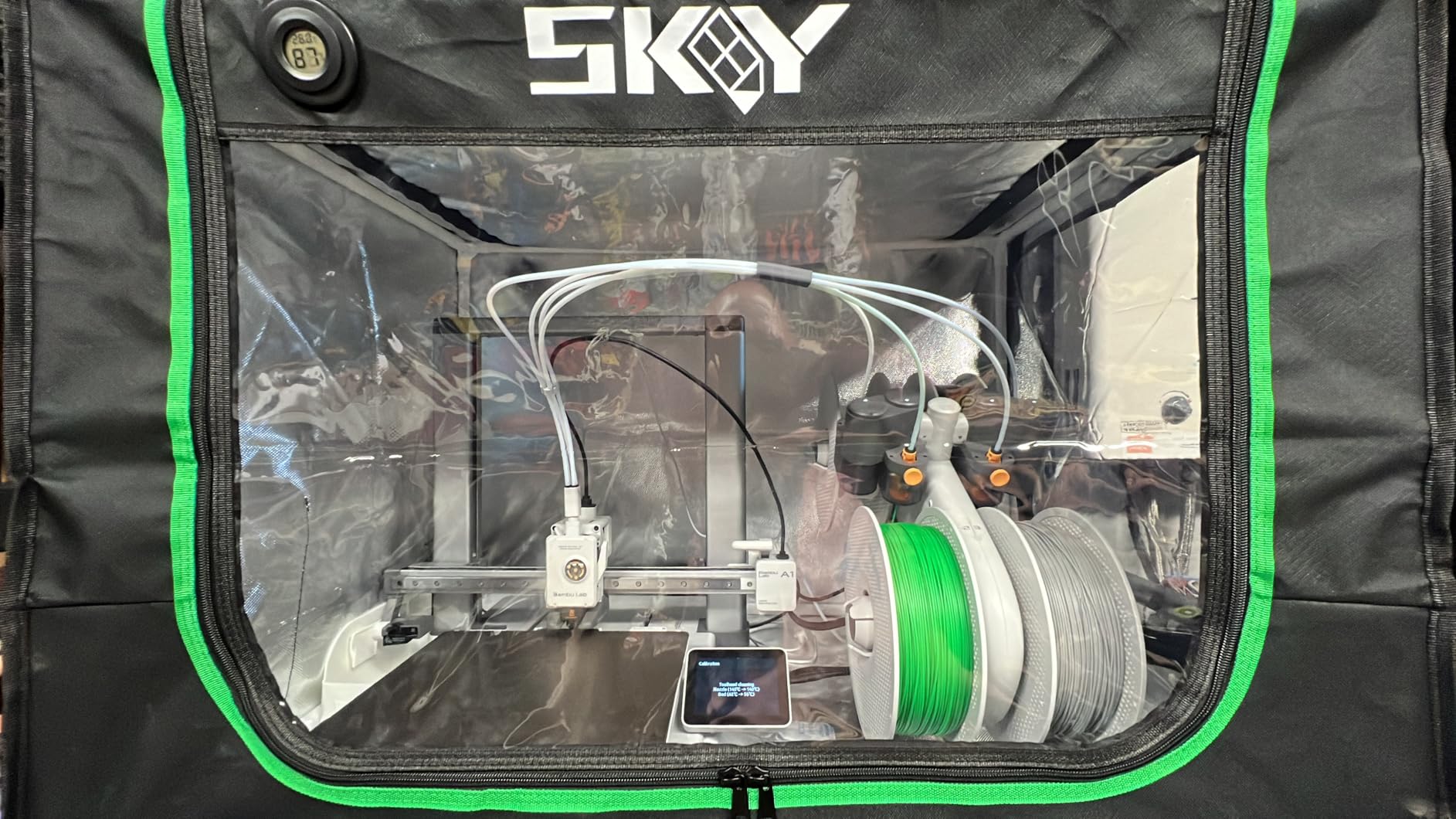
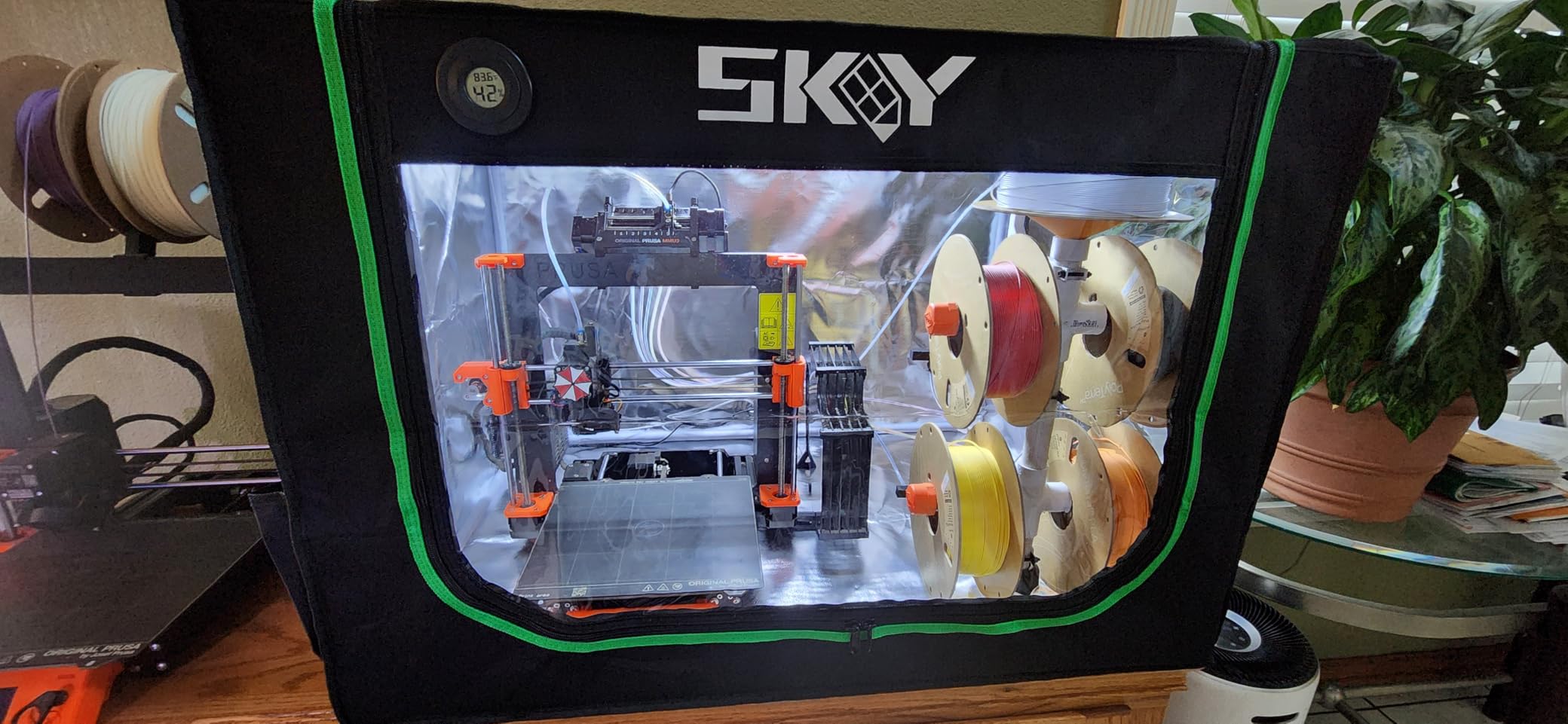
The openable perspective window provides quick visual access without fully exposing the chamber. Combined with the LED light strip, this window design balances monitoring convenience with temperature stability during printing.
Three-layer composite exhaust pipe construction provides durability and effective fume routing. The pipe diameter may require adapters depending on your exhaust setup, so check your routing requirements before ordering.
For Budget-Conscious Bambu A1 Owners
If you want enclosure benefits for your Bambu Lab A1 without the premium price, this option delivers temperature stability, fume containment, and noise reduction at a reasonable cost. The tradeoffs versus the TOPCUBE are minor for most users.
For Users Needing Both Ventilation and Monitoring
The combination of 4000 RPM fan, thermo-hygrometer, and LED light provides comprehensive environmental management. You get active ventilation, real-time monitoring, and visibility without paying for unnecessary extras.
How to Choose the Best 3D Printer Enclosure for ABS Printing
Selecting the right enclosure depends on understanding the differences between FDM and resin printing requirements, matching dimensions to your printer, and prioritizing features that matter for your specific situation.
FDM vs Resin Enclosures
FDM enclosures focus on heat retention and draft blocking. The bed and hotend generate heat that needs to stay inside the chamber to maintain 40-50C temperatures for successful ABS printing. Look for aluminum film interiors that reflect heat back into the chamber, sealed edges that prevent draft infiltration, and fire-resistant materials for safety during extended unattended prints.
Resin enclosures prioritize fume extraction and UV protection. Photopolymer resins emit fumes that require active ventilation rather than passive containment. Look for carbon filtration, exhaust fan systems, and UV-blocking windows that prevent unintended resin curing from ambient light.
Some users run both FDM and resin printers and need dual-purpose solutions. Larger tent-style enclosures with ventilation kits can handle both, though dedicated resin enclosures provide better fume control for photopolymer printing.
Sizing Your Enclosure
Measure your printer including any filament holders, cable slack, and clearance needed for maintenance access. Add 3-4 inches to each dimension for comfortable fit and airflow. Most standard enclosures fit printers up to 25 inches tall. Larger printers like Ender 5 Plus and CR-10 variants require the large-format options.
Printer compatibility lists help narrow options, but physical dimensions matter more than brand names. A Creality Ender 3 fits in most standard enclosures, while the Ender 3 Max Neo needs the larger variants.
Key Features to Consider
Fireproof materials provide safety for unattended printing. ABS printing involves heated beds and hotends, and any enclosure should include flame-retardant construction to prevent fire spread if something goes wrong.
Noise reduction matters for home offices and shared living spaces. Budget tents provide minimal sound dampening, while rigid enclosures with proper seals reduce noise significantly.
LED lighting enables print monitoring without opening the chamber. Opening an enclosure releases heat and disrupts temperature stability, so good visibility through windows or built-in lighting helps maintain print quality.
Ventilation systems balance fume containment with temperature management. Active extraction fans remove fumes but also release heat. Some enclosures include adjustable ventilation to find the right balance for your environment.
Enclosure Temperature for ABS
ABS prints best with chamber temperatures between 40-50C. At these temperatures, the filament stays pliable enough to bond between layers without cooling too quickly and causing warping or layer separation. Most enclosures reach these temperatures using bed heat alone, but colder environments may require supplemental heating.
A thermo-hygrometer helps verify actual chamber conditions rather than estimating based on bed temperature settings. The YOOPAI Premium with Ventilation includes this monitoring capability, and standalone meters work with any enclosure.
Frequently Asked Questions
Does ABS 3D printing need an enclosure?
Yes, ABS 3D printing benefits significantly from an enclosure. ABS filament cools unevenly in open air, causing corners to lift and layers to separate. An enclosure maintains stable chamber temperatures between 40-50C, blocks drafts that disrupt print cooling, and contains fumes for safer indoor printing. Without an enclosure, successful ABS prints require careful environment control.
What temperature should a 3D printer enclosure be for ABS?
A 3D printer enclosure should maintain 40-50 degrees Celsius for successful ABS printing. This chamber temperature keeps the ABS filament pliable during cooling, preventing thermal stress that causes warping and layer separation. Most enclosures reach this temperature using the printer bed and hotend heat alone, without supplemental heating.
Are 3D printer enclosures worth it?
3D printer enclosures are worth the investment for anyone printing ABS, ASA, Nylon, or polycarbonate filaments. They also benefit users printing in shared living spaces or offices by containing fumes and reducing noise. Even basic enclosures make measurable differences in print consistency for temperature-sensitive materials.
What enclosure for resin printing?
Resin printing requires enclosures with active ventilation and carbon filtration to handle photopolymer fumes. The YOOPAI Resin Enclosure and DORUNDEA Resin Enclosure include the necessary carbon filters, exhaust fans, and UV-blocking windows for safe indoor resin printing.
How to vent a 3D printer enclosure?
To vent a 3D printer enclosure, route an exhaust hose from the enclosure fan to a window or ventilation system. Passive venting works through convection, while active venting uses a box fan to create negative pressure that draws fumes out more quickly. The YOOPAI Premium with Ventilation includes a dedicated ventilation kit for this purpose.
Final Recommendations
For most users printing ABS on FDM printers, the YOOPAI LED Enclosure strikes the best balance of temperature control, build quality, and practical features like built-in lighting and easy assembly. The 4.6-star rating from over 1100 reviews confirms that thousands of users have had success with this enclosure for their ABS printing needs.
Budget-conscious buyers should look at the Creality/Skouphy Ender Enclosure at $29.99. It delivers the core temperature stability and draft protection that make ABS printing viable without the premium features. The flame-resistant materials provide safety for unattended printing at a price that leaves room in your budget for filament.
Bambu Lab A1 Combo owners have two solid options depending on budget. The TOPCUBE provides premium build quality with stainless steel construction and perfect fit. The Cregrant3D enclosure delivers similar functionality at a lower price for users who want enclosure benefits without the premium pricing.
Resin printer users need to prioritize fume extraction over heat retention. The DORUNDEA Resin Enclosure with its three-layer filtration and UV-blocking window represents the best overall option, while the YOOPAI Resin Enclosure provides solid performance at a lower price point.
Whatever enclosure you choose, maintaining chamber temperatures between 40-50C and ensuring adequate ventilation will transform your ABS printing results. The investment in an enclosure pays for itself through reduced print failures and improved part quality.