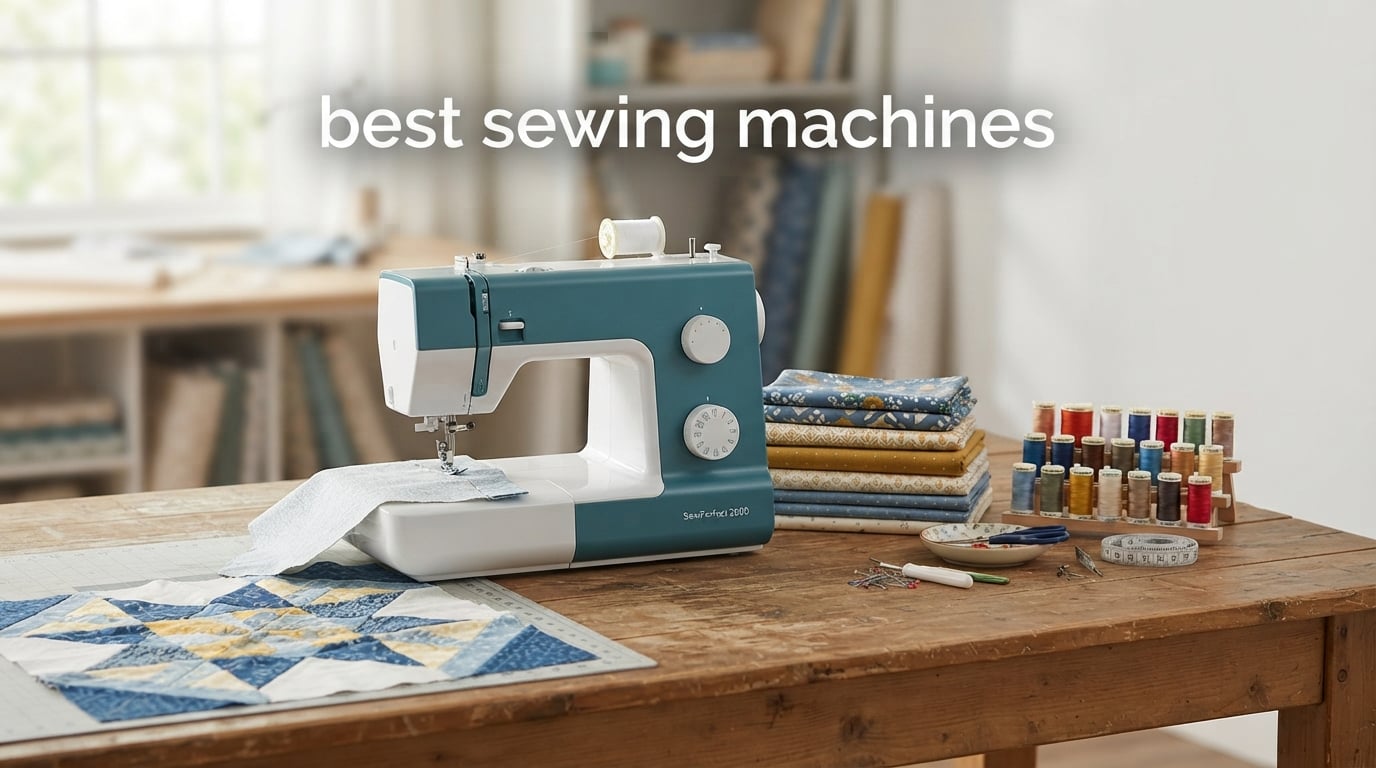
The best sewing machines for most home makers are easy to thread, steady on the table, and matched to the fabric you actually plan to sew. My leading all-purpose choice from this 12-model group is the Brother CS7205 because its 150 built-in stitches, automatic needle threader, quick-set drop-in bobbin, and included wide table cover a broad range of home projects.
For thick denim and canvas, I would move toward a metal-frame SINGER Heavy Duty model; for quilting, the Janome 4120QDC-G brings a quilt kit, LCD touch panel, and automatic thread trimming. The Brother SE700 is the clear fit when embroidery is part of the plan, while the Brother PQ1600S is purpose-built for fast, straight-stitch work rather than decorative sewing.
This guide evaluates the published specifications, feature lists, ratings, review volumes, and review summaries supplied for every machine here. I also used recurring sewing-community concerns as a practical filter: beginners often ask for an automatic needle threader, while experienced owners repeatedly point to stable frames, manageable bobbins, clean threading, and a machine that matches its intended workload.
Quick answer: Choose the CS7205 for general sewing, the HD 4423 for frequent heavy fabric work, the 4120QDC-G for quilting features, and the SE700 for embroidery. A larger stitch count is useful only when you will use those stitches; straightforward controls and reliable setup matter more for many first projects.
Table of Contents
Top 3 Picks for Best Sewing Machines (September 2026)
The Brother CS7205 is the balanced all-around pick, the SINGER HD 4423 is the more focused heavy-fabric option, and the Janome 4120QDC-G is the feature-rich quilting choice. These three cover the needs behind most searches: an approachable home machine, greater confidence on dense woven fabrics, and quilting-focused workflow features.
Brother CS7205 Computerized Sewing Machine
- 150 built-in stitches
- Automatic needle threader
- Wide table
SINGER HD 4423 High Speed Sewing Machine
- Metal frame
- 50% more power
- 1100 stitches per minute
Janome 4120QDC-G Quilting Machine
- 120 built-in stitches
- LCD Touch Panel
- Automatic thread trimming
Best Sewing Machines In 2026
The quick overview below puts every analyzed machine in one place. Narrow the field by sewing style first: straight-stitch speed, everyday clothing repairs, dense materials, quilting, decorative stitching, or embroidery.
| Product | Specifications | Action |
|---|---|---|
| Brother PQ1600S High-Speed Straight Stitch |
|
Check Latest Price |
| Brother CS7205 Computerized |
|
Check Latest Price |
| Janome 4120QDC-G Quilting |
|
Check Latest Price |
| Janome 3160QDC-G Quilting |
|
Check Latest Price |
| SINGER HD 4423 |
|
Check Latest Price |
| SINGER 4411 Pink |
|
Check Latest Price |
| SINGER C5980Q Patchwork Plus |
|
Check Latest Price |
| SINGER Heavy Duty 4432 |
|
Check Latest Price |
| Brother SE700 |
|
Check Latest Price |
| Janome 1522BL Mechanical |
|
Check Latest Price |
| SINGER Heavy Duty 6600C |
|
Check Latest Price |
| SINGER C7290Q Quilting |
|
Check Latest Price |
1. Brother PQ1600S delivers high-speed straight stitching for focused work
Pros
- 1500 stitches per minute
- Extra large workspace
- Four feed dog levels
- Push-button cutter
Cons
- Straight stitch only
- No decorative stitch selection
The Brother PQ1600S is a straight-stitch machine rather than an all-purpose computerized model. That limitation is also its point: if your projects rely on long straight seams and repeatable speed, the stated 1,500 stitches per minute gives it a different role from a machine with dozens of decorative patterns.
I would reserve it for a maker who already knows that stitch variety is not the priority. The published 4.6 rating across 1,270 reviews and the review summary point toward professional-grade speed, broad workspace, and control features rather than a beginner learning menu.
Its 11.1 by 23.3 inch extra-large table is meaningful for broad fabric panels, long seams, and projects where fabric support affects accuracy. The four color-coded feed dog levels, push-button thread cutter, and custom needle-stop position reduce repetitive handling steps.
There is no published claim of decorative stitches, automatic buttonholes, embroidery, or an LCD stitch selector. Buy this machine for fast straight stitching, not as a single machine intended to cover every craft category.
This machine fits straight-seam and production-minded projects
It makes the most sense for garment construction, piecing, alterations, and other work where straight seams dominate. The large table is especially helpful when the project becomes wider than the arm space of a compact home machine.
I would consider it after basic sewing skills are settled, since the feature set does not substitute for utility or decorative stitches. A separate serger can be a sensible companion for seam finishing.
This machine is not the answer for decorative and embroidery work
Anyone who needs zigzag, stretch stitches, buttonholes, letters, or embroidery designs should look elsewhere in this roundup. Straight stitch only means there is no workaround in the built-in selection.
Beginners who want one flexible machine for mending, clothes, and crafts may find the CS7205 easier to grow with. It has a far wider published stitch range and automatic setup aids.
2. Brother CS7205 is the best all-around home sewing choice
Pros
- 150 built-in stitches
- Jam-resistant drop-in bobbin
- Automatic needle threader
- Wide table included
Cons
- No published speed specification
- Computerized interface is less spare than mechanical controls
The Brother CS7205 is the best sewing machine in this group for a household that wants one model to handle repairs, simple garments, home décor, and early quilting attempts. Its 150 built-in stitches create room to experiment, but the everyday conveniences make it approachable.
The automatic needle threader removes a task that beginners regularly flag, and the quick-set drop-in bobbin is described as jam-resistant. Those features do not mean that any machine can never tangle thread; correct threading, a suitable needle, and a clean bobbin area still matter.
The wide table gives fabric more support during broader seams and smaller quilt tops. It also has eight one-step auto-size buttonholes, giving garment projects a more direct path than a manual multi-stage buttonhole process.
Published review data shows a 4.6 rating from 677 reviews, and the supplied summary describes a strong bundle of automatic features and accessories. I like it as a practical starting point because its controls can meet a beginner at the first hem and still support more varied work later.
This machine works best for beginners who want room to grow
A new sewer can begin with straight stitches, zigzag, and buttonholes without needing a second machine when curiosity grows. The wide table gives a gentle introduction to fabric handling on larger projects.
The stitch range may look overwhelming at first, so start with the manual’s threading path and a few core stitches. A small scrap test before each project is the quickest way to check tension and stitch length.
This machine asks buyers to accept computerized controls
People who want only a few dial-selected stitches may prefer the mechanical Janome 1522BL. The CS7205’s feature depth is useful, but its computerized interface is a different experience from a straightforward mechanical dial.
No maximum sewing speed is published in the supplied data, so high-speed production should not be the deciding assumption. Choose the PQ1600S if straight-stitch speed is the central requirement.
3. Janome 4120QDC-G is the full-featured choice for quilting
Pros
- 120 built-in stitches
- Automatic thread trimming
- Quilt Kit included
- Built-in needle threader
Cons
- Quilting-focused feature set may exceed basic repair needs
- No published speed specification
The Janome 4120QDC-G matches a sewist who wants quilting-specific equipment alongside general sewing capability. It has 120 built-in stitches, a 7 mm maximum stitch width, an LCD Touch Panel, automatic thread trimming, and a Quilt Kit in the supplied specifications.
I see the automatic thread trimming as its most workflow-focused feature because it can reduce repeated snipping at the end of seams. The built-in needle threader is another practical inclusion for users who find fine threading tiring or slow.
The 4.6 rating from 669 reviews gives the listing a substantial review base, and the available summary calls it feature-rich. Those figures do not tell us how it performs on every fabric, but they support its position as a well-regarded quilting-focused model here.
Its LCD touch panel gives a guided way to choose stitches. A first-time owner should still learn the threading, bobbin, needle, and presser-foot basics before relying on automated functions.
This machine suits quilters who want convenience features
The included quilt kit and automatic thread trimming speak directly to piecing and quilt assembly, where many seams create repeated small steps. The 7 mm maximum width also broadens decorative stitch possibilities beyond basic straight seams.
It can also serve garment makers and home sewers who value an organized computerized interface. Use the stitch selection with purpose rather than treating the count as a scorecard.
This machine is less compelling for a minimal mechanical setup
If your routine is limited to hems, repairs, and a few utility stitches, 120 stitches and an LCD panel can be more capacity than you need. The Janome 1522BL has a simpler 22-stitch mechanical format.
No published speed figure appears in this dataset, so do not choose it on an assumption of maximum throughput. The PQ1600S and selected SINGER heavy-duty models publish 1,100 or 1,500 stitches-per-minute figures.
4. Janome 3160QDC-G makes portable quilting more practical
Pros
- Superior Plus Feed System
- Automatic thread cutter
- Extension table included
- Portable 12.5 lbs
Cons
- 60 stitches is fewer than some computerized options
- No published maximum speed
The Janome 3160QDC-G balances quilting features with a listed weight of 12.5 pounds, useful if the machine must move between a closet, class, or sewing table. Its 60 built-in stitches are paired with the Superior Plus Feed System, automatic thread cutter, speed-control slider, extension table, and quilt kit.
Feed control matters because shifting layers can turn a simple seam into a frustrating one. I would view the SFS+ feed system as a reason to consider this model for regular quilting or layered projects, while still testing each fabric stack on scraps.
The extension table supports a wider working area, and the speed-control slider lets the user set a more comfortable pace. That can reassure a newer sewer who wants to control stitches without relying only on foot-pedal pressure.
The supplied review summary calls it portable yet capable, and its 4.6 rating is based on 597 reviews. It fits a sewist who needs a machine to travel but does not want to leave quilting-oriented tools behind.
This machine fits quilters who move their setup often
The published 12.5-pound weight gives it a portable identity, while the extension table and quilt kit keep the project focus intact. It suits piecing, smaller quilt projects, and sewing sessions away from a permanent studio.
The speed slider is useful when practicing an unfamiliar seam or working near a marked point. Slower, deliberate stitches usually beat rushing through fabric alignment.
This machine leaves some makers wanting a larger stitch library
Sixty stitches are enough for many projects, but the CS7205 has 150 and the SINGER quilting models list 417 stitch applications. Choose based on patterns you expect to use, not the highest number alone.
Anyone doing only simple mechanical repairs may not need a quilt kit, automatic cutter, or extension table. In that case, the Janome 1522BL has a more direct mechanical approach.
5. SINGER HD 4423 brings speed and a metal frame to heavy fabrics
Pros
- Heavy-duty metal frame
- 50% more power
- 1100 stitches per minute
- Automatic needle threader
Cons
- 23 built-in stitches
- Mechanical format offers fewer automated selections
The SINGER HD 4423 is the heavy duty sewing machine I would examine first for frequent denim, canvas, and structured home projects. The published specification combines a heavy-duty metal frame, a stated 50% more-powerful motor, and a top speed of 1,100 stitches per minute.
It lists 97 stitch applications from 23 built-in stitches, including a one-step buttonhole, plus an automatic needle threader. That combination is less about decorative abundance and more about useful stitch choices in a machine designed around speed and a sturdier frame.
The listing has a 4.5 rating from more than 21,000 reviews, the largest review count among the products analyzed. The supplied review summary identifies it as a top-selling heavy-duty model, making it a well-known starting point for buyers who ask what can handle thicker materials.
Thicker fabric is still not permission to force the machine through every stack. Use the appropriate needle, test the seam over the same layers, and approach bulky crossings steadily; preparation is often the difference between a clean seam and a jam.
This machine handles frequent denim, canvas, and home décor work
The metal frame and stated higher-power motor make this the clearest general heavy-fabric pick in the roundup. It is a practical fit for bags, cushions, hems, and garments that call for regular medium-to-heavy woven fabric.
Its speed can shorten long, uncomplicated seams, though control remains more important than raw pace around corners and thick intersections. Start slowly until the material feeds evenly.
This machine is not built around a huge decorative stitch menu
Twenty-three built-in stitches serve core utility and decorative needs, but they do not compete with the 417 applications on the C5980Q or C7290Q. Makers focused on lettering and ornamental work should compare those computerized models.
Heavy-duty branding does not remove the need for maintenance. Remove lint from the bobbin area, change a dull needle, and rethread from the top before assuming a tension issue is a machine defect.
6. SINGER 4411 Pink offers simple high-speed heavy-duty sewing
Pros
- Metal frame
- 60% more powerful motor
- 1100 stitches per minute
- Simple 11-stitch selection
Cons
- Four-step buttonhole
- No automatic needle threader listed
The SINGER 4411 Pink is a mechanically oriented high-speed option with a metal frame and a stated 60% more-powerful motor. It lists 69 stitch applications from 11 built-in stitches and reaches 1,100 stitches per minute, matching the published speed of the other selected SINGER heavy-duty models.
Its smaller built-in stitch count keeps the control set more focused than the 4423 or the computerized models. I would treat that as a benefit for someone who wants to learn a handful of staples rather than scroll through a long stitch menu.
The machine uses a four-step buttonhole process, so it asks for more involvement than a one-step buttonhole system. That matters if you plan to make many garments with buttons, though it is not a barrier to basic projects with care.
It has a 4.5 rating based on 9,304 reviews in the supplied data. The published summary calls it a high-speed heavy-duty special edition, and the pink exterior is a cosmetic preference rather than a performance feature.
This machine suits sewers who want direct mechanical operation
The 11 built-in stitches cover a deliberately simple set of sewing tasks, and the metal frame plus motor specification point toward regular use on firmer materials. It fits the person who prefers physical controls and quick access to core stitches.
Use appropriate needles and thread for the fabric, especially when moving from lightweight cotton to denim. A machine’s motor cannot correct a mismatched needle or poorly threaded upper path.
This machine gives up some convenience for simplicity
No automatic needle threader is listed in the supplied specifications, which may matter if manual threading is difficult for you. The 4423 includes that feature, as do several Brother and Janome machines in this guide.
The four-step buttonhole also requires a more hands-on process than a one-step setup. Buyers making frequent button-front clothing may prefer a model that lists a one-step automatic buttonhole.
7. SINGER C5980Q Patchwork Plus favors decorative quilting and lettering
Pros
- 417 stitch applications
- Built-in lettering font
- Extension table
- LCD screen
Cons
- Review base is small
- No published maximum speed
The SINGER C5980Q Patchwork Plus is for sewists who want a broad published stitch catalog and quilting-oriented accessories. It lists 417 stitch applications, a built-in lettering font, programmable needle, LCD screen, extension table, and a heavy-duty metal frame.
The built-in font separates it from most general models, offering a route to personalized labels or decorative fabric details without an embroidery module. Its extension table also gives wider projects a more supported work surface.
There is a trade-off in the available review data: its 4.5 rating comes from 37 reviews. I would treat that as an encouraging but limited signal compared with the thousands of reviews behind several SINGER Heavy Duty machines.
The programmable needle and LCD screen indicate a model where learning the controls has real payoff. Read the manual alongside small test samples, particularly when selecting a decorative stitch or setting up a layered quilt sandwich.
This machine works for makers who will use decorative stitch depth
The 417 applications and lettering font are compelling when personalization and decorative quilting are routine parts of the work. The extension table supports those aims by giving broad fabric more room beside the needle.
This is an alternative to a basic mechanical machine for someone who enjoys exploring stitch options. Begin with a few repeatable favorites so the feature list remains useful rather than distracting.
This machine has less review history than established heavy-duty choices
Thirty-seven reviews is a much smaller data set than the thousands attached to the HD 4423, 4411 Pink, and 4432. Buyers who place a high weight on a long review record should account for that difference.
It also does not replace dedicated embroidery capability. The Brother SE700 is the relevant option when built-in embroidery designs and a hoop are needed.
8. SINGER Heavy Duty 4432 adds stitch range to heavy fabric sewing
Pros
- 110 stitch applications
- 60% more power
- One-step buttonhole
- Free arm
Cons
- No automatic needle threader listed
- Rating trails some alternatives
The SINGER Heavy Duty 4432 builds on the heavy-fabric formula with a stated 60% more-powerful motor, 1,100 stitches per minute, and 110 stitch applications from 32 built-in stitches. It also includes a one-step buttonhole and free arm, broadening its usefulness for clothes and cylindrical items.
The free arm is useful for sleeves, cuffs, and narrow trouser hems, where a flat bed can make positioning awkward. That practical feature gives the 4432 an edge for garment maintenance and construction beyond long flat seams.
Its 4.4 rating is supported by 11,904 reviews, a large body of buyer feedback even though the rating is below the 4.5 and 4.6 scores elsewhere here. The supplied summary positions it as a popular black model for heavier fabrics.
I see the 4432 as middle ground for a user who wants a heavy-duty direction but also wants more built-in stitch options than the 4411 Pink. The one-step buttonhole is a practical difference for regular clothing projects.
This machine fits garment makers who sew heavier woven fabrics
The free arm, one-step buttonhole, and 32 built-in stitches help it move beyond simple flat repairs. It can serve people sewing sturdy garments, bags, or home décor items made from medium-to-heavy materials.
Like any heavier-duty model, it benefits from patient fabric feeding instead of pulling the material. Let the feed dogs advance the work and use a scrap test to set expectations for a thick seam.
This machine does not list every beginner convenience feature
An automatic needle threader is not listed in the supplied 4432 features. If that feature is high on your list, the CS7205, HD 4423, Janome 4120QDC-G, Janome 1522BL, or C7290Q publish one.
The 4.4 rating should be viewed in the context of its large review count, rather than compared mechanically with small-review listings. Read current support details if service access is a deciding concern.
9. Brother SE700 combines everyday sewing with built-in embroidery
Pros
- Sewing and embroidery combo
- 135 embroidery designs
- Wireless LAN
- Touchscreen display
Cons
- 4 x 4 embroidery field
- Embroidery setup adds a learning step
The Brother SE700 is the distinct choice for a maker who wants a sewing and embroidery machine in one unit. Its specifications list 103 built-in sewing stitches, 135 built-in embroidery designs, wireless LAN, a 3.7-inch LCD touchscreen, and a 4 by 4 inch embroidery hoop.
The sewing side gives it a role for repairs, garments, and crafts, while the embroidery side adds names, motifs, and decorative designs. I would choose it for that combination rather than expecting it to be the best specialist at high-speed straight stitching or large-format quilting.
Wireless LAN makes its digital orientation clear, and the touchscreen gives users a visual control point. Those tools can be rewarding, but they also make careful reading of setup instructions more important than on a basic dial-operated machine.
The listing has a 4.4 rating from 966 reviews, and the supplied summary identifies it as a computerized sewing-and-embroidery combination. An embroidery newcomer should set aside time to practice hooping and stabilizer placement.
This machine is right for hobbyists who want embroidery capability
The 135 built-in designs and included 4 by 4 hoop make embroidery a core part of the machine’s identity rather than an add-on. It is a fit for custom gifts, embellishment, and small personalized textile projects.
Its 103 sewing stitches also mean you are not limited to embroidery-only work. This makes it flexible for a home maker who alternates between repairs, sewing, and decorative projects.
This machine has a defined embroidery field and learning curve
The published hoop measures 4 by 4 inches, so buyers planning larger embroidery layouts should confirm that field suits their designs. Do not assume a small hoop will cover every project without repositioning.
Embroidery adds steps beyond ordinary sewing, including hooping and stabilizer selection. If those tasks are not appealing, a sewing-focused model such as the CS7205 may be the more straightforward choice.
10. Janome 1522BL keeps dependable mechanical sewing straightforward
Pros
- Heavy-duty metal frame
- Built-in needle threader
- Drop feed
- 25-year warranty
Cons
- 22-stitch selection
- No LCD or computerized stitch controls
The Janome 1522BL is the mechanical counterpoint to the feature-heavy computerized machines in this guide. It lists 22 built-in stitches, a one-step buttonhole, a heavy-duty metal frame, built-in needle threader, LED lighting, and drop feed.
I like the clarity of this specification set for someone who wants the durability reputation associated with a metal frame but does not want an LCD or a long menu of programmed stitches. The built-in needle threader keeps an often-requested convenience without changing the direct mechanical character.
Drop feed is useful when the project calls for free-motion work, darning, or fabric movement controlled by the operator. That makes the machine more capable than its modest stitch count might suggest, especially for a sewer who values technique over automated selection.
The listing shows a 4.4 rating from 116 reviews and notes a 25-year warranty in the supplied features. Warranty terms can have conditions, so read current documentation rather than treating that duration alone as a service promise.
This machine suits buyers who prefer mechanical controls and a metal frame
Its 22 stitches cover core construction, utility, and basic decorative work without creating a large computerized catalog to navigate. This is the machine for a user who wants to build confidence through direct control.
LED lighting and the needle threader add comfort where it counts near the needle area. The drop-feed function is a bonus for makers who expect to explore free-motion techniques.
This machine is not designed for extensive decorative programming
There is no LCD screen, lettering font, or hundreds-deep stitch application list in the supplied data. Quilters who want a broad digital selection should consider the Janome 4120QDC-G or SINGER C5980Q.
A simple machine still needs routine care. Keep lint from building up around the bobbin, replace needles regularly, and follow the manual’s maintenance directions before seeking repair help for a sudden stitching problem.
11. SINGER Heavy Duty 6600C joins power with computerized stitch choice
Pros
- 215 stitch applications
- LCD screen
- 60% more power
- Six one-step buttonholes
Cons
- Smaller review base
- No automatic threader listed
The SINGER Heavy Duty 6600C Sterling is for a user who wants computerized stitch selection without leaving the heavy-duty family. It lists 215 stitch applications from 100 built-in stitches, an LCD screen, metal frame, a stated 60% more-powerful motor, and six one-step buttonhole styles.
The result is a larger stitch palette than the HD 4423 or 4432, alongside the same published 1,100 stitches-per-minute speed. I would consider it for garment makers and home sewers who want utility, decorative options, and a computer-guided selector in one machine.
The premium accessory set may help a buyer get started with different techniques, though the exact contents should be confirmed in the current product documentation. The six buttonhole styles are a clear advantage for someone who expects to sew varied button-front projects.
Its 4.3 rating is based on 132 reviews in the provided data, a more limited record than the older high-volume SINGER Heavy Duty options. That does not invalidate the model, but it is useful context when rating history is part of your decision.
This machine suits sewists who want digital variety with heavy-duty features
The 100 built-in stitches and LCD screen make it easier to justify a computerized machine when decorative and garment-focused work is frequent. The metal frame and motor claim keep its stated purpose tied to firmer fabrics as well.
The six one-step buttonhole styles add garment flexibility without a multi-stage manual process. Test each fabric and interfacing combination before committing to a finished buttonhole row.
This machine has a shorter review record than several alternatives
With 132 reviews, its rating comes from a much smaller pool than the 4423, 4411 Pink, or 4432. Buyers who want a long history of broad user feedback may prefer one of those higher-volume listings.
An automatic needle threader is not listed in the supplied specifications. If that is non-negotiable, look to the CS7205, HD 4423, or one of the listed Janome models.
12. SINGER C7290Q supplies an accessory-rich computerized quilting setup
Pros
- 417 stitch applications
- 12 presser feet
- Extension table
- Built-in needle threader
Cons
- 3.9 rating
- Small review base
The SINGER C7290Q is a computerized sewing and quilting machine built around a large published stitch selection and a generous accessory list. It includes 417 stitch applications, 12 presser feet, an extension table, LCD screen, built-in needle threader, and one-touch Start/Stop.
The extension table and 12 feet make it attractive for a buyer who expects to switch techniques often. The one-touch Start/Stop function can also help a learner practice speed control without coordinating the foot pedal at the same time.
There is important review context to keep in view: the supplied rating is 3.9 from 38 reviews. I would not ignore that number just because the feature list is extensive, and I would compare current support information and return terms before deciding.
This is a machine to choose when its specific assortment of stitches, feet, table, and controls suits your planned projects. It is not the automatic recommendation for every quilter, especially when other quilting models here carry a 4.6 rating in the available data.
This machine fits quilters who want many included tools and stitches
The 417 applications, 12 presser feet, and extension table give a wide foundation for quilting and decorative sewing experiments. The needle threader is a welcome convenience when changing thread frequently.
Its Start/Stop control may help a newer user focus on fabric guidance at a deliberately set speed. Practice on scraps before using a decorative stitch over a finished quilt top.
This machine needs careful consideration of its rating record
The 3.9 rating is the lowest in this 12-product dataset, and it is based on 38 reviews. That does not predict every owner’s experience, but it is a relevant signal when compared with the higher-rated Janome quilting choices.
If a more established quilting recommendation is the priority, the Janome 4120QDC-G has 120 stitches, automatic trimming, and a 4.6 rating from 669 reviews. The choice depends on whether the C7290Q’s extra listed applications and feet matter to your projects.
How To Choose The Best Sewing Machines?
Start with fabric and project type, not the longest feature list. A person mending jeans, sewing canvas tote bags, and making cushions needs a different machine from someone piecing quilts, embroidering gifts, or stitching long straight garment seams quickly.
For general home use, look for a practical set of utility stitches, a clear bobbin system, a needle threader if that task is difficult, and a buttonhole method that fits your garment plans. The Brother CS7205 has the most balanced published mix of these features in this group.
A computerized machine is best when stitch variety and guided selection matter
Computerized models commonly use an LCD screen or touch panel to select a stitch and may add controls such as Start/Stop, thread trimming, or a speed slider. The CS7205, Janome 4120QDC-G, Janome 3160QDC-G, C5980Q, SE700, 6600C, and C7290Q fit this more feature-rich category.
Choose this type when you expect to use decorative stitches, multiple buttonhole styles, quilting functions, or embroidery features. It is not automatically better for every beginner; a new sewer can learn well on a clear mechanical machine with fewer decisions.
A mechanical machine is best when direct controls and simplicity matter
Mechanical machines use direct controls and often have a smaller stitch selection. The SINGER HD 4423, SINGER 4411 Pink, SINGER 4432, and Janome 1522BL fit this approach in the present list.
This style can be reassuring when you want to concentrate on threading, fabric guidance, seam allowance, and tension rather than menus. A metal internal frame is a recurring durability signal mentioned in sewing communities, but it should still be paired with maintenance and fabric preparation.
Heavy materials need a suitable needle, preparation, and measured expectations
For denim and canvas, the SINGER HD 4423, 4411 Pink, 4432, and 6600C publish increased-power motor claims, and several list metal frames. These are the models to compare when thick woven fabrics are a regular part of your projects.
Even a heavy-duty sewing machine can jam if the needle is dull, thread is unsuitable, or the fabric stack is beyond what the foot and needle can manage. Use a needle designed for the material, reduce bulk where possible, and do not pull fabric from behind the presser foot.
Quilting needs fabric support and even feeding more than a huge stitch count
An extension or wide table supports fabric so it does not drag at the needle, which helps with larger quilt pieces. The Janome 4120QDC-G, Janome 3160QDC-G, C5980Q, and C7290Q all publish a quilting-oriented table or kit feature.
Feed behavior is just as important as workspace when layers are involved. The 3160QDC-G’s Superior Plus Feed System is a notable published feature, but every machine and fabric stack still benefits from a small layered test.
A clean bobbin area solves many apparent tension and jamming problems
Forum discussions repeatedly mention thread bunching below the fabric and unexpected jams. Before blaming the machine, rethread the upper path with the presser foot raised, confirm the bobbin direction from the manual, fit a fresh compatible needle, and clear lint from the bobbin area.
Use the manual’s stated oiling directions rather than applying oil by guesswork. If stitches remain inconsistent after careful rethreading and a scrap test, a qualified service shop is a better next step than forcing the mechanism.
A vintage machine can be worthwhile when local service and condition are clear
Experienced sewing communities often praise older Singer Featherweights and Berninas for durability, but a vintage purchase is condition-dependent. Check that it sews a sample, has compatible parts and needles, and can be serviced locally before treating age as proof of reliability.
A modern machine may be the easier route for someone who needs a needle threader, drop-in bobbin, automatic buttonholes, or warranty documentation. The best route is the one you can maintain and use confidently.
A serger complements a sewing machine instead of replacing one
A standard sewing machine makes construction stitches, buttonholes, repairs, topstitching, and decorative stitches. A serger is useful for fast seam finishing and knit seams, but it does not replace the straight stitch and other functions of a regular machine.
If knit garments are a major goal, consider the sewing machine as the core tool and add a serger later when seam finishing becomes a regular need. That staged setup keeps the first purchase tied to the projects you will make now.
FAQs
What is the most reliable brand of sewing machine?
Brother, Janome, and SINGER all have well-known models in this roundup, but reliability depends on the specific machine, correct threading, routine cleaning, suitable needles, and access to service. For a long review record here, the SINGER HD 4423 has more than 21k reviews; for a higher supplied rating, several Brother and Janome models show 4.6.
Which is the best sewing machine for home use?
The Brother CS7205 is the best general home-use choice in this group because it combines 150 built-in stitches, an automatic needle threader, a jam-resistant quick-set drop-in bobbin, a wide table, and eight one-step auto-size buttonholes. It suits repairs, simple garments, home décor, and early quilting projects.
What are the top 10 sewing machines?
The top choices depend on the task. This guide reviews 12 models: the Brother CS7205 for all-around home sewing, SINGER HD 4423 for heavy fabrics, Janome 4120QDC-G for quilting, Brother SE700 for embroidery, and eight more options for straight stitching, portability, mechanical sewing, and decorative work.
What is the number one sewing machine?
The Brother CS7205 is the number one all-around recommendation from these 12 models. Its published 150-stitch selection, automatic needle threader, quick-set drop-in bobbin, wide table, and 4.6 rating give it the most balanced feature set for many home users.
The Brother CS7205 is the best sewing machine for most home makers
For the best sewing machines in 2026, start by matching the machine to the work on your table. Choose the Brother CS7205 for broad home sewing, the SINGER HD 4423 for recurring heavy-fabric seams, the Janome 4120QDC-G for quilting features, and the Brother SE700 when embroidery matters.
Read the current manual, test stitches on scraps, and keep up with basic cleaning from day one. The machine that feels understandable, feeds your usual fabric cleanly, and has the functions you will use is the right machine to take to checkout.