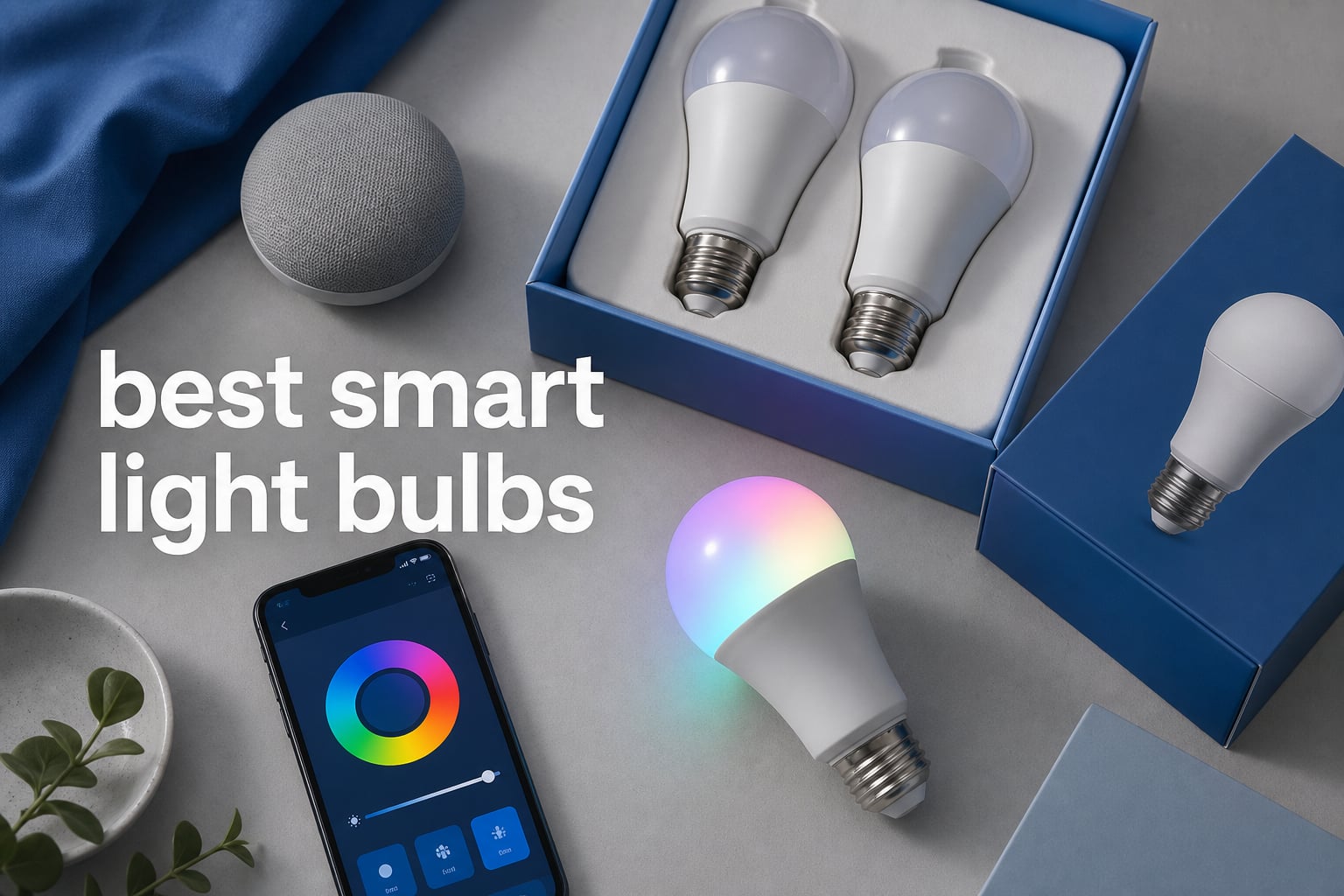
The best smart light bulbs for most rooms are Govee’s 1000-lumen A19 bulbs because they pair high white-light output with Wi-Fi, Bluetooth, voice control, a CRI of 90, and 54 scenes. Tapo is a stronger fit when Matter and Siri support matter most, while a Philips Hue system suits people who already want a Bridge-based setup.
Smart LED bulbs are ordinary-looking LED lamps with a radio inside. That connection lets you turn lights on from an app, use voice controlled lights, create schedules, dim a bulb, or change its color without replacing the fixture.
I compared the eight products in this guide against the details published for each listing: output in lumens, control method, white range where stated, voice platforms, connection type, ratings, review volume, and limits such as 2.4 GHz-only Wi-Fi. That approach matters because a bulb can look great in a color scene yet be a poor match for a kitchen, a physical dimmer, or an Apple Home household.
Keep the wall switch supplying power to a smart bulb. When someone turns that switch off, the bulb is not merely “off” in the app; it loses power and cannot answer an app or voice command until the switch is turned back on.
Forum users repeatedly put fast response and long-term dependability ahead of a huge feature list. They also report occasional nonresponse with some setups, so I would start with a small group in the room you use most, confirm the connection is solid, and only then expand a smart home lighting setup.
Table of Contents
Top 3 Picks for Best Smart Light Bulbs (September 2026)

Choose Govee for a high-output color bulb with a deep scene library and both Wi-Fi and Bluetooth. Choose Tapo when cross-platform Matter support, 1% dimming, and a stated 1,100-lumen output are more important than a remote.
Choose Sengled for a simple Matter-enabled 800-lumen option with a large review history and a stated two-year warranty. Each of the other five bulbs fills a narrower need, from an included remote to Alexa-only control or the highest listed brightness.
8 Best Smart Light Bulbs In 2026
| Product | Specifications | Action |
|---|---|---|
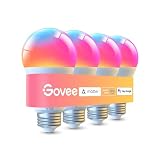 Govee 1000LM Smart Bulbs 4-Pack Govee 1000LM Smart Bulbs 4-Pack |
|
View Details |
 Philips Hue Essential A19 4-Pack Philips Hue Essential A19 4-Pack |
|
View Details |
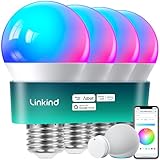 Linkind Smart Bulbs with Remote 4-Pack Linkind Smart Bulbs with Remote 4-Pack |
|
View Details |
 Cync GE A19 Full Color 2-Pack Cync GE A19 Full Color 2-Pack |
|
View Details |
 Amazon Basics Alexa Smart A19 4-Pack Amazon Basics Alexa Smart A19 4-Pack |
|
View Details |
 Lightinginside 1350LM Bulbs 4-Pack Lightinginside 1350LM Bulbs 4-Pack |
|
View Details |
 Tapo L535E Matter Bulbs 2-Pack Tapo L535E Matter Bulbs 2-Pack |
|
View Details |
| Sengled Matter A19 Multicolor Bulb |
|
View Details |
The quickest way to narrow this list is to begin with brightness and platform. An 800-lumen bulb is roughly a 60-watt incandescent replacement, 1,000 to 1,100 lumens gives more headroom for active rooms, and Lightinginside’s 1,350-lumen listing is aimed at the brightest task-lighting need here.
Protocol is the next filter. Matter products can work across more smart-home platforms when the rest of your setup supports Matter, while Wi-Fi-only products usually depend on their named app and supported assistants; Bluetooth can help with nearby setup or local control on models that include it.
1. Govee 1000LM bulbs are the best for bright, colorful rooms
Govee LED Smart Light Bulbs, 1000LM Color Changing Light Bulb, Wi-Fi & Bluetooth Light Bulbs, Work with Alexa and Google Assistant, Dimmable RGBWW A19 75W Equivalent Smart Bulbs, 4 Pack
1000 lumens
Wi-Fi + Bluetooth
54 scenes
CRI 90
Pros
- 1000-lumen output
- 54 scene modes
- Wi-Fi and Bluetooth
- CRI 90
- Alexa and Google control
Cons
- Cannot use smart switches
- Presets need Wi-Fi
Govee earns the lead spot because its stated 1,000-lumen output is stronger than the usual 800-lumen smart-bulb baseline while still offering 16 million colors and tunable white from 2700K to 6500K. That is a practical combination for a living room that needs clear white light for reading and a saturated color scene later.
I also like that this model lists both Wi-Fi and Bluetooth rather than Wi-Fi alone. The data supports app and voice control, group control, sunrise and sunset scheduling, and compatibility with Alexa and Google Assistant, so it covers the common routine-and-voice use case without a separate hub.
The 4.6 rating is backed by 5.5k+ reviews, with 82% of ratings listed as five-star. Those numbers do not predict every home’s network experience, but they provide a broader customer-feedback base than most bulbs in this comparison.
Its stated CRI of 90 is another advantage for white light, since a higher CRI can make colors in the room appear more natural. The listing also gives a 75-watt equivalent and 9-watt consumption, which makes this a better fit for fixtures where a standard 60-watt equivalent feels dim.
The best placement is a room that needs both task light and color
Put these Govee bulbs in open living areas, a finished basement, or a bedroom with a ceiling fixture. The 1,000-lumen rating gives them enough white-light presence that they are not only decorative color changing light bulbs.
The 54 scene modes and Music Mode make more sense in rooms where mood lighting is welcome. Group control is helpful when several sockets should behave as one room.
The key limitation is the switch and preset behavior
Do not pair this model with a smart switch, because the published limitations say it cannot be used with one. It also should not be installed on a physical dimmer circuit unless the fixture documentation says that combination is appropriate.
Saving presets calls for Wi-Fi, and the listing says Bluetooth must be off for preset saving. That is not a deal-breaker, but it is a detail worth knowing before building a routine around custom scenes.
2. Philips Hue Essential bulbs are the best for a Bridge-based system
Philips Hue Essential Smart LED A19 Bulb, White and Color Ambiance, E26 Base, 8.8W, 2200K-6500K, 800 Lumens, Dimmable, Works with Alexa, Google, and Apple Home, 4-Pack
800 lumens
2200K to 6500K
2% dimming
Hue Bridge compatible
Pros
- Smooth 2% dimming
- Hue app scenes
- Alexa Google Apple Home
- Hue Bridge expansion
Cons
- Expanded features need Hue Bridge
- 800-lumen output
Philips Hue Essential is the pick for someone who wants to build around the Hue app and, if needed, a Hue Bridge. Its listing gives white and color ambiance, millions of colors, 800 lumens, and a 2200K to 6500K range, which is a broad span from a very warm evening setting to a cool work-light setting.
The notable specification is dimming down to 2%. Low-end dimming can matter more than maximum brightness in bedrooms, nurseries, and media rooms, where a bulb that bottoms out too bright is annoying even when its colors look good.
Hue lists support for Alexa, Google Assistant, and Apple Home. The product is Bridge compatible, and the published notes say the Bridge expands functionality and enables music, movie, and gaming sync, so this is a system choice rather than a bare-bones single-bulb choice.
Its 4.6 rating comes from 752 reviews, with 83% listed as five-star. That is a smaller feedback sample than Govee or Sengled, so I would focus more on whether the Hue ecosystem is the one you want to live with than on a rating comparison alone.
The best reason to choose it is smooth control across a Hue setup
Choose this bulb when you want a consistent app experience and expect to add more Hue devices. The listed preset scenes give a ready-made starting point for routines rather than requiring every color and brightness combination to be built from scratch.
An 800-lumen output is appropriate for lamps, bedrooms, hallways, and typical ceiling fixtures. For a large workspace that needs intense white light, one of the 1,000-lumen or brighter bulbs above is the more direct answer.
The deciding question is whether you want the Hue Bridge
The listing is clear that expanded features need the separately sold Hue Bridge. A hub can be welcome in a larger home because it gives a dedicated center for the ecosystem, but it is another device to place and set up.
Do not treat the Bridge as an optional detail if music or video syncing is your goal. Pick Hue for its broader system path, not merely because the bulb can produce a color scene.
3. Linkind bulbs are the best when an included remote matters
Linkind Smart Light Bulbs with Remote Control, Smart Bulb that Work with Alexa & Google Home, 16 Million Color Changing Light Bulbs 60W, A19 E26 2.4Ghz WiFi Light Dimmable,1800K-6500K,800lm 4 Pack
800 lumens
Included remote
1800K to 6500K
104 scenes
Pros
- Remote works without Wi-Fi
- 104 preset scenes
- 1800K to 6500K white
- CRI 90
- Alexa and Google
Cons
- 2.4GHz Wi-Fi only
- Not for dimmer switches
Linkind is the most practical option here for a fixture used by people who do not always want to open an app or ask a speaker. It includes a remote, and the listing says the remote works without Wi-Fi, giving the bulb a straightforward fallback for nearby manual control.
The published range runs from 1800K to 6500K, which is wider on the warm side than the other bulbs that state a full white range. It also offers 800 lumens, 16 million colors, CRI 90, 104 preset scenes, schedules, and group control through the AiDot app.
Alexa and Google Assistant are supported for voice control. The 4.6 rating is based on 653 reviews, and 79% of those are listed as five-star, providing decent but more limited customer feedback than the highest-volume products here.
A stated 25,000-hour operating life is a helpful durability specification. Actual life changes with use and fixture conditions, so I see it as a manufacturer claim to compare rather than a promise for a particular installation.
The best household is one that needs a non-app fallback
Use Linkind in a guest room, a child’s room, or a lamp shared by people with different comfort levels around apps. The included remote makes simple on, off, dimming, and color adjustments less dependent on a phone or smart speaker.
The very warm 1800K setting is especially suited to low-key evening lighting. At the 6500K end, the same bulb can shift toward a cooler white setting for daytime tasks.
The setup condition is a 2.4 GHz network and a non-dimmer circuit
Linkind’s Wi-Fi connection is 2.4 GHz only, a common restriction in smart bulbs. Check that your router exposes a 2.4 GHz band during setup rather than assuming a phone connected to 5 GHz will complete the pairing.
The manufacturer warns that dimmer switches may make the bulbs flicker or buzz. Use the app, voice control, or included remote for dimming, and keep power at the wall switch on.
4. Cync GE A19 bulbs are the best for Matter without a hub
Cync GE A19 LED Smart Light Bulbs, Room Decor Aesthetic Bluetooth and WiFi Color Changing Lights, LED Indoor Light Bulb, Compatible with Alexa and Google (2 Pack)
800 lumens
Matter support
Wi-Fi + Bluetooth
No hub
Pros
- Matter support
- No hub needed
- Apple Home via Matter
- Sunrise and sunset schedules
- 3-year warranty
Cons
- 2.4GHz Wi-Fi only
- Listed mainly for decoration
Cync’s full-color A19 takes a focused approach: it lists Bluetooth, Wi-Fi, Matter, and no hub requirement in one bulb. That makes it a strong candidate for a household that uses Alexa, Google Assistant, SmartThings, or Apple Home through Matter and does not want to begin with a separate bridge.
It is an 800-lumen, 60-watt-equivalent model with a stated CRI of 90. The Cync app supplies remote control and sunrise or sunset scheduling, which is enough for common security and wake-up routines without adding a different app for every task.
The published rating is 4.6 from 585 reviews, with 81% listed as five-star. It also has a stated three-year warranty, the longest published warranty among the reviewed bulbs, which is a meaningful point for buyers concerned about early replacement.
Matter is the headline feature, not a promise that every smart-home setup will work identically. It is a common protocol intended to let compatible devices work across participating platforms, and pairing still depends on the platform, home network, and controller you already own.
The best reason to buy it is broad platform flexibility
Choose Cync when Apple Home support via Matter is important but you also want the option to use Alexa, Google Assistant, or SmartThings. It is one of the cleanest answers in this list for a mixed-platform household.
The stated no-hub setup also suits renters or anyone starting with a small number of bulbs. You get app-based schedules and color control without reserving an outlet and a network port for another device.
The main boundary is that it is still a 2.4 GHz Wi-Fi bulb
Matter does not remove the listed 2.4 GHz Wi-Fi requirement. Set up the bulb close to stable wireless coverage and keep the network details handy before beginning the Cync app process.
The product is described primarily for decorative use, so make brightness part of the room decision. Its 800 lumens work well for ordinary ambient lighting, while 1,000 lumens or more is the safer call for a large room or focused task area.
5. Amazon Basics A19 bulbs are the best for Alexa-only homes
Amazon Basics Smart A19 LED Light Bulb, Color Changing, 9W (60W Equivalent), 800LM, Works with Alexa Only, 2.4 GHz Wi-Fi, No Hub Required, Energy Saving, 4-Pack
800 lumens
Alexa only
16 preset colors
No hub
Pros
- Simple Alexa-only setup
- No hub required
- 5 to 100% dimming
- Room group control
- Suitable for damp locations
Cons
- Alexa only
- 2.4GHz Wi-Fi only
- No physical-dimmer control
Amazon Basics makes sense only when Alexa is already the clear center of the home. The bulb is intentionally narrow: it works with Alexa only, pairs over 2.4 GHz Wi-Fi, requires no hub, and offers remote control, room grouping, routines, 16 preset colors, and 5% to 100% dimming through Alexa.
That limitation can be an advantage in an Alexa-only household because it reduces platform decisions. It is a poor choice if Google Assistant, Apple Home, SmartThings, or another ecosystem is part of the plan, since the published compatibility does not include those platforms.
The bulb is rated at 800 lumens and uses 9 watts, with a stated CRI of 90. It is also listed as suitable for damp locations such as bathrooms, though that is not the same as an outdoor rating or permission for direct exposure to weather.
Its 4.4 rating is below the 4.6 leaders here, but it has the largest review count at 13.8k+. That broad feedback base is useful context, while the product’s ecosystem limit remains the deciding factor.
The best fit is a home that already speaks Alexa
Put these bulbs in rooms where Alexa routines and voice commands are already part of daily use. Group control by room can make a four-bulb ceiling fixture behave like a single voice controlled light.
The preset colors work for occasional accent lighting, and the white-light output is suitable for standard lamps and everyday fixtures. Buyers who enjoy building many custom scenes may prefer Govee, Linkind, or a system with a larger published scene library.
The non-negotiable limitation is platform exclusivity
Do not buy this model with a plan to bring it into Google Home, Apple Home, or SmartThings later. Alexa is its sole published controller compatibility, so the setup is simple only if that boundary matches your house.
As with the other Wi-Fi bulbs, use an ordinary on-off wall switch rather than a physical dimmer. The bulb’s dimming controls live in Alexa voice commands or the Alexa app.
6. Lightinginside bulbs are the best for the brightest white light
Lightinginside Smart Light Bulbs 100W Equiv., 1350LM 11W Smart Bulb Works with Alexa/Google Home/SmartLife, A19 E26 RGBCW Color Changing Bulbs, No Hub Required, 2.4G WiFi & BLE Bulb, ETL Listed, 4PCS
1350 lumens
Wi-Fi + BLE
Music sync
2700K to 6500K
Pros
- 1350-lumen output
- Wi-Fi and BLE
- Alexa and Google
- Music sync
- 2-year warranty
Cons
- Pairing needs Wi-Fi and BLE
- Not for dimmer switches
Lightinginside is the clear output specialist in this group. Its stated 1,350 lumens and 100-watt equivalent make it the right direction for a large kitchen, laundry room, garage-adjacent interior fixture, or workspace where an 800-lumen bulb leaves shadows.
It combines Wi-Fi and Bluetooth Low Energy, lists Alexa and Google Home support, and offers 16 million RGB colors plus tunable white from 2700K to 6500K. Music sync, schedules, timers, and biorhythm automation in the SmartLife app add entertainment and routine options beyond basic on-off control.
The product uses 11 watts, has a published 25,000-hour life, and carries a stated two-year warranty. Its 4.4 rating across 2.8k+ reviews is a substantial pool of feedback, even though its average rating is not as high as the 4.6-rated choices.
BLE is described as a backup for control when Wi-Fi is off, which can be helpful near the bulb. Remote controls and cloud-dependent actions are different from local nearby control, so do not assume every routine will continue the same way during an internet outage.
The best room is one where 800 lumens is not enough
Choose Lightinginside for a room where useful white brightness comes first and color is a welcome extra. A 1,350-lumen bulb can provide more task-lighting margin than a standard 60-watt-equivalent smart bulb.
For kitchen counters, use the white setting rather than treating RGB color as functional task light. The published 2700K to 6500K range makes it possible to set a warm everyday scene or a cooler work-oriented one.
The pairing process needs both 2.4 GHz Wi-Fi and BLE
The listing calls for both 2.4 GHz Wi-Fi and BLE during initial pairing. That additional condition explains why the setup may feel more involved than on a basic Wi-Fi-only bulb, so begin near the router and confirm Bluetooth is active on the phone.
It also cannot be used with dimmer switches. Keep the fixture on a standard switch, then dim through the SmartLife app or voice commands instead.
7. Tapo L535E bulbs are the best Matter option for bright rooms
TP-Link Tapo Smart Light Bulbs, 1100 Lumens High Brightness (75W Equivalent), Matter-Certified, 16M Colors WiFi Light Bulb, Dimmable, Works w/Siri, Alexa & Google Home, A19 E26, Tapo L535E(2-Pack)
1100 lumens
Matter certified
2500K to 6500K
CRI 90
Pros
- 1100 lumens
- Matter certified
- Siri Alexa Google support
- 1 to 100% dimming
- CRI 90
Cons
- 2.4GHz Wi-Fi only
- No included remote
Tapo L535E combines two features that are often separated: Matter certification and a stated 1,100-lumen output. It is the strongest selection for someone who wants a bright A19 bulb while keeping Siri, Alexa, Google Home, and compatible Matter platforms in view.
The listed white range is 2500K to 6500K, and its CRI is 90. Tapo also states 1% to 100% dimming, 16 million colors, remote control in the Tapo app, and 9.5-watt energy use.
The rating is 4.3 from 2.0k+ reviews, with 71% listed as five-star. Those ratings are lower than the 4.6 options, but the combination of 1,100 lumens and Matter compatibility is uncommon enough that it remains a very purposeful choice.
The listing says Matter-certified local operation can work without internet. That is a benefit of the protocol and a compatible local setup, not a blanket statement that every voice command, away-from-home action, or third-party automation has no network dependency.
The best use case is a multi-platform home that needs stronger output
Choose Tapo for a high ceiling lamp, a busy kitchen, or a home office where 800 lumens feels limited. It gives more usable white-light headroom while preserving full-color and tunable-white controls.
Matter support makes it especially attractive when a household includes more than one preferred assistant. Rather than choosing a bulb tied to Alexa alone, you retain support for Siri, Alexa, and Google Assistant as published.
The network requirement remains 2.4 GHz Wi-Fi
Tapo is a 2.4 GHz Wi-Fi bulb, so the first setup should take place where that band is available. A dual-band router is fine when its 2.4 GHz network can be reached and the app pairing instructions are followed.
This product does not list an included remote. If every household member wants a handheld control independent of an app, Linkind provides a more direct solution.
8. Sengled Matter bulbs are the best for simple cross-platform pairing
Sengled Matter LED Smart Light Bulb (A19), Multicolor, Compatible with Alexa, 60W Equivalent, 800LM, Instant Pairing, 1-Pack
800 lumens
Matter certified
Instant pairing
2-year warranty
Pros
- Matter certified
- Instant pairing
- Alexa Google Apple Home SmartThings
- 16 million colors
- 2-year warranty
Cons
- 2.4GHz Wi-Fi only
- Single bulb
Sengled’s A19 is a straightforward Matter smart bulb for someone who wants broad platform compatibility without pursuing extra brightness or a large scene catalog. It is listed as compatible with Apple HomeKit, Alexa, Google Home, and SmartThings, with 800 lumens, 16 million colors, schedules, dimming, and voice or app control.
Instant pairing is the feature that separates it from a typical basic Wi-Fi bulb. Any smart-bulb setup can still run into router, controller, or app steps, but a product designed around quick Matter pairing is a sensible place to begin for a smaller mixed-platform installation.
This is another 9-watt, 60-watt-equivalent bulb with a stated 25,000-hour operating life and CRI 90. Sengled also lists a two-year warranty and U.S.-based support, details that matter when long-term support is part of the purchase decision.
The 4.3 rating is based on 14.8k+ reviews, the second-largest feedback base in this guide. A large review count does not erase the need to check platform and network fit, but it offers more observed customer history than an early-release product with very few ratings.
The best starting point is a simple Matter-compatible room
Use Sengled in a bedside lamp, hallway, or standard ceiling fixture where 800 lumens is adequate. It gives the core smart-bulb experience—color, dimming, schedules, and voice control—without centering the decision on a brand-specific bridge.
It is also a good candidate for a home deciding between Apple Home, Alexa, Google Home, and SmartThings. Matter certification gives the published compatibility a broader foundation than an assistant-exclusive bulb.
The trade-off is standard brightness and a single-bulb format
An 800-lumen output is enough for normal ambient light, but it will not replace a brighter 1,000-, 1,100-, or 1,350-lumen choice where task lighting is weak. Measure the room’s current light before assuming color features can compensate for missing brightness.
The selected listing is for one bulb, and it requires 2.4 GHz Wi-Fi. Plan a larger fixture one bulb at a time, confirm the first pairing and response behavior, and then add matching bulbs if the result meets your needs.
How To Choose The Best Smart Light Bulbs?
Start with the smart-home ecosystem already in your home. Alexa-only control points directly to Amazon Basics; Alexa and Google support are available from Govee, Linkind, Lightinginside, and others; Matter products such as Cync, Tapo, and Sengled are the better starting point when Apple Home, SmartThings, or a mixed household is involved.
Do not choose a protocol because its name sounds more advanced. Choose it because it matches the controller you use today and the controller you may use next, then verify your phone, router, smart speaker, and home platform support the route you expect to use.
The right hub choice depends on whether you want a system or a small setup
A smart bulb hub or Bridge is a separate device that coordinates compatible bulbs. Philips Hue Essential is Hue Bridge compatible, and its published features expand with that Bridge; this is a sensible path for people deliberately building a Hue system.
Hub-free bulbs such as Govee, Cync, Amazon Basics, Lightinginside, Tapo, and the listed Linkind option remove a device from the initial setup. That is easier for a few bulbs, although it can put more dependence on Wi-Fi and the brand app.
Zigbee bulbs are often discussed in smart-home communities because users value their response behavior, but none of the eight selected products is listed as Zigbee. Buy a Zigbee model only after confirming that you own or plan to add a compatible hub; none should be assumed to join a Wi-Fi network directly.
The right brightness depends on the job, not only the bulb shape
For lamps, halls, bedrooms, and gentle ambient lighting, 800 lumens is usually the sensible starting point. Philips Hue, Linkind, Cync, Amazon Basics, and Sengled all publish 800-lumen output.
For larger rooms and task-oriented fixtures, choose the 1,000-lumen Govee, 1,100-lumen Tapo, or 1,350-lumen Lightinginside bulb. A brighter bulb can be dimmed when needed, while a bulb that is permanently underpowered leaves less room to adjust.
Color temperature describes the white tone. For a kitchen, 3500K to 4000K is a practical middle range for clear food-prep and cleanup lighting; use about 2700K to 3000K for a warmer look, or move toward 5000K to 6500K only if you prefer a distinctly cool work-light effect.
The right control plan keeps power available at the socket
Smart bulbs are dimmable smart bulbs through their app, remote, or voice platform, not through every wall dimmer. Linkind and Lightinginside explicitly warn against dimmer-switch use, and Amazon Basics says dimming happens through Alexa rather than a physical dimmer.
A standard on-off switch is still useful, but family members need to leave it on for routines and remote controls to work. If a wall switch is frequently turned off, a conventional bulb with a smart switch can be the better design, provided the fixture and switch support it.
For app controlled light bulbs, name rooms clearly during setup and create one simple schedule before building complicated routines. A sunset-on routine and a bedtime dim are easy ways to expose connection trouble early, while the person doing the setup is still nearby.
The realistic Wi-Fi plan begins with 2.4 GHz coverage
Every Wi-Fi product in this list that states a band calls for 2.4 GHz. If your router combines 2.4 GHz and 5 GHz under one name, follow the maker’s pairing steps closely; if pairing fails, temporarily connecting the phone and bulb setup to a clearly available 2.4 GHz band can help.
When Wi-Fi or internet goes out, the exact result depends on the bulb and control path. A Wi-Fi-only bulb may lose app or remote-away control, while Bluetooth-capable models can still offer nearby control and compatible Matter setups may support some local actions; check the published behavior of your particular platform rather than expecting all functions to remain.
Forum discussions also show why response speed deserves a trial run. Put one bulb in the farthest intended fixture, use it for several days with your normal phone and voice control, and watch for delays or a need to power-cycle before filling the rest of the house with the same model.
The right outdoor decision starts with the fixture rating
None of the selected products is documented here as an outdoor smart bulb. Amazon Basics is listed for damp locations such as bathrooms, but damp-location suitability does not mean it can sit exposed to rain, snow, or direct weather.
For an exterior fixture, read both the fixture’s enclosed rating and the bulb’s published environmental rating before installation. If neither document states outdoor suitability, choose a bulb specifically approved for that setting instead of treating a regular A19 as weatherproof.
FAQs
Which brand smart bulb is best?
Govee is the strongest all-around choice in this list because its A19 bulb combines 1000 lumens, Wi-Fi and Bluetooth, CRI 90, 54 scenes, Alexa and Google Assistant support, and a 4.6 rating from more than 5.5k reviews. Tapo is the better match for a bright Matter bulb, while Philips Hue is better for a Hue Bridge-based system.
What color temperature is best for a kitchen?
A kitchen usually works best around 3500K to 4000K because that white light is clear without looking excessively blue. Choose 2700K to 3000K for a warmer kitchen, or up to 5000K to 6500K if you prefer a cool work-light effect. Tapo, Govee, Linkind, and Lightinginside all publish tunable-white ranges that reach cooler settings.
Is Philips WiZ better than Hue?
Our selected product data covers Philips Hue Essential but does not cover a Philips WiZ bulb, so it cannot establish that one is better. Hue Essential lists 800 lumens, 2200K to 6500K white light, Alexa, Google Assistant, Apple Home compatibility, and expanded features through the Hue Bridge. Compare the exact WiZ model’s published protocol, brightness, controls, and platform support before choosing.
What are the disadvantages of smart bulbs?
Smart bulbs need continuous power at the wall switch, and many require 2.4 GHz Wi-Fi for setup. Physical dimmer switches can cause flicker or are incompatible with some models, app and voice functions can be affected by network trouble, and platform-exclusive bulbs such as the Alexa-only Amazon Basics model limit future ecosystem changes. A hub can add another device, while hub-free Wi-Fi bulbs can add more network-dependent devices to a home.
Govee is the best smart light bulb choice for most homes in 2026
For most buyers, Govee is the best smart light bulbs choice because its listed 1,000-lumen output, 54 scenes, Wi-Fi and Bluetooth, CRI 90, and Alexa and Google support cover both useful white light and colorful routines. Pick Tapo when Matter and 1,100 lumens lead your requirements, or choose Sengled for a simpler Matter-compatible 800-lumen bulb.
Before selecting any model, match it to your existing assistant, check for 2.4 GHz Wi-Fi, confirm the fixture uses a standard on-off switch, and decide how much white-light output the room needs. That short checklist prevents most of the setup regrets users describe after the bulb is already in the socket.